DiplomacyFounding years
Liaquat Ali Khan's American tour
Pakistan's first prime minister chose Washington over Moscow, and spent weeks introducing his country to American audiences.
2 min read
Background
In Pakistan's first years Washington's attention in South Asia was focused on India. When Truman invited the Indian prime minister, Jawaharlal Nehru, to the United States in 1949, Pakistani leaders were keen to secure similar attention1. In June 1949 Liaquat Ali Khan received an invitation from the Soviet Union to visit Moscow, conveyed through the Soviet embassy in Tehran. Arrangements stalled over dates - the proposed date clashed with Pakistan's first Independence Day after Jinnah's death - and the visit never happened. In December 1949 Liaquat accepted an invitation from Truman instead1,2.
What happened
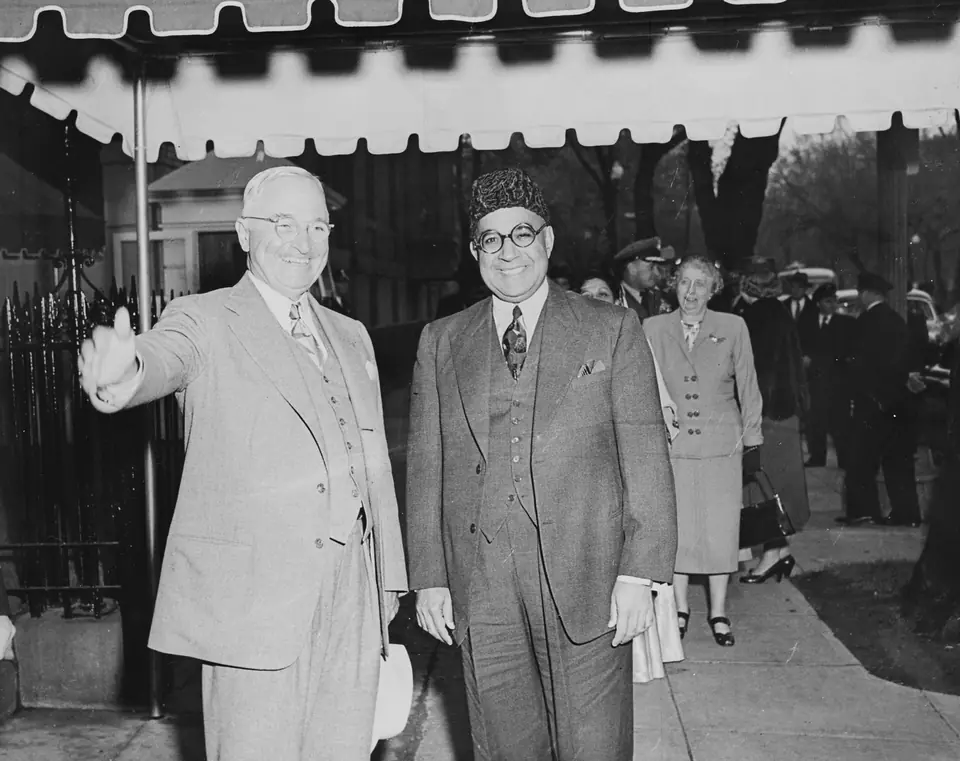
Liaquat and his wife, Begum Ra'ana Liaquat Ali Khan, arrived in Washington on 3 May 1950. Truman sent his own aircraft, the Independence, to bring them from London and greeted them personally at Washington National Airport, where he spoke of how much Americans had looked forward to the visit3,4. During the state visit Liaquat addressed the House of Representatives3.
The prime minister then embarked on a long tour that took him to New York, Chicago, the Midwest, the West Coast, the South and New England, and on to Canada. He received an honorary degree from Columbia University and spoke at universities including the Massachusetts Institute of Technology, while Begum Liaquat addressed audiences of her own, including at Wellesley College3,5. His speeches, which presented Pakistan as a new Muslim democracy committed to development and to friendship with the free world, were published by Harvard University Press later that year under the title Pakistan: The Heart of Asia6.
Why it mattered
The visit gave Pakistan a profile in the United States that it had lacked. In Pakistan it has often been remembered as the moment the country chose the West over the Soviet Union, though historians note that the abandoned Moscow trip was as much a matter of circumstance as of design2,7. It did not bring the economic or military aid Pakistan wanted; Washington was still reluctant to take on security commitments in South Asia7.
Legacy
Liaquat's tour set the template for many later Pakistani leaders' visits: public diplomacy aimed at American opinion as well as at the administration, and an emphasis on shared values alongside requests for support. Liaquat himself was assassinated in October 1951, but within four years of his visit Pakistan had become a formal American ally7.
Sources
- Special report: The legendary Liaquat 1895–1951, Dawn · Press
- Pakistan–Soviet Union relations, Wikipedia · Reference
- State visit by Liaquat Ali Khan to the United States, Wikipedia · Reference
- Remarks of Welcome to the Prime Minister of Pakistan at the Washington National Airport, Harry S. Truman Library and Museum (Public Papers of the Presidents), 3 May 1950 · Primary document
- Prime Minister Liaquat Ali Khan's speech (South Asia and MIT exhibit), MIT Libraries · Primary document
- Pakistan, the Heart of Asia: speeches in the United States and Canada, May and June 1950 (catalogue record), Texas A&M University Libraries (Harvard University Press, 1950), 1950 · Scholarly
- The United States and Pakistan, 1947–2000: Disenchanted Allies (Dennis Kux), Woodrow Wilson Center Press / Johns Hopkins University Press, 2001 · Scholarly
Next in The Long ArcFulbright exchanges begin with a 1950 agreement