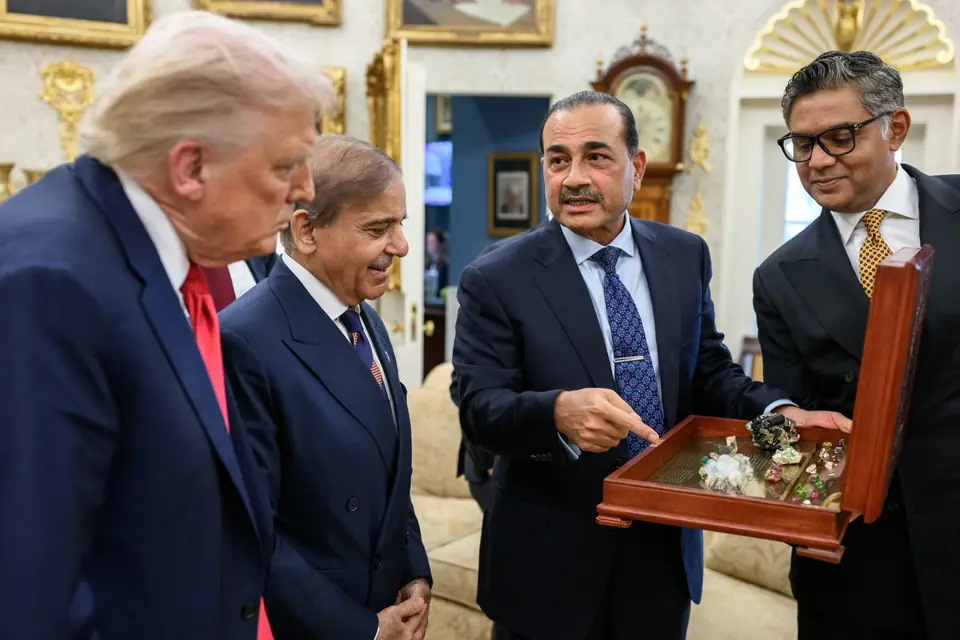
Islamabad Washington, DC

The Long Arc

US–Pakistan Relations, 1947 to Today

Seven decades of a relationship that has swung between alliance and estrangement, era by era: the agreements, crises, visits and turning points that shaped how the United States and Pakistan see each other. Every entry is checked against its sources before it appears.

Stories
103
Eras
8
Years
79
Begin in 1947 Read it as a book
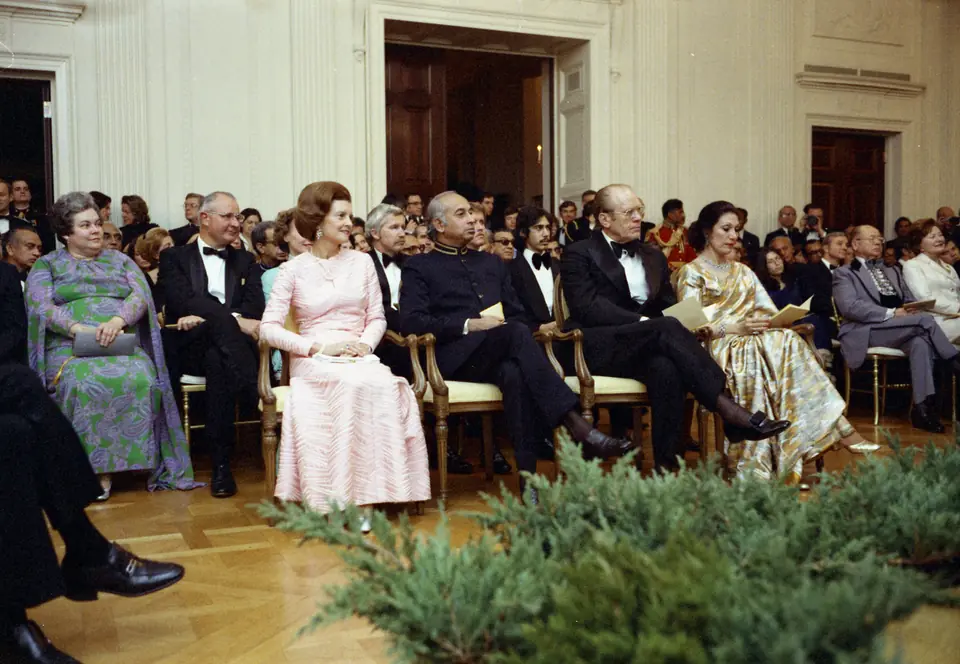
President Gerald R. Ford, Betty Ford, Prime Minister Zulfikar Ali Bhutto and Nusrat Bhutto seated with other guests in the East Room of the White House, 5 February 1975

Vol. IThe Long Arc1947–1953 Edition

Founding years

194719537 stories

Pakistan’s first years of statehood. The United States established relations as soon as Pakistan became independent, and the new government in Karachi looked to Washington for economic support and for help in building its armed forces.

The long read4 min

A new state looks west

Pakistan came into being on 14–15 August 1947 with almost none of the machinery a state needs: a makeshift capital in Karachi, a civil service and army still being divided with India, and a treasury that could barely meet its running costs. The United States was quick to acknowledge it. On 15 August President Harry Truman sent a congratulatory message to the Governor-General, Mohammad Ali Jinnah, and the State Department opened an embassy in Karachi the same day; Paul Alling was named the first ambassador in September1.
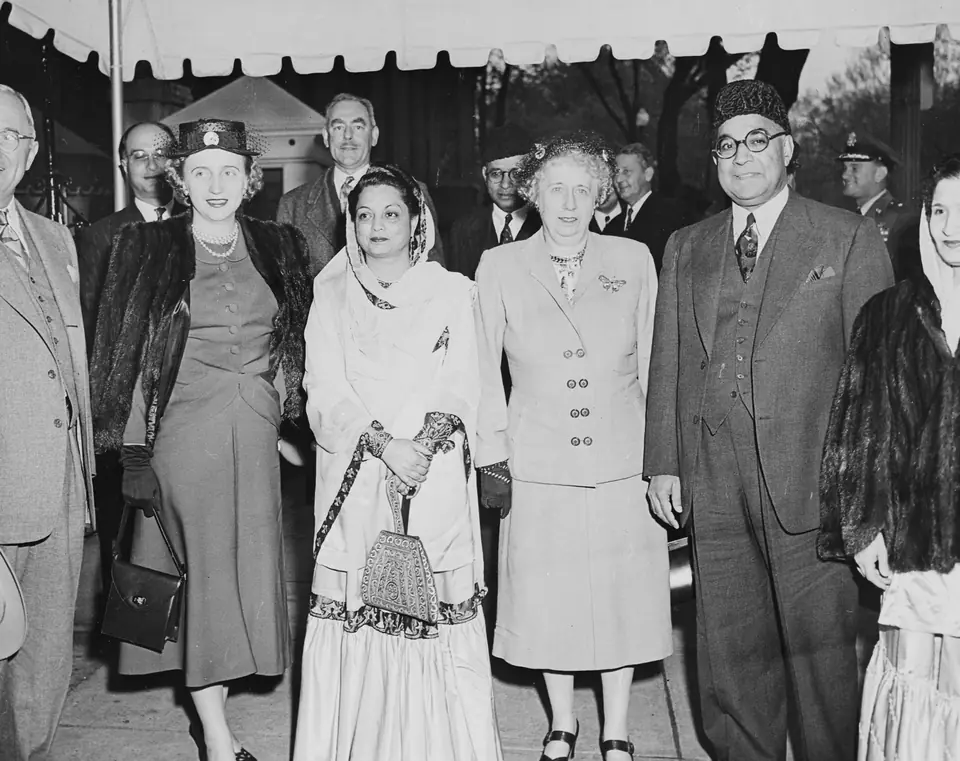
President Truman and Prime Minister Liaquat Ali Khan of Pakistan with others in Washington, 3 May 1950

What Pakistan wanted from Washington, however, went far beyond recognition. Within weeks the new government sent an emissary, Mir Laik Ali, with memoranda setting out a programme of economic reconstruction and development and asking for American credit on a large scale. The answer recorded in the State Department's own papers was that the US government had no authority to extend credits of that magnitude without the approval of Congress2. The figure usually cited for Pakistan's request is about $2 billion; the former ambassador and historian Husain Haqqani has noted that the Americans offered around $10 million3. The gap between Pakistani hopes and American priorities set a pattern that the diplomat-historian Dennis Kux would later describe as a relationship oscillating between close partnership and deep frustration4.

Kashmir and the United Nations

The first great test of the new state's diplomacy was Kashmir. Fighting over the princely state of Jammu and Kashmir began in late 1947, and India took the dispute to the UN Security Council. The Council created a UN Commission for India and Pakistan (UNCIP) in January 1948 and enlarged it in April; the United States became one of its five members in May 19485. A ceasefire took effect at the start of 1949, and in March of that year the UN Secretary-General nominated an American, Fleet Admiral Chester Nimitz, as plebiscite administrator. The plebiscite never took place, because India and Pakistan could not agree on the conditions for demilitarisation6. For Pakistan, the episode established a lasting expectation that the United States, as a power with influence at the UN and in New Delhi, might help bring about a settlement; for Washington it was an early lesson in how hard it would be to stay on good terms with both countries at once.

Courting Washington

Through these years Washington's attention in South Asia was fixed chiefly on India, the larger and more populous country. Pakistan's leaders worked to change that. In 1949 Prime Minister Liaquat Ali Khan received an invitation to Moscow, but the visit never took place, and in December 1949 he accepted an invitation from President Truman instead7. His visit in May 1950 was a public success: Truman met him at Washington National Airport, and over several weeks Liaquat toured the United States and Canada, delivering speeches later published as Pakistan: The Heart of Asia8,9. The visit is widely read in Pakistan as an early signal of the country's western orientation, although it brought no immediate aid commitment.

Smaller agreements laid the groundwork for a broader relationship. A technical cooperation agreement under Truman's Point Four programme was signed in Karachi in February 195110, and an agreement of September 1950 created the binational commission now called the United States Educational Foundation in Pakistan, which has run the Fulbright programme ever since11.

Turmoil at home, a turn in Washington

Liaquat Ali Khan was assassinated in Rawalpindi in October 1951, leaving Pakistan's politics unsettled12. His successors continued to look west. In April 1953 Mohammad Ali Bogra, until then Pakistan's ambassador in Washington, became prime minister13, at a moment when American thinking was shifting. The Eisenhower administration, seeking ways to contain Soviet influence in the Middle East and Asia, began to see Pakistan as a possible partner on the "northern tier" of states bordering the Soviet sphere. Secretary of State John Foster Dulles visited Karachi in May 195314, and Vice-President Richard Nixon followed in December, when military aid dominated his conversations with Pakistani leaders15.

A humanitarian crisis also brought the countries closer. After two years of drought in the wheat-growing areas of West Pakistan, President Eisenhower asked Congress in June 1953 to authorise up to one million long tons of American wheat; the Pakistan Wheat Aid Act was signed on 25 June and the first shipment sailed from Baltimore the next day16.

Why these years mattered

By the end of 1953 the elements of the next decade were in place: a Pakistani leadership looking for a powerful patron to strengthen it against India and to fund its development, and an American administration looking for allies on the edge of the Soviet sphere. The two sides wanted different things from the same relationship. That divergence, visible from the first request for aid in 1947, would shape the alliance that followed and the disappointments that came after it4.

Sources for this era (16)
  1. A Guide to the United States' History of Recognition, Diplomatic, and Consular Relations, by Country, since 1776: Pakistan, Office of the Historian, US Department of State · Official
  2. Foreign Relations of the United States, 1947, Volume III, Document 117 (Pakistan's request for financial assistance), Office of the Historian, US Department of State, 1947 · Primary document
  3. 'We don't want you as allies': Ex-diplomat Husain Haqqani on how US snubbed Pakistan in early years, Business Today, 11 May 2025 · Press
  4. The United States and Pakistan, 1947–2000: Disenchanted Allies (Dennis Kux), Woodrow Wilson Center Press / Johns Hopkins University Press, 2001 · Scholarly
  5. Foreign Relations of the United States, 1948, Volume V, Part 1, Editorial Note (composition of UNCIP), Office of the Historian, US Department of State, 1948 · Primary document
  6. Foreign Relations of the United States, 1951, Volume VI, Part 2, Editorial Note (Kashmir), Office of the Historian, US Department of State, 1951 · Primary document
  7. Special report: The legendary Liaquat 1895–1951, Dawn · Press
  8. Remarks of Welcome to the Prime Minister of Pakistan at the Washington National Airport, 3 May 1950, Harry S. Truman Library and Museum (Public Papers of the Presidents), 3 May 1950 · Primary document
  9. Pakistan, the Heart of Asia: speeches in the United States and Canada, May and June 1950 (catalogue record), Texas A&M University Libraries (book published by Harvard University Press, 1950), 1950 · Scholarly
  10. Foreign Relations of the United States, 1952–1954, Volume XI, Part 2, Editorial Note (Point Four agreements), Office of the Historian, US Department of State · Primary document
  11. Celebrating 75 Years of U.S.-Pakistan Educational and Cultural Exchange, United States Educational Foundation in Pakistan (USEFP) · Official
  12. Assassination of Liaquat Ali Khan, Wikipedia · Reference
  13. Mohammad Ali Bogra, Wikipedia · Reference
  14. John Foster Dulles – Travels of the Secretary of State, Office of the Historian, US Department of State · Official
  15. Foreign Relations of the United States, 1952–1954, Volume XI, Part 2: United States relations with Pakistan; wheat aid; visit of Vice President Nixon to Pakistan; military aid, Office of the Historian, US Department of State · Primary document
  16. Special Message to the Congress Requesting Authority To Make Wheat Available for Famine Victims in Pakistan, The American Presidency Project, UC Santa Barbara, 10 June 1953 · Primary document
The record1947–1953

DiplomacyKey moment

AfghanistanIranIndiaChinaArabian SeaPakistanIIOJKN0100 milesKarachi

Sindh, on the Arabian Sea

24° 52′ N · 67° 01′ E

Map: Karachi, Sindh, on the Arabian Sea

Washington recognises Pakistan on its first day

The United States recognised the new state on independence and opened an embassy in Karachi, beginning a relationship Pakistan hoped would bring large-scale help.

The United States recognised Pakistan on 15 August 1947, with a message from President Truman to Governor-General Jinnah, and opened an embassy in Karachi that day. Pakistan soon asked for substantial American credit, but Washington's early help was modest.

Multilateral

Kashmir goes to the UN, with America on the commission

Security Council Resolution

Resolution 47

The UN commission for India and Pakistan enlarged to five members

Resolution 47, 1948

After fighting over Kashmir, the UN Security Council created a commission for India and Pakistan; the United States became one of its five members in May 1948. In 1949 Admiral Chester Nimitz was nominated plebiscite administrator, but the vote was never held.

Diplomacy

Liaquat Ali Khan's American tour

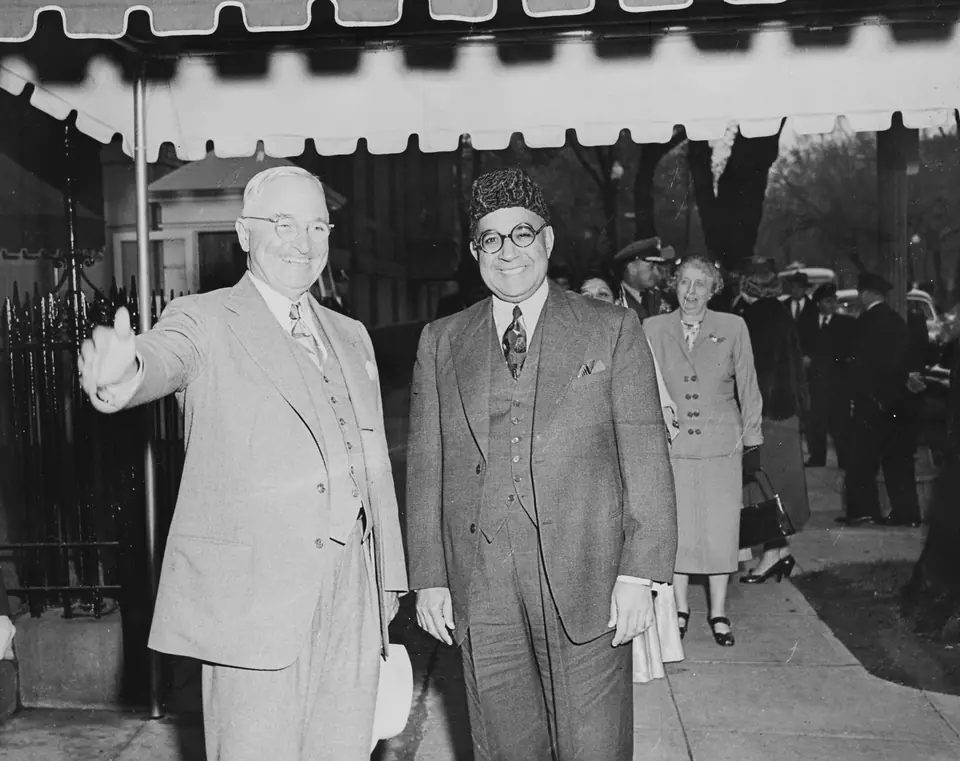
President Truman and Prime Minister Liaquat Ali Khan of Pakistan in Washington, 3 May 1950

Prime Minister Liaquat Ali Khan arrived in Washington on 3 May 1950 at President Truman's invitation, was welcomed by Truman at the airport, spoke to Congress and toured the United States and Canada for several weeks. The visit is widely seen as an early marker of Pakistan's western orientation.

People & culture

Fulbright exchanges begin with a 1950 agreement

A binational agreement signed in Karachi created the commission that has run the Fulbright programme in Pakistan for more than seven decades.

Economy & aid

A million tons of wheat against famine

Act of Congress

Pakistan Wheat Aid Act

Up to one million long tons of wheat

Signed by President Eisenhower

Pakistan Wheat Aid Act, 1953

Facing famine after two successive droughts in West Pakistan, Pakistan asked for help. President Eisenhower asked Congress on 10 June 1953 for authority to send up to one million long tons of wheat; he signed the Pakistan Wheat Aid Act on 25 June and the first shipment sailed the next day.

Security & defence

Dulles and Nixon come calling

AfghanistanIranIndiaChinaArabian SeaPakistanIIOJKN0100 milesKarachi

Sindh, on the Arabian Sea

24° 52′ N · 67° 01′ E

Map: Karachi, Sindh, on the Arabian Sea

Secretary of State Dulles visited Karachi in May 1953 and Vice-President Nixon followed on 6–9 December. Their trips came as Washington began to see Pakistan as part of a 'northern tier' against Soviet expansion, and military aid dominated the talks.

Vol. IIThe Long Arc1954–1964 Edition

The alliance era

1954196415 stories

Pakistan signed a defence agreement with the United States and joined the US-backed regional pacts, SEATO and the Baghdad Pact (later CENTO). It became one of Washington’s closest partners in Asia and received substantial military and economic assistance.

The long read4 min

From suitor to ally

In the space of a year, between the spring of 1953 and the spring of 1954, Pakistan went from being a hopeful suitor to a formal American ally. The change came from Washington's side. The Eisenhower administration, determined to contain the Soviet Union and China, was searching for partners along the southern rim of the communist world, and Pakistan - with a large army, a strategic position between the Middle East and South Asia, and leaders eager for support - fitted the role. On 25 February 1954 Eisenhower announced that the United States would provide military aid to Pakistan, writing at the same time to the Indian prime minister, Jawaharlal Nehru, to assure him that the step was not directed against India1. Nehru was not persuaded; he warned that the decision brought the Cold War to the subcontinent2.

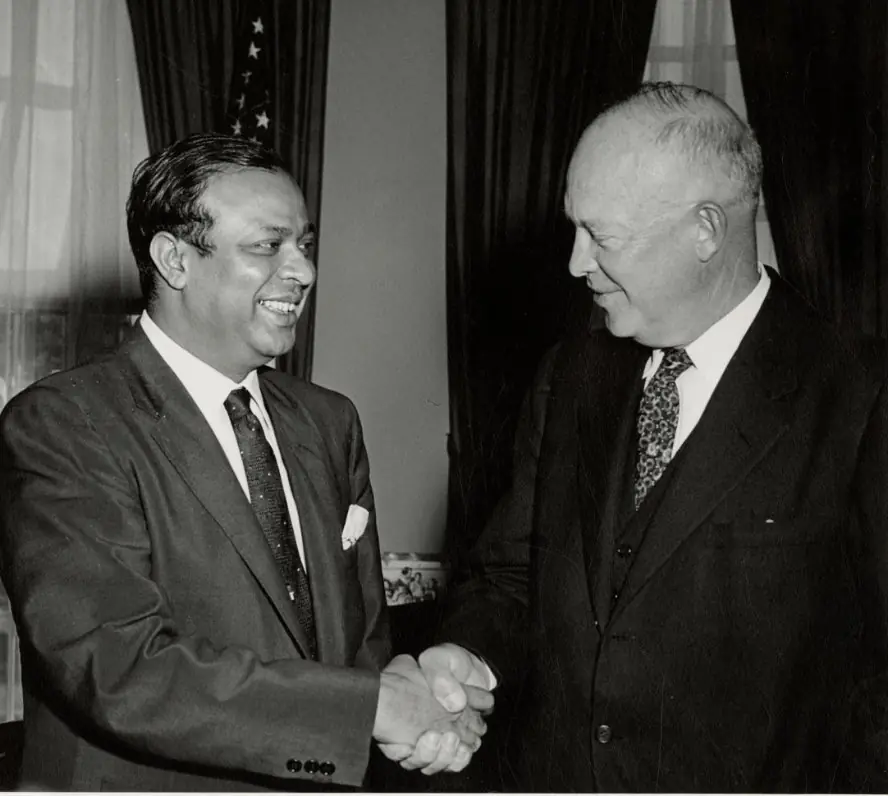
Pakistani Prime Minister Bogra shakes hands with President Eisenhower in the Oval Office, 16 October 1954

The formal architecture followed quickly. A Mutual Defense Assistance Agreement was signed in Karachi on 19 May 19543. In September Pakistan joined the Southeast Asia Treaty Organization at Manila, and in September 1955 it acceded to the Baghdad Pact, the alliance of "northern tier" states that became the Central Treaty Organization (CENTO) after Iraq's withdrawal in 19594,5. In March 1959 the United States signed a bilateral Agreement of Cooperation with Pakistan, promising appropriate action, including the use of armed force if mutually agreed, in the event of aggression against it6.

Different reasons for the same alliance

From the start, the two partners joined for different reasons. Washington's commitment was framed against communism: when it signed the Manila treaty, the United States formally stated that its undertaking to act against armed attack applied only to communist aggression7. Pakistan's leaders, and many Pakistani scholars since, have been clear that their principal concern was India and the unresolved dispute over Kashmir; American arms and money were the means to balance a much larger neighbour8. Each side knew this about the other, and for a decade both found it convenient not to dwell on it.

The fruits of alliance

The alliance brought Pakistan substantial resources. Economic assistance flowed through commodity programmes and development aid, beginning with packages negotiated by Prime Minister Mohammad Ali Bogra in Washington in October 19549. Military aid re-equipped the army and air force with American tanks and jet fighters; estimates of military aid in the decade from 1954 are commonly put at around $700 million, alongside some $2.5 billion in economic assistance, though figures vary with what is counted10.

In return, Pakistan offered more than diplomatic support. In July 1959 it signed a ten-year agreement for an American communications facility near Peshawar, at Badaber11, and US reconnaissance aircraft flew from Pakistani soil. That arrangement was exposed to the world on 1 May 1960, when Francis Gary Powers' U-2, which had taken off from Peshawar, was shot down over the Soviet Union12. Nikita Khrushchev's warning that he had drawn a red circle round Peshawar on his map made the risks of the alliance vivid in Pakistan13.

Generals and presidents

Pakistan's politics changed sharply during the decade. In October 1958 President Iskander Mirza abrogated the constitution and declared martial law, and within three weeks General Mohammad Ayub Khan had taken power himself. American officials largely welcomed the change, expecting a more stable and reliably pro-Western government14. Ayub became the face of the alliance: he hosted President Eisenhower in Karachi in December 195915, and in July 1961 President Kennedy honoured him with the only state dinner ever held at George Washington's home, Mount Vernon16. Public diplomacy flourished alongside high politics, from Vice-President Johnson's invitation to a Karachi camel driver in 1961 to Jacqueline Kennedy's celebrated tour of Lahore and the Khyber Pass in 196217.

The turn of 1962

Yet the Kennedy administration also wanted a closer relationship with India, and Ayub watched that courtship with mounting unease16. The rupture came in October 1962, when China attacked India along their Himalayan border. Washington rushed arms to New Delhi. Kennedy assured Ayub that the weapons were for India's immediate needs against China18, but Ayub complained that Pakistan's vital interests had been jeopardised and that he had not been consulted in advance as promised19. American and British pressure produced six rounds of India–Pakistan talks on Kashmir between December 1962 and May 1963, which ended without agreement20. Meanwhile Pakistan signed a boundary agreement with China in March 1963, a step the State Department regarded as damaging to the Kashmir negotiations21.

By January 1964 Ayub was setting out his grievances publicly, in an article for Foreign Affairs on the strains in the Pakistan–American alliance22. The alliance still stood, but its central bargain - American support in return for Pakistani alignment - was being questioned by both sides. The war of 1965 would put it to the test.

Sources for this era (22)
  1. Statement by the President on Military Aid to Pakistan, The American Presidency Project, UC Santa Barbara, 25 February 1954 · Primary document
  2. India and Military Aid (statement, 1 March 1954), Nehru Archive, 1 March 1954 · Primary document
  3. Foreign Relations of the United States, 1952–1954, Volume XI, Part 2, Editorial Note (Mutual Defense Assistance Agreement), Office of the Historian, US Department of State · Primary document
  4. Milestones: Southeast Asia Treaty Organization (SEATO), 1954, Office of the Historian, US Department of State · Official
  5. 1959: The Baghdad Pact becomes CENTO (NATO Update), NATO · Official
  6. Foreign Relations of the United States, 1958–1960, Volume XV, Editorial Note 346 (bilateral agreement of cooperation), Office of the Historian, US Department of State · Primary document
  7. Southeast Asia Collective Defense Treaty (Manila Pact), 8 September 1954, Avalon Project, Yale Law School, 8 September 1954 · Primary document
  8. Security Game: SEATO and CENTO as instruments of economic and military assistance to encircle Pakistan (Jabeen and Mazhar), Pakistan Economic and Social Review, University of the Punjab · Scholarly
  9. Foreign Relations of the United States, 1952–1954, Volume XI, Part 2, Document 1163, Office of the Historian, US Department of State, October 1954 · Primary document
  10. United States aid to Pakistan, Wikipedia · Reference
  11. Foreign Relations of the United States, 1958–1960, Volume XV, Editorial Note 291 (Peshawar communications facility), Office of the Historian, US Department of State · Primary document
  12. Milestones: U-2 Overflights and the Capture of Francis Gary Powers, 1960, Office of the Historian, US Department of State · Official
  13. From the U-2 to the P-3: the US–Pakistan relationship (Lawrence Lifschultz), New Left Review, 1986 · Scholarly
  14. Foreign Relations of the United States, 1958–1960, Volume XV, Editorial Note 332, Office of the Historian, US Department of State · Primary document
  15. Travels of the President: Pakistan, Office of the Historian, US Department of State · Official
  16. When JFK hosted Pakistan's president at Mount Vernon (Bruce Riedel), Brookings Institution, 6 July 2021 · Scholarly
  17. Jacqueline Kennedy In Pakistan, Radio Free Europe/Radio Liberty · Press
  18. JFK's Overshadowed Crisis, The National Interest · Scholarly
  19. Foreign Relations of the United States, 1961–1963, Volume XIX, Document 228: Letter From President Ayub to President Kennedy, Office of the Historian, US Department of State, November 1962 · Primary document
  20. India and Pakistan's surprisingly successful negotiations, Foreign Policy · Press
  21. Sino-Pakistan Agreement, Wikipedia · Reference
  22. Foreign Relations of the United States, 1964–1968, Volume XXV, Document 6 (telegram, January 1964, discussing Ayub's Foreign Affairs article), Office of the Historian, US Department of State, January 1964 · Primary document

The record1954–1964

Security & defence

Eisenhower decides to arm Pakistan

White House Statement

Military Aid to Pakistan

Military Aid to Pakistan, 1954

On 25 February 1954 President Eisenhower announced that the United States would give military aid to Pakistan, after Pakistan and Turkey said they would study closer cooperation. A letter to Nehru promised the aid was not aimed at India; Nehru condemned the decision as bringing the Cold War to South Asia.

Security & defenceKey moment

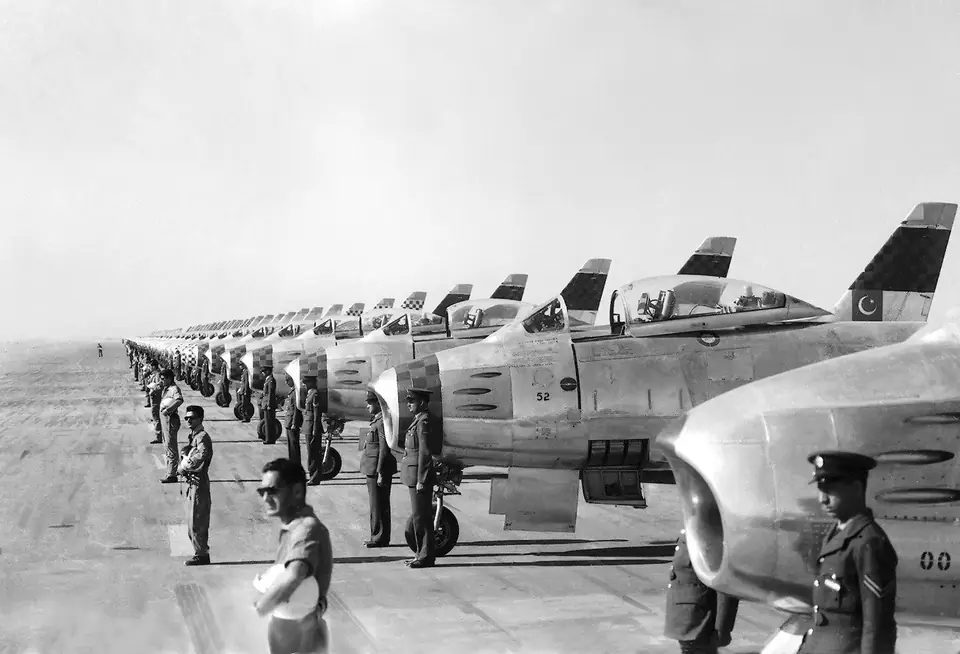
American-built F-86F Sabre jets of the Pakistan Air Force’s Falcons aerobatic team lined up with their crews at PAF Base Mauripur, February 1958

The alliance is signed in Karachi

A Mutual Defense Assistance Agreement opened the way for a decade of American weapons, training and money for Pakistan's armed forces.

On 19 May 1954 the United States and Pakistan signed a Mutual Defense Assistance Agreement in Karachi, under which Washington would provide military equipment and training. It began a formal security relationship that re-equipped Pakistan's army and air force over the following decade.

Multilateral

Pakistan signs the Manila Pact

Treaty

Southeast Asia Collective Defense Treaty

The Manila Pact

Signed at Manila by eight states

Southeast Asia Collective Defense Treaty, 1954

On 8 September 1954 Pakistan was one of eight signatories of the Southeast Asia Collective Defense Treaty in Manila, which created SEATO. The United States limited its commitment to communist aggression; Pakistan hoped the alliance would strengthen it against India.

Multilateral

Pakistan joins the Baghdad Pact

Treaty

The Baghdad Pact

Pakistan formally adheres

Turkey · Iraq · Britain · Pakistan

The Baghdad Pact, 1955

Pakistan formally joined the Baghdad Pact on 23 September 1955, after Turkey, Iraq and Britain; Iran followed in November. The United States backed the pact without becoming a full member. After Iraq withdrew in 1959 it was renamed the Central Treaty Organization (CENTO).

Diplomacy

Suhrawardy defends the alliance in Washington

An East Pakistani prime minister who had championed the western alliances at home came to Washington and addressed both houses of Congress.

Diplomacy

Martial law, and Ayub Khan takes power

Proclamation

Martial Law

The constitution abrogated

President Iskander Mirza

Martial Law, 1958

On 7 October 1958 President Iskander Mirza abrogated the constitution and declared martial law, naming General Ayub Khan chief martial law administrator. On 27 October Ayub took over the presidency. American officials expected the new government to be more stable and reliably pro-Western.

Security & defence

A bilateral pledge signed in Ankara

Agreement

Agreement of Cooperation

United States · Pakistan

Signed at Ankara · 10 UST 317

Agreement of Cooperation, 1959

On 5 March 1959 in Ankara, the United States signed identical bilateral Agreements of Cooperation with Pakistan, Iran and Turkey. It undertook, in case of aggression against Pakistan, to take appropriate action, including the use of armed force as mutually agreed. Pakistan and the United States later read the commitment differently.

Security & defence

A secret listening post at Badaber

AfghanistanIranIndiaChinaArabian SeaPakistanIIOJKN0100 milesBadaber

near Peshawar, Pakistan

33° 56′ N · 71° 34′ E

Map: Badaber, near Peshawar, Pakistan

On 18 July 1959 the United States and Pakistan signed a ten-year agreement for an American communications facility near Peshawar, at Badaber. It became a major US listening post. Pakistan declined to renew it, and the agreement lapsed in July 1969; the Americans left in early 1970.

Diplomacy

Eisenhower's two days in Karachi

The first sitting US president to visit Pakistan came at the high point of the alliance.

Security & defence

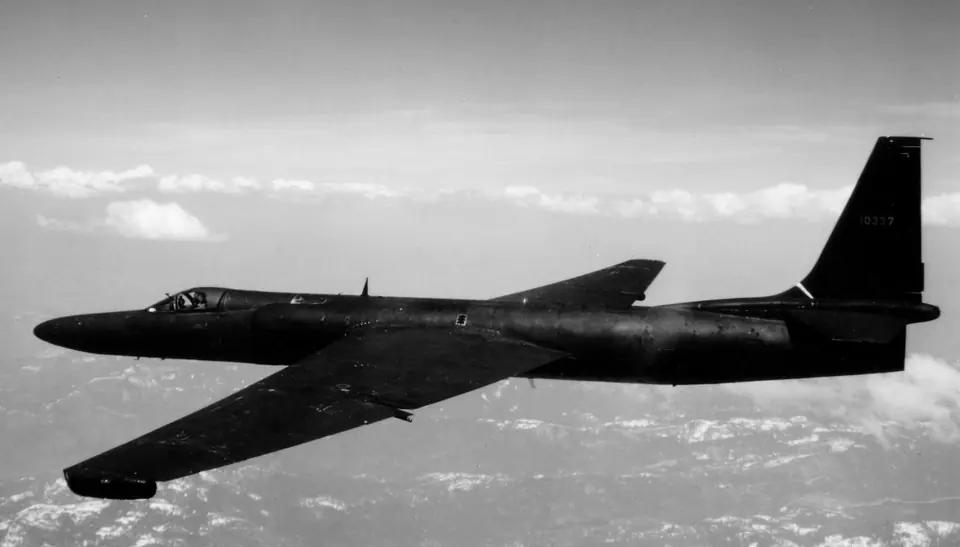
The U-2 that flew from Peshawar

A Lockheed U-2R in flight, about 1967-70: a later model of the U-2 spy plane, the type flown from Peshawar in 1960

On 1 May 1960 a CIA U-2 reconnaissance aircraft that had taken off from Peshawar was shot down over the Soviet Union and its pilot, Francis Gary Powers, captured. The affair wrecked the Paris summit and exposed Pakistan's role; Khrushchev warned Pakistan that Peshawar was now a target.

People & culture

Lyndon Johnson and the camel driver

A vice-president's offhand invitation to a Karachi camel-cart driver became one of the best-loved stories of the era.

Diplomacy

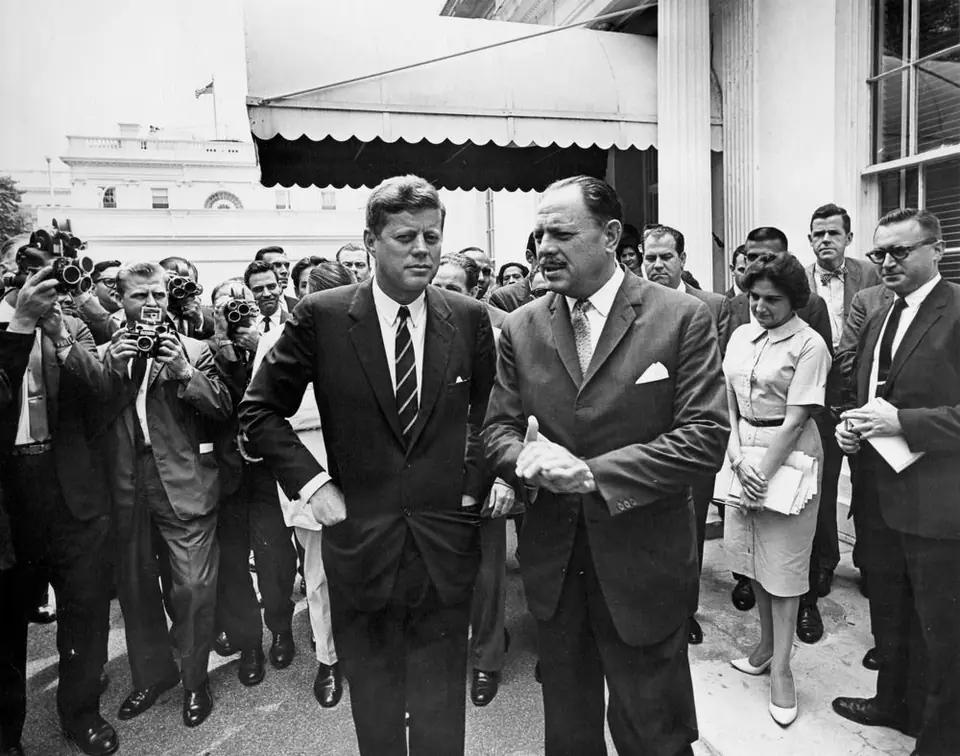
Dinner at Mount Vernon

President John F. Kennedy and President Mohammad Ayub Khan of Pakistan at the West Wing entrance of the White House, with photographers and reporters behind them, 13 July 1961

President Ayub Khan's state visit in July 1961 included an address to a joint session of Congress and a state dinner at Mount Vernon on 11 July, the only one ever held there. Behind the ceremony, Ayub was uneasy about Kennedy's courtship of India.

People & culture

Jacqueline Kennedy at the Khyber Pass

The First Lady's tour of Lahore, Rawalpindi and the Khyber became a set of images that defined warm public ties.

Regional conflictKey moment

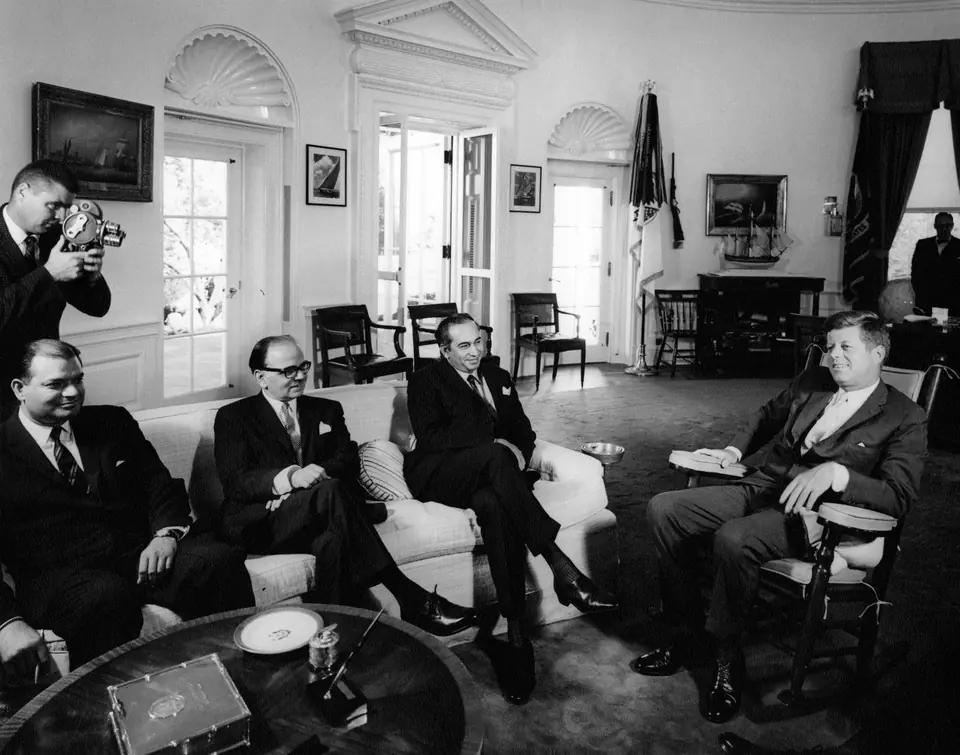
President John F. Kennedy, in his rocking chair, meets Pakistan’s Foreign Minister Zulfikar Ali Bhutto, Ambassador Ghulam Ahmed and an embassy official in the Oval Office, 4 October 1963

American arms for India shake the alliance

When China attacked India, Washington rushed weapons to New Delhi. To Pakistan, it looked like an ally arming its enemy.

After China's attack on India in October 1962, the United States sent emergency military aid to India. Kennedy assured Ayub it was for use against China, but Pakistan protested that its interests had been jeopardised and that it had not been consulted. US-backed Kashmir talks followed but failed, and Pakistan moved closer to China.

Vol. IIIThe Long Arc1965–1979 Edition

Strains and embargoes

1965197915 stories

Wars between India and Pakistan in 1965 and 1971 led Washington to cut off arms supplies to both, which many in Pakistan saw as a failure of an ally. Pakistan meanwhile helped open the channel between the United States and China, and concern in Washington over Pakistan’s nuclear programme began to grow.

The long read4 min

The alliance tested

The war of 1965 was the moment when the gap between what Pakistan and the United States expected of their alliance could no longer be papered over. Relations were already cooling. In April 1965 President Johnson postponed a planned visit by Ayub Khan, and in July the meeting of the aid consortium for Pakistan's development plan was postponed too; Ayub concluded that Washington had become indifferent to Pakistan's essential interests1. When fighting over Kashmir escalated into full-scale war in September, the United States suspended military assistance shipments to both India and Pakistan on 8 September2. The measure applied to both sides, but its effects were not equal: Pakistan's armed forces depended almost entirely on American equipment, India's did not3.

President Lyndon B. Johnson greets President Ayub Khan in Karachi, Pakistan, 23 December 1967

To many Pakistanis this was abandonment by an ally. American officials, for their part, had never intended their weapons to be used against India and saw the embargo as support for the UN Security Council's ceasefire efforts2. The war ended in a ceasefire on 23 September, and peace was negotiated not by Washington but by the Soviet Union, at Tashkent in January 19664. The United States later relaxed its embargo - for non-lethal items in 1966 and for spare parts on a cash basis in 1967 - but it never resumed grant military aid on the old scale5. In 1967 Ayub published his memoir under the title Friends Not Masters, a phrase that captured Pakistan's insistence on equality in its dealings with great powers6; and in 1968 his government gave notice that it would not renew the lease of the American communications facility at Badaber7.

The China channel

Paradoxically, the moment of greatest American need for Pakistan came as the formal alliance was withering. Richard Nixon, who had known Pakistan's leaders since 1953, visited Lahore in August 1969 and asked President Yahya Khan to tell the Chinese leadership that the United States wanted better relations8. By the end of 1970, after Yahya's visit to the White House that October, Pakistan had become the key channel for messages between Washington and Beijing9,10. In July 1971 Henry Kissinger flew secretly from Pakistan to Beijing on a Pakistan International Airlines aircraft, preparing Nixon's historic visit to China in February 197210,11.

1971

At the same time, Pakistan was tearing itself apart. After the Awami League's victory in the December 1970 elections was blocked, the army cracked down in East Pakistan from March 1971; millions of refugees fled to India, and India supported the Bengali guerrillas. Open war between India and Pakistan began on 3 December 1971 and ended with the surrender of Pakistani forces in Dacca on 16 December and the independence of Bangladesh12. American diplomats in Dacca had protested against their government's silence over the killings13, but the Nixon administration, valuing Pakistan's role in the China opening, leaned towards Islamabad and sent a naval task force led by the carrier Enterprise to the Bay of Bengal12,14. That "tilt" remains intensely debated: many in Pakistan feel the United States did too little, many in India and Bangladesh that it did far too much for the wrong side14.

Bhutto, the bomb and the break

Zulfikar Ali Bhutto, who took over a truncated Pakistan in December 1971, pursued a more independent foreign policy, leaving SEATO in 197215, while seeking American arms. India's nuclear test of May 1974 transformed the agenda: Pakistan accelerated its own programme, and Washington, which had led the creation of the Nuclear Suppliers Group in response to India's test, made non-proliferation a central concern16. The Ford administration lifted the arms embargo in February 197517, but in August 1976 Kissinger came to Lahore to try to persuade Bhutto to give up a French reprocessing plant18. Congress, meanwhile, wrote new non-proliferation conditions into law, the Symington and Glenn amendments of 1976 and 197719.

The Carter administration, which arrived in 1977 emphasising human rights and non-proliferation, found itself at odds with Pakistan on both counts. Bhutto accused Washington of conspiring with his opponents during the political crisis of spring 197720; the army under General Zia-ul-Haq removed him in July21, and in April 1979 he was hanged despite appeals for clemency, including from President Carter22. Days later the United States cut off economic and military aid under the Symington amendment because of Pakistan's secret uranium enrichment programme23. Pakistan left CENTO in March 1979 and joined the Non-Aligned Movement24. In November 1979 a mob, inflamed by false reports that the United States was behind the seizure of the Grand Mosque in Mecca, burned the US embassy in Islamabad25.

By the end of 1979 the relationship was at its lowest point since 1947. Within weeks, the Soviet intervention in Afghanistan would change everything again.

Sources for this era (25)
  1. Foreign Relations of the United States, 1964–1968, Volume XXV, Editorial Note 160 (postponement of Ayub's visit and of the aid consortium), Office of the Historian, US Department of State, 1965 · Primary document
  2. Foreign Relations of the United States, 1964–1968, Volume XXV, Editorial Note 172 (suspension of military assistance), Office of the Historian, US Department of State, September 1965 · Primary document
  3. Our on-off relationship, Defence Journal (Pakistan), 10 May 2018 · Press
  4. Milestones: The India–Pakistan War of 1965, Office of the Historian, US Department of State · Official
  5. Foreign Relations of the United States, 1969–1976, Volume E–7, Document 42: Analytical Summary Prepared for the National Security Council Review Group, Office of the Historian, US Department of State, 1969 · Primary document
  6. Friends Not Masters, Wikipedia · Reference
  7. Foreign Relations of the United States, 1964–1968, Volume XXV, Document 491, Office of the Historian, US Department of State, 1968 · Primary document
  8. Remarks on Arrival in Lahore, Pakistan, The American Presidency Project, UC Santa Barbara, 1 August 1969 · Primary document
  9. October 25, 1970 (Nixon Library almanac), Richard Nixon Presidential Library and Museum, 25 October 1970 · Official
  10. Milestones: Rapprochement with China, 1972, Office of the Historian, US Department of State · Official
  11. Kissinger's secret trip in 1971 that paved the way for U.S.-China relations, The China Project, 9 July 2020 · Press
  12. Milestones: The South Asia Crisis and the Founding of Bangladesh, 1971, Office of the Historian, US Department of State · Official
  13. Foreign Relations of the United States, 1969–1976, Volume E–7, Document 130: Telegram 1249 From the Consulate General in Dacca to the Department of State (the 'Blood telegram'), Office of the Historian, US Department of State, 6 April 1971 · Primary document
  14. 1971: A Global History of the Creation of Bangladesh (Srinath Raghavan), Harvard University Press (bookseller listing), 2013 · Scholarly
  15. Southeast Asia Treaty Organization (SEATO), Encyclopedia.com · Reference
  16. Nuclear Suppliers Group, Wikipedia · Reference
  17. Foreign Relations of the United States, 1969–1976, Volume E–8, Document 193: National Security Decision Memorandum 289, Office of the Historian, US Department of State, February 1975 · Primary document
  18. Kissinger, Bhutto and the reprocessing plant (Dawn feature), Dawn · Press
  19. Confrontation and Retreat: The U.S. Congress and the South Asian Nuclear Tests – Key Legislation, Arms Control Association (Arms Control Today), January 2000 · Scholarly
  20. Foreign Relations of the United States, 1977–1980, Volume XIX, Document 246: Telegram From the Department of State to the Embassy in Pakistan, Office of the Historian, US Department of State, April 1977 · Primary document
  21. 1977 Pakistani military coup, Wikipedia · Reference
  22. Execution of Zulfikar Ali Bhutto, Wikipedia · Reference
  23. Pakistan: A Country Study – The United States, Library of Congress Federal Research Division (via countrystudies.us), 1994 · Official
  24. Pakistan – Relations with the United States (background), GlobalSecurity.org · Reference
  25. The other embassy attack of November 1979: the siege of Embassy Islamabad, Association for Diplomatic Studies and Training (ADST), October 2015 · Reference

The record1965–1979

Regional conflictKey moment

War with India, and an American embargo

When India and Pakistan went to war over Kashmir, Washington stopped arms shipments to both. Pakistan, almost wholly American-equipped, felt it far more.

As the 1965 war over Kashmir escalated, the United States suspended military assistance shipments to both India and Pakistan on 8 September. Pakistan, whose forces relied almost entirely on American equipment, was hit much harder, and many Pakistanis saw the embargo as an ally's betrayal.

Diplomacy

Peace made in Tashkent, not Washington

Ayub Khan met President Johnson in Washington in December 1965, but it was the Soviet premier, Alexei Kosygin, who brokered the Tashkent Declaration between Ayub and India's Lal Bahadur Shastri on 10 January 1966. The United States supported the effort; it later eased its embargo only partially.

Diplomacy

Nixon in Lahore asks for a message to Beijing

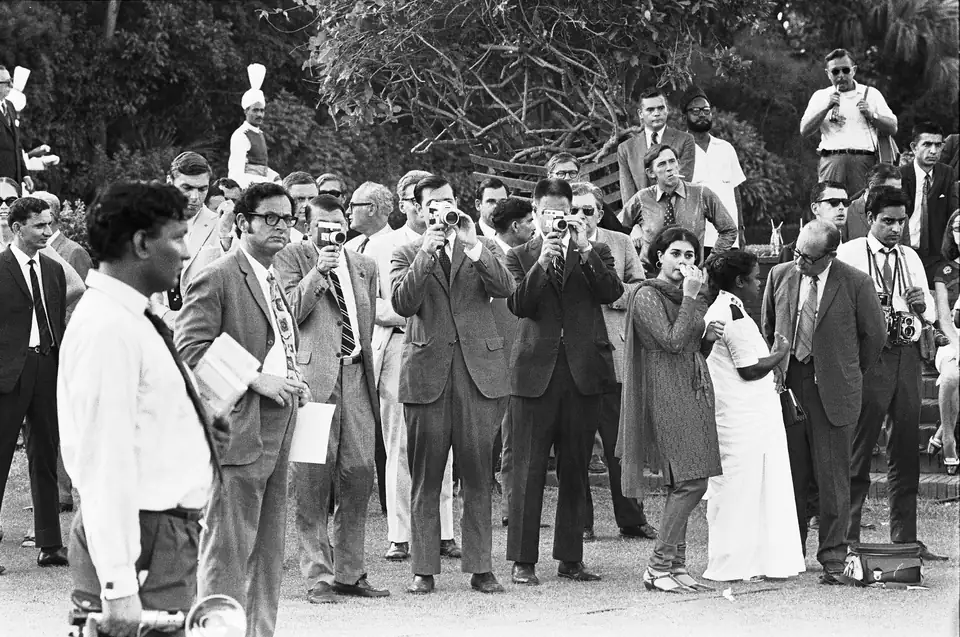
Observers and photographers at the arrival ceremony for President Nixon in Pakistan, among them H. R. Haldeman filming with his own cine camera, 1 August 1969

On 1–2 August 1969 President Nixon visited Lahore and held talks with President Yahya Khan. Nixon said the United States would not join any arrangement to isolate China and asked Yahya to convey that to the Chinese leadership at the highest level - the start of the 'Yahya channel'.

Diplomacy

Yahya at the White House: a message for Zhou Enlai

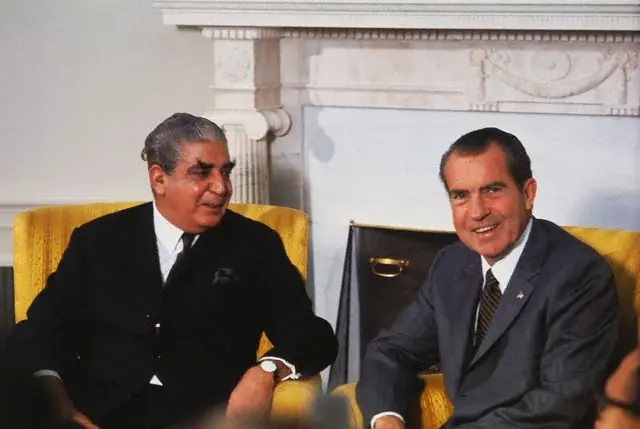
President Yahya Khan of Pakistan with President Richard Nixon during his visit to the United States, October 1970

On 25 October 1970 President Yahya Khan met Nixon at the White House, and Nixon used the meeting to send a message to China's leaders through him. Weeks earlier Nixon had offered Pakistan a one-time exception to the arms embargo. By the end of 1970 Pakistan was Washington's key channel to Beijing.

People & culture

The Bhola cyclone and American relief

One of the deadliest storms on record struck East Pakistan; US helicopters joined the relief effort as anger grew at the government's response.

DiplomacyKey moment

AfghanistanIranIndiaChinaArabian SeaPakistanIIOJKN0100 milesChaklala

the air base at Rawalpindi

33° 37′ N · 73° 06′ E

Map: Chaklala, the air base at Rawalpindi

Kissinger's secret flight from Pakistan to Beijing

Feigning illness in Islamabad, Nixon's national security adviser slipped away on a Pakistani airliner and opened the door to China.

On 9 July 1971 Henry Kissinger, ostensibly resting in the hills after falling ill in Islamabad, flew secretly from Chaklala on a Pakistan International Airlines aircraft to Beijing. Pakistan had carried messages between Washington and Beijing since 1969. The trip prepared Nixon's 1972 visit to China.

Regional conflictKey moment

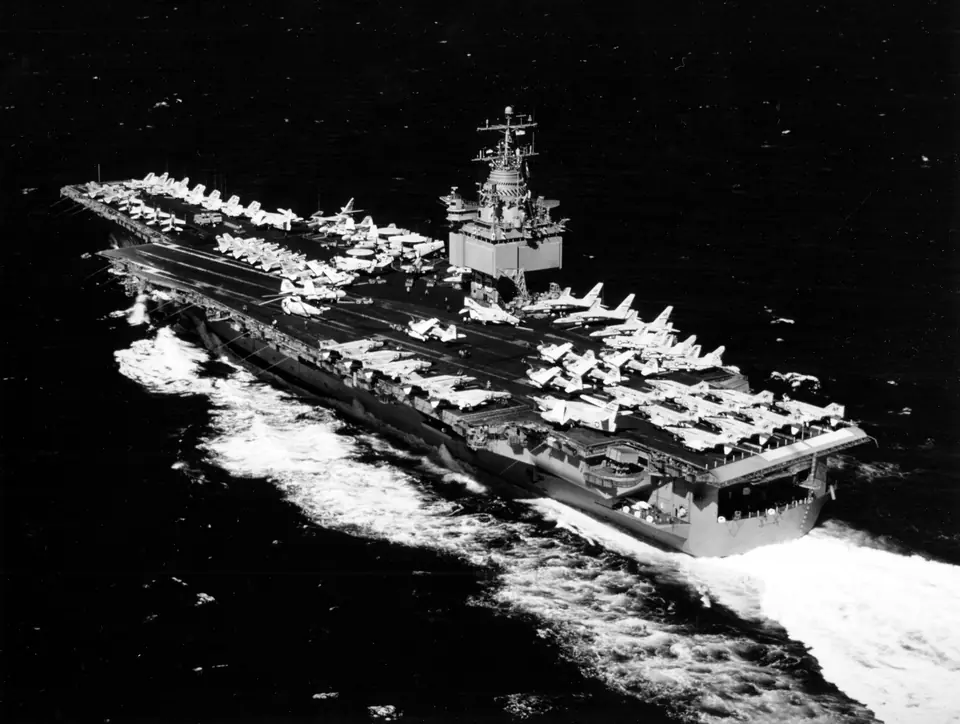
The US Navy aircraft carrier USS Enterprise at sea in 1971, the year it led the task force sent towards the Bay of Bengal

1971: civil war, war with India, and the birth of Bangladesh

The Nixon administration's 'tilt' towards Pakistan in the crisis that split the country remains one of the most debated episodes in US policy in South Asia.

After the army's crackdown in East Pakistan from March 1971, millions of refugees fled to India and war between India and Pakistan began on 3 December. It ended with Pakistan's surrender in Dacca on 16 December and the independence of Bangladesh. The Nixon administration leaned towards Pakistan and sent a carrier task force to the Bay of Bengal.

Nuclear

India's nuclear test changes the agenda

AfghanistanIranIndiaChinaArabian SeaPakistanIIOJKN0100 milesPokhran

Rajasthan, India

27° 06′ N · 71° 55′ E

Map: Pokhran, Rajasthan, India

On 18 May 1974 India detonated a nuclear device at Pokhran, calling it a peaceful nuclear explosion. Pakistan, shaken, vowed not to submit to nuclear blackmail and accelerated its own programme. The United States responded by leading efforts to tighten nuclear export controls, including the creation of the Nuclear Suppliers Group.

Security & defence

Ford lifts the ten-year arms embargo

Announcement

Arms Embargo Lifted

Lethal equipment for Pakistan and India, for cash only

Arms Embargo Lifted, 1975

After Prime Minister Bhutto's visit in February 1975, President Ford's administration announced on 24 February that it was lifting the embargo on sales of lethal military equipment to Pakistan and India, on a cash-only basis. India protested; Pakistan welcomed the end of a ten-year grievance.

Nuclear

Kissinger in Lahore: aircraft for a reprocessing plant

AfghanistanIranIndiaChinaArabian SeaPakistanIIOJKN0100 milesLahore

Punjab, Pakistan

31° 33′ N · 74° 20′ E

Map: Lahore, Punjab, Pakistan

On 10 August 1976 Secretary of State Kissinger met Prime Minister Bhutto in Lahore to try to dissuade him from buying a nuclear reprocessing plant from France, reportedly offering 110 A-7 attack aircraft in return. Bhutto declined. France later withdrew from the deal under US pressure.

Diplomacy

Bhutto blames America; Zia takes power

During protests after the March 1977 elections, Bhutto told parliament on 28 April that the United States was funding his opponents, a charge Washington rejected. On 5 July 1977 the army chief, General Zia-ul-Haq, overthrew him. Relations with the Carter administration were cool, strained by human rights and nuclear concerns.

People & culture

Bhutto is hanged despite appeals for clemency

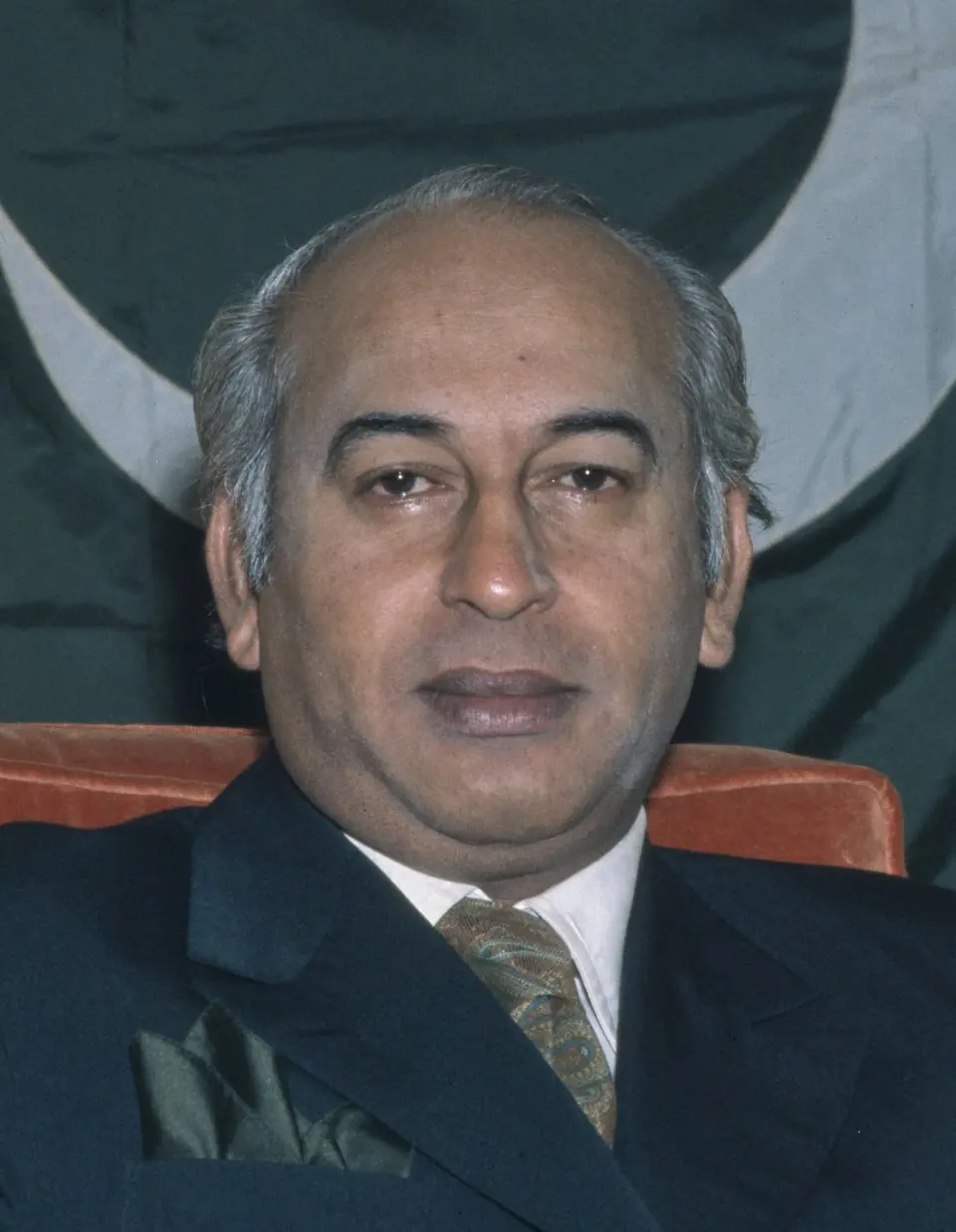
Zulfikar Ali Bhutto, former Prime Minister of Pakistan, in a portrait from the 1970s with a Pakistani flag behind him

Zulfikar Ali Bhutto was hanged in Rawalpindi jail on 4 April 1979 after General Zia rejected appeals for clemency from around the world, including from President Carter, who appealed on humanitarian grounds. The execution deepened the isolation of Zia's government in the West.

Nuclear

Aid cut off over uranium enrichment

Sanction

The Symington Amendment

Economic and military aid suspended, except food aid

Foreign Assistance Act, section 669

The Symington Amendment, 1979

On 6 April 1979 the Carter administration cut off US economic and military aid to Pakistan, except food aid, under the Symington amendment, after concluding that Pakistan was secretly building a uranium enrichment plant. It was the first time the law was applied to Pakistan.

Diplomacy

A mob burns the US embassy in Islamabad

AfghanistanIranIndiaChinaArabian SeaPakistanIIOJKN0100 milesIslamabad

Pakistan’s capital

33° 41′ N · 73° 03′ E

Map: Islamabad, Pakistan’s capital

On 21 November 1979, after false reports that the United States was behind the seizure of the Grand Mosque in Mecca, a mob stormed and set fire to the US embassy in Islamabad. Two Americans and two Pakistani staff were killed; about 100 people survived in a vault. Help from Pakistani forces was slow to arrive.

Vol. IVThe Long Arc1979–1989 Edition

The Afghan decade

1979198914 stories

The Soviet intervention in Afghanistan made Pakistan a front-line partner once again. Large US aid packages followed, while Congress tied continued assistance to Pakistan’s nuclear programme.

The long read4 min

A front line, again

In the last days of December 1979 Soviet troops poured into Afghanistan and took control of Kabul and much of the country. The Office of the Historian at the US State Department describes the invasion as a watershed of the Cold War: the only time the Soviet Union invaded a country outside the Eastern Bloc1. For Pakistan, which shared a long and porous border with Afghanistan, the invasion turned a regional upheaval into a direct strategic threat. For the United States, still absorbing the Iranian revolution and the hostage crisis in Tehran, it made Pakistan indispensable almost overnight.

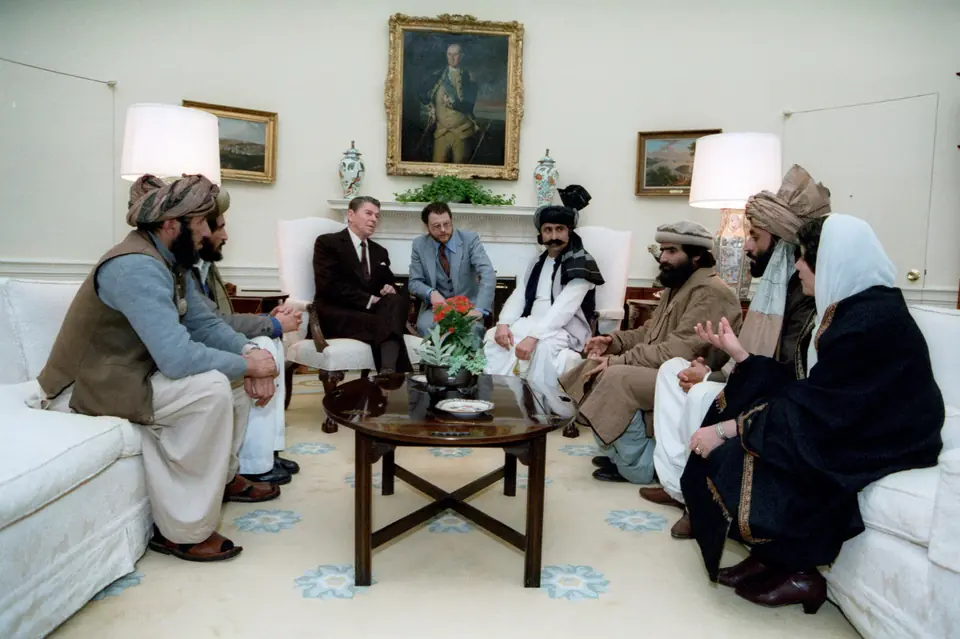
President Ronald Reagan meets Afghan resistance representatives in the Oval Office to discuss Soviet atrocities in Afghanistan, 2 February 1983

The relationship that met this crisis was in poor repair. In April 1979 the Carter administration had cut off most aid over Pakistan’s secret uranium-enrichment programme, and in November a mob had stormed and burned the US embassy in Islamabad. Within weeks of the invasion, however, Washington was offering help, and Zbigniew Brzezinski, Carter’s national security adviser, flew to Islamabad in February 1980 to say publicly that the 1959 bilateral agreement covered aggression by the Soviet Union2. The Carter administration settled on a three-pronged response: diplomatic pressure on Moscow, economic sanctions, and covert aid to the Afghan resistance with Pakistan’s help1.

From “peanuts” to partnership

The first offer fell flat. Carter proposed about $400 million in economic aid and military credits; President Zia-ul-Haq judged it far too small for the risk Pakistan would run in provoking its superpower neighbour, and Pakistan turned it down in March 19802,3. Zia bet that the next administration would pay more, and he was right. In 1981 the Reagan administration agreed a six-year package of economic aid and military sales worth $3.2 billion, including F-16 fighters, and Congress waived the nuclear-related Symington restrictions to allow it4. Zia’s state visit to Washington in December 1982 sealed the new intimacy, although in private President Reagan set out limits on Pakistan’s nuclear programme that he expected Zia to respect5.

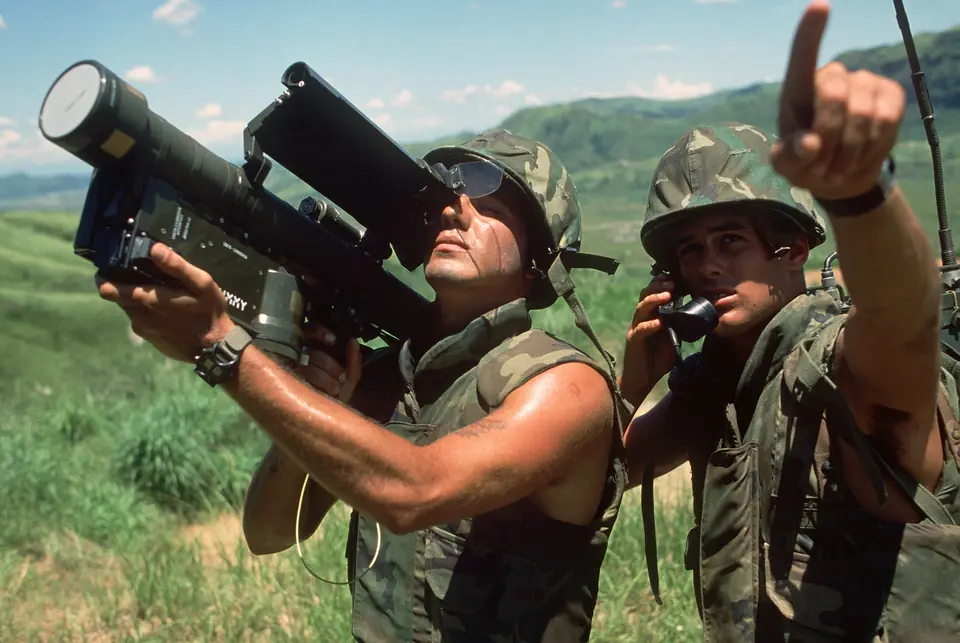
A second, larger package of just over $4 billion followed in 1986, announced as Prime Minister Mohammad Khan Junejo visited Washington after the lifting of martial law6. By then the United States, Pakistan and Saudi Arabia were partners in one of the largest covert operations of the Cold War. Reagan’s National Security Decision Directive 166 of March 1985 set the removal of Soviet forces from Afghanistan as the goal of US policy7, and in 1986 the administration took the controversial step of supplying American-made Stinger anti-aircraft missiles8.

Who ran the war

The covert programme depended on Pakistan. The Central Intelligence Agency supplied money and weapons, but Pakistan’s Inter-Services Intelligence (ISI) decided which of the Afghan mujahideen parties based in Peshawar received them, trained the fighters and moved the arms across the border9,10. Bruce Riedel, a former CIA officer, has argued that the war was in this sense run by Zia rather than by Washington9. Pakistani accounts, notably that of Brigadier Mohammad Yousaf, who headed the ISI’s Afghan bureau from 1983 to 1987, describe the same arrangement from the other side10. Pakistan also carried a heavy human burden: by the late 1980s it hosted roughly three million registered Afghan refugees11.

The nuclear shadow

Throughout the decade, the partnership coexisted with a quarrel that never went away. US intelligence continued to report Pakistani progress towards a nuclear weapon. Congress responded with the Pressler Amendment of 1985, which made aid conditional on an annual presidential certification that Pakistan did not possess a nuclear explosive device12. The 1987 arrest in the United States of a Pakistani-born businessman, Arshad Pervez, for trying to export specialised steel for the programme brought the issue to a head; the Reagan administration chose to keep aid flowing, judging the Afghan war the higher priority13. Critics in Washington and in India saw this as wilful blindness; Pakistani officials argued that their country faced a nuclear-armed India and was being singled out.

Endgame

The war ended faster than many expected. Pakistan and Afghanistan signed the Geneva Accords in April 1988, with the United States and the Soviet Union as guarantors, and Soviet troops completed their withdrawal on 15 February 198914,15. The last year of the decade was also one of shocks inside Pakistan: an ammunition depot used for the Afghan pipeline exploded at Ojhri camp near Rawalpindi in April 1988, and in August President Zia died in an air crash near Bahawalpur together with the US ambassador, Arnold Raphel16,17. Elections in November 1988 brought Benazir Bhutto to power; in June 1989 she addressed a joint meeting of the US Congress18.

For Pakistan, the Afghan decade brought large-scale aid, modern weapons and a reputation in Washington as a steadfast ally. It also left a legacy that both countries would wrestle with for decades: armed Afghan factions, a powerful intelligence service with its own networks, millions of refugees, and a nuclear programme that the United States had decided, for the time being, to live with. Dennis Kux’s history of the relationship captures the pattern: intimate partnership when strategic interests aligned, followed by disenchantment when they diverged19. With the Soviet army gone, that divergence was about to begin.

Sources for this era (19)
  1. Milestones: The Soviet Invasion of Afghanistan and the U.S. Response, 1978–1980, Office of the Historian, US Department of State · Official
  2. Afghanistan crisis yields critical policy, The Christian Science Monitor, 4 February 1980 · Press
  3. Pakistan rejects 'peanuts' in American military aid, The Christian Science Monitor, 6 March 1980 · Press
  4. Chronology of Key Events (US v. Pakistan sanctions case), Peterson Institute for International Economics · Scholarly
  5. nsarchive.gwu.edu document page on Reagan–Zia meeting, 7 December 1982, National Security Archive, George Washington University · Primary document
  6. Pakistan: relations with the United States (country study text), GlobalSecurity.org (reproducing Library of Congress country study) · Reference
  7. National Security Decision Directive 166: U.S. Policy, Programs and Strategy in Afghanistan, Ronald Reagan Presidential Library, 27 March 1985 · Primary document
  8. NEW MISSILES GOING TO REBELS AS WARNING TO SOVIETS (press clipping), CIA FOIA Reading Room, 1986 · Press
  9. What We Won: America's Secret War in Afghanistan, 1979–89 (Bruce Riedel), Brookings Institution Press, 2014 · Scholarly
  10. Mohammad Yousaf (author page: The Bear Trap), Pen & Sword Books · Scholarly
  11. Afghan refugees in Pakistan, bpb – Federal Agency for Civic Education (Germany) · Reference
  12. The making of Pressler Amendment: an excerpt, Penguin Random House India · Scholarly
  13. The Pervez Case: Pakistani Nuclear Procurement and Reagan Administration Nonproliferation Policy, National Security Archive · Primary document
  14. UNGOMAP background, United Nations Peacekeeping · Official
  15. Afghanistan and the Soviet Withdrawal 1989: 20 Years Later, National Security Archive, 15 February 2009 · Primary document
  16. Pakistan sorts out debris of blast. Questions linger on sabotage, siting of munitions dump, The Christian Science Monitor, 14 April 1988 · Press
  17. The Death of Ambassador Arne Raphel, Association for Diplomatic Studies and Training, July 2015 · Primary document
  18. Benazir Bhutto: Address to the US Congress (text), American Rhetoric, 7 June 1989 · Primary document
  19. The United States and Pakistan, 1947–2000: Disenchanted Allies (Dennis Kux), Woodrow Wilson Center Press / Johns Hopkins University Press, 2001 · Scholarly

The record1979–1989

Regional conflictKey moment

AfghanistanIranIndiaChinaArabian SeaPakistanIIOJKN0100 milesKabul

Afghanistan

34° 32′ N · 69° 11′ E

Map: Kabul, Afghanistan

Soviet forces enter Afghanistan, and Pakistan becomes a front-line state

The Soviet invasion of Afghanistan at the end of 1979 transformed Pakistan from a sanctioned problem country into Washington’s indispensable partner in the region.

At the end of December 1979 Soviet troops took control of Kabul. The invasion overturned US policy towards Pakistan, which had been under aid sanctions months earlier: Pakistan became the base for the Afghan resistance, the conduit for covert US support and host to millions of Afghan refugees.

Economy & aid

Carter offers $400 million; Zia turns it down

In January 1980 the Carter administration offered Pakistan about $400 million in economic aid and military credits. Pakistan’s leaders called it inadequate, and in March 1980 Pakistan formally declined, betting on a better offer. The episode became shorthand for Zia’s hard bargaining with Washington.

Economy & aidKey moment

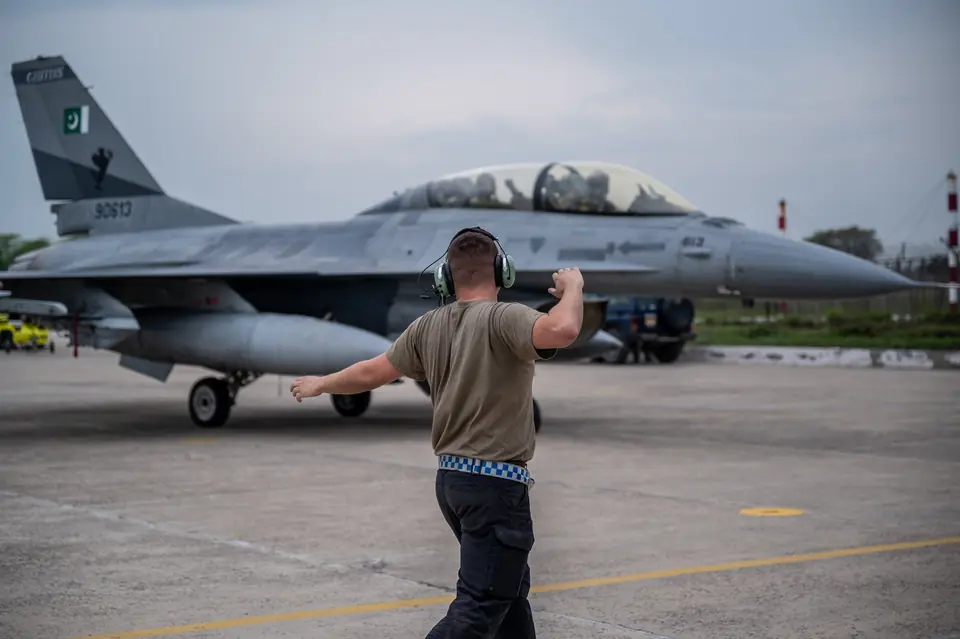
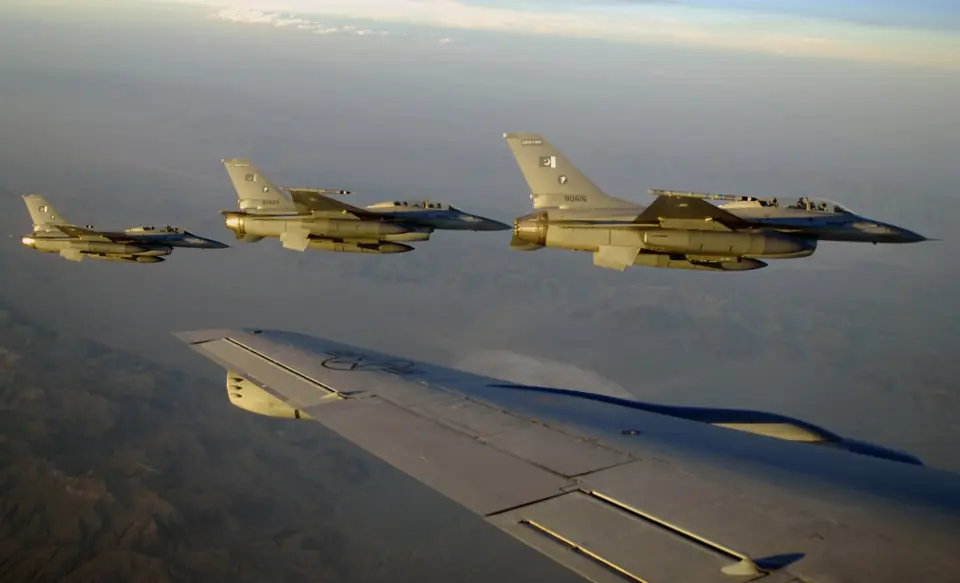
A US Air Force crew chief marshals a Pakistan Air Force F-16 during joint training in Pakistan, 2 March 2022: the fighter first sold to Pakistan in the 1981 package

Reagan’s $3.2 billion package and the F-16 deal

A six-year programme of economic aid and military sales, including 40 F-16 fighters, restored the alliance and set aside the nuclear sanctions of 1979.

In 1981 the Reagan administration agreed a six-year, $3.2 billion package of economic assistance and military sales credits with Pakistan, including the sale of 40 F-16 fighters. Congress approved it with a six-year waiver of the Symington Amendment’s nuclear-related ban.

Diplomacy

Zia-ul-Haq’s state visit to the White House

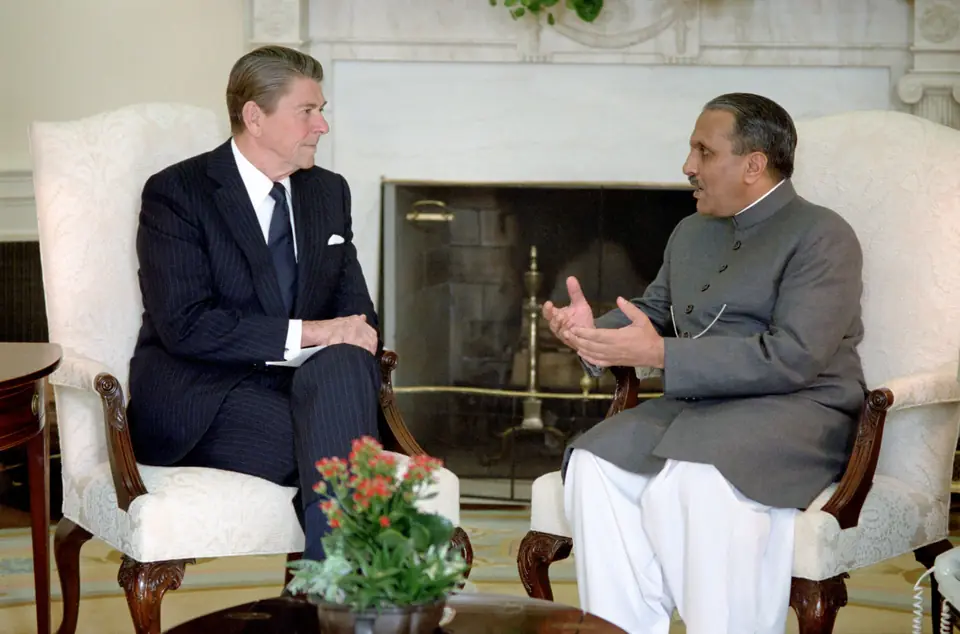
President Ronald Reagan meets President Mohammad Zia ul-Haq of Pakistan in the Oval Office, 7 December 1982

President Zia-ul-Haq was welcomed at the White House on 7 December 1982, the high point of the renewed alliance. Reagan praised Pakistan’s care for Afghan refugees; in the Oval Office he set out the nuclear lines Washington expected Pakistan not to cross.

Security & defence

Washington widens the covert war in Afghanistan

National Security Decision Directive

NSDD-166

The removal of Soviet forces from Afghanistan

NSDD-166, 1985

National Security Decision Directive 166, signed in March 1985, set the removal of Soviet forces from Afghanistan as the aim of US policy. The expanded covert programme, run by the CIA in partnership with Pakistan’s ISI and supported by Saudi funds, made Pakistan the hub of the war.

NuclearKey moment

Act of Congress

The Pressler Amendment

Aid only with a yearly presidential certificate

Foreign Assistance Act, section 620E(e)

The Pressler Amendment, 1985

The Pressler Amendment ties aid to a nuclear certificate

A 1985 law made every year’s aid to Pakistan conditional on a presidential certificate that it did not possess a nuclear explosive device - a compromise that became a trap five years later.

Signed into law on 8 August 1985, the Pressler Amendment barred US aid and arms sales to Pakistan unless the president certified each year that Pakistan did not possess a nuclear explosive device. It applied to Pakistan alone and shaped relations until 2001.

Security & defence

Stinger missiles reach the Afghan resistance

US Marines with an FIM-92 Stinger missile launcher and a field radio during an exercise in 1984: the shoulder-fired missile supplied to the Afghan resistance from 1986

In March 1986 the Reagan administration decided to give the Afghan mujahideen American-made Stinger anti-aircraft missiles, delivered and taught through Pakistan’s ISI. They were first used in September 1986. Their military impact is still debated; their symbolism is not.

Economy & aid

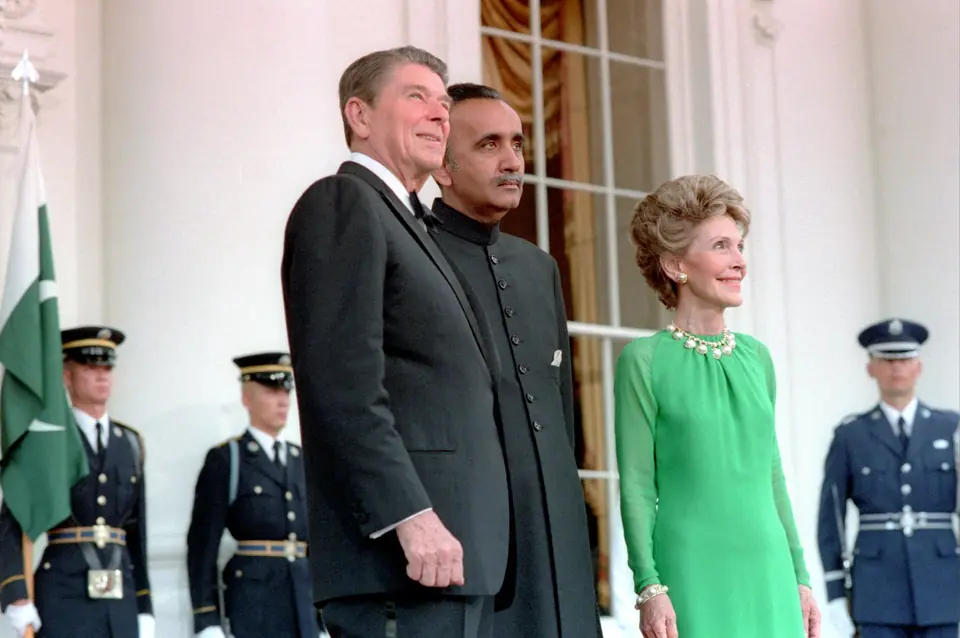
Junejo in Washington and a second, $4 billion package

President Ronald Reagan, Nancy Reagan and Prime Minister Mohammad Khan Junejo of Pakistan on the North Portico of the White House before a state dinner, 16 July 1986

During Prime Minister Mohammad Khan Junejo’s July 1986 visit to Washington, the Reagan administration confirmed a follow-on six-year assistance package of $4.02 billion, to begin when the 1981 programme ended. Congressional debate over it became entangled with mounting evidence about Pakistan’s nuclear programme.

Nuclear

The Pervez case puts Pakistan’s nuclear procurement on trial

In July 1987 US authorities arrested Arshad Pervez for trying to export specialised steel and beryllium for Pakistan’s nuclear programme. The case triggered the Solarz Amendment, but the Reagan administration kept aid flowing, invoking and then waiving the sanction in January 1988.

Security & defence

Ojhri camp explodes between Rawalpindi and Islamabad

AfghanistanIranIndiaChinaArabian SeaPakistanIIOJKN0100 milesOjhri camp

between Rawalpindi and Islamabad

33° 38′ N · 73° 04′ E

Map: Ojhri camp, between Rawalpindi and Islamabad

On 10 April 1988 the Ojhri camp ammunition depot near Rawalpindi, used to store arms for the Afghan mujahideen, blew up. Over a hundred people were killed and many more injured. Junejo’s inquiry into the disaster is widely seen as one factor in Zia’s dismissal of his government weeks later.

Multilateral

The Geneva Accords set the Soviet exit

On 14 April 1988 Pakistan and Afghanistan signed the Geneva Accords, with the United States and the Soviet Union as guarantors. They set a timetable for Soviet withdrawal beginning on 15 May 1988. Washington declared it would keep supplying the mujahideen as long as Moscow supplied Kabul.

Diplomacy

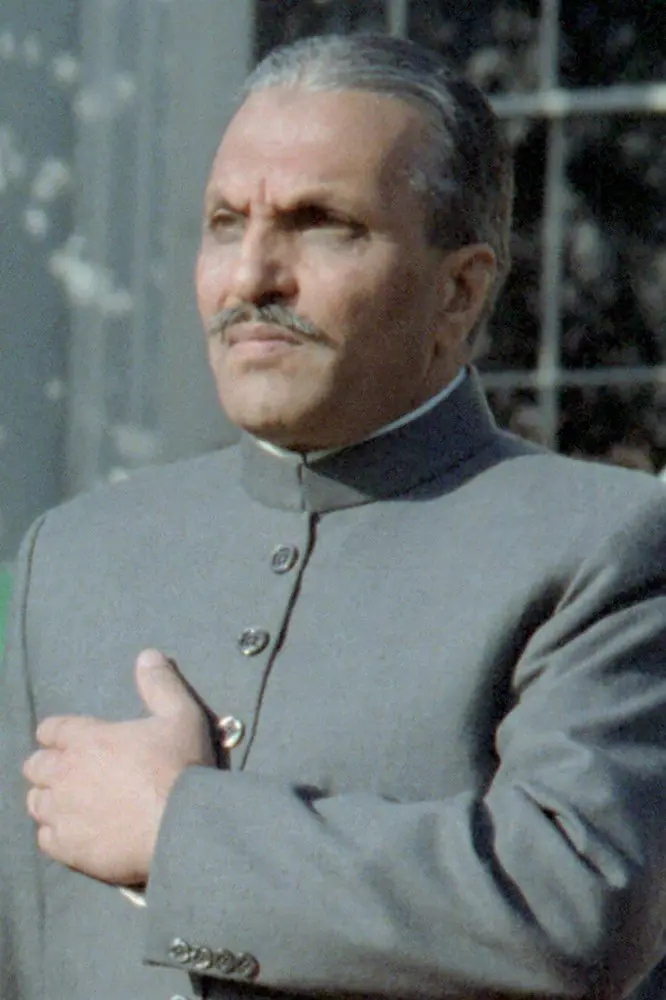
Zia and the US ambassador die in an air crash

President Mohammad Zia-ul-Haq of Pakistan at the arrival ceremony for his state visit, South Lawn of the White House, 7 December 1982

On 17 August 1988 a Pakistan Air Force C-130 crashed shortly after take-off from Bahawalpur, killing President Zia-ul-Haq, US Ambassador Arnold Raphel, Brigadier General Herbert Wassom and senior Pakistani officers. The cause has never been established beyond dispute.

Regional conflict

The last Soviet soldier leaves Afghanistan

AfghanistanIranIndiaChinaArabian SeaPakistanIIOJKN0100 milesFriendship Bridge

on the Amu Darya, Afghanistan’s northern border

37° 14′ N · 67° 25′ E

Map: Friendship Bridge, on the Amu Darya, Afghanistan’s northern border

On 15 February 1989 the commander of the Soviet 40th Army crossed the bridge over the Amu Darya, completing the withdrawal agreed at Geneva. The war in Afghanistan continued, but with the Soviet army gone the nuclear question returned to the centre of US–Pakistan relations.

Diplomacy

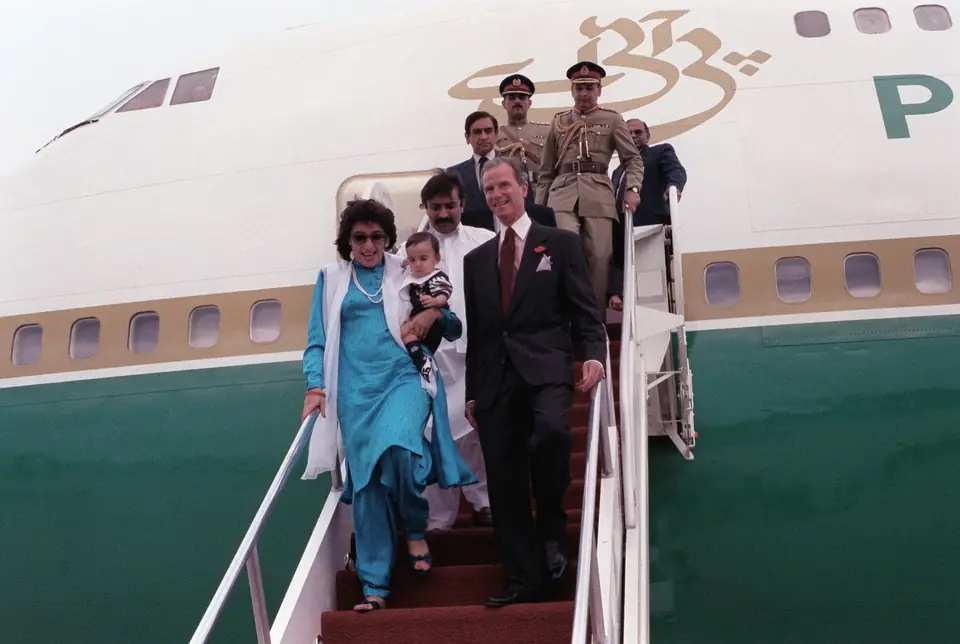
Benazir Bhutto addresses Congress

Prime Minister Benazir Bhutto of Pakistan, carrying her son Bilawal Bhutto Zardari, leaves her aircraft on arrival for a state visit at Andrews Air Force Base, 5 June 1989

On 7 June 1989 Prime Minister Benazir Bhutto addressed a joint meeting of the US Congress during an official visit, pressing for continued support for the Afghan resistance and for Pakistan’s new democracy, and assuring her audience that Pakistan neither possessed nor intended to make a nuclear device.

Vol. VThe Long Arc1990–2000 Edition

The sanctions years

1990200014 stories

With the Soviet withdrawal from Afghanistan complete, US nuclear-related sanctions took effect in 1990, and further sanctions followed the 1998 nuclear tests and the 1999 change of government. High-level contact continued but cooperation narrowed sharply.

The long read4 min

The partnership unwinds

The 1990s began with a cut-off. On 1 October 1990, with the Soviet army gone from Afghanistan, President George H. W. Bush did not make the annual certification required by the Pressler Amendment that Pakistan did not possess a nuclear explosive device, and most US military assistance and new economic aid to Pakistan stopped1,2. An aid programme worth more than half a billion dollars a year ended, and so did the sale of military equipment worth about $1.4 billion, including 28 F-16 fighters that Pakistan had largely paid for3. For the next eleven years the relationship was conducted under one layer of sanctions after another.

For Pakistanis the timing was the message. Washington had certified Pakistan every year while it needed Pakistani help against the Soviet Union, and stopped as soon as the war was over. A generation of Pakistani officers and officials came to see the United States as a fair-weather friend that had kept both the aircraft and the money4. American officials replied that the law left them no choice, that Pakistan had been warned repeatedly, and that its nuclear programme had crossed lines it had promised not to cross2,5.

Crises without a framework

The end of the alliance did not end American involvement. In May 1990, months before the cut-off, the Bush administration sent Deputy National Security Adviser Robert Gates to Islamabad and New Delhi to defuse a confrontation over the uprising in Indian-administered Kashmir6. In 1992–93 the State Department weighed adding Pakistan to its list of state sponsors of terrorism because of support for militants in Kashmir and Punjab, before deciding in July 1993 against designation7. In August 1993 Washington imposed missile-technology sanctions on Chinese and Pakistani entities over M-11 missile transfers.

Counter-terrorism cooperation continued in parallel. In February 1995 Pakistani and US agents arrested Ramzi Yousef, a planner of the 1993 World Trade Center bombing, in Islamabad, and in 1997 Mir Aimal Kansi, who had shot CIA employees outside the agency’s headquarters, was captured in Pakistan and flown to the United States.

A partial thaw

Benazir Bhutto’s second government sought to loosen the sanctions. During her April 1995 visit, President Clinton said publicly that it was not right for the United States to keep both Pakistan’s money and its equipment3,8. Congress responded with the Brown Amendment, adopted by the Senate in September 1995 and signed into law in February 1996, which released about $368 million of military equipment ordered before 1990 and eased some economic restrictions, while keeping the F-16 ban in place9.

1998: the tests

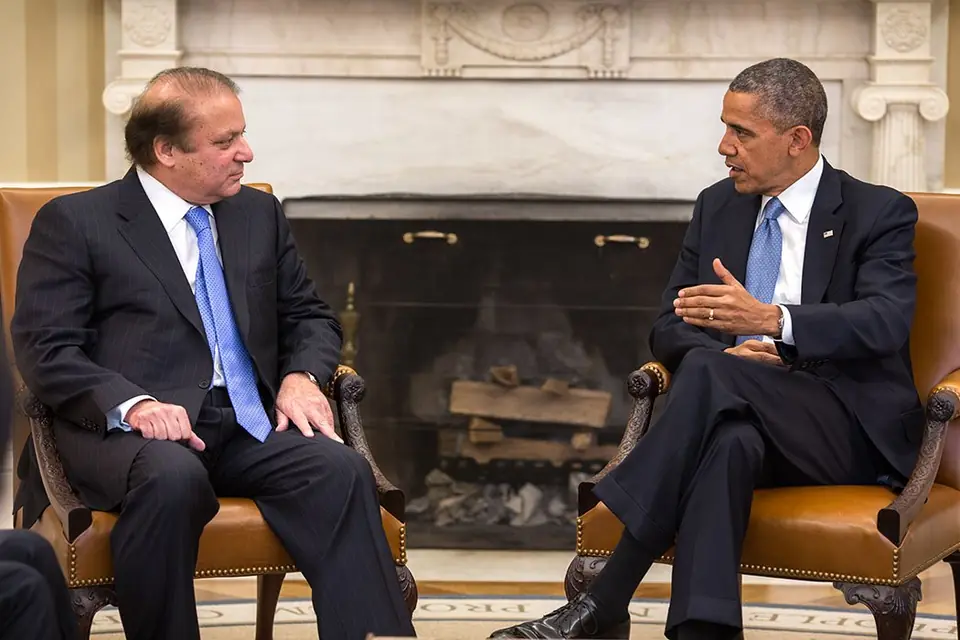
Any prospect of normalisation was overtaken by the nuclear tests of May 1998. India tested on 11 and 13 May; despite intensive US diplomacy and offers of incentives, Pakistan followed on 28 and 30 May10. The Glenn Amendment imposed automatic and sweeping sanctions on both countries, and the UN Security Council condemned the tests10,11. Yet the sanctions were quickly eroded: Congress exempted agricultural credits within weeks, and in the autumn it gave the president authority to waive many restrictions for a year11. In December 1998 Prime Minister Nawaz Sharif visited Washington, Clinton waived some of the new sanctions, and the long dispute over the undelivered F-16s was finally settled12.

Afghanistan returned as a source of friction. Pakistan had recognised the Taliban government in 199713. In August 1998, after the bombings of the US embassies in Kenya and Tanzania, US cruise missiles struck camps in eastern Afghanistan linked to Osama bin Laden; the missiles crossed Pakistani airspace, and Washington informed Pakistan’s army chief only as they were in flight14,15.

Kargil, the coup and a five-hour visit

In 1999 the two crises the United States most feared, a war between nuclear-armed neighbours and the collapse of civilian rule, came within months of each other. In May, Pakistani forces and militants were found occupying heights across the Line of Control near Kargil. On 4 July, at Blair House in Washington, Clinton and Sharif agreed that concrete steps would be taken to restore the Line of Control16. Bruce Riedel, the only other American in the room, later wrote that Clinton refused to reward the incursion with US mediation on Kashmir17. The withdrawal that followed was deeply unpopular in Pakistan, and on 12 October 1999 Sharif was overthrown by the army chief, General Pervez Musharraf. The Clinton administration invoked Section 508 of the foreign-aid appropriations law, adding a democracy sanction to the nuclear ones18.

In March 2000, at the end of a five-day visit to India, President Clinton stopped in Islamabad for a few hours, met General Musharraf and spoke directly to the Pakistani people on television - the first presidential visit since 196919. The contrast between the two legs of the trip captured the state of the relationship at the end of the century: India courted, Pakistan admonished. Dennis Kux, whose history of the relationship ends in 2000, called the two countries ‘disenchanted allies’5. Within eighteen months, the attacks of 11 September 2001 would change the relationship again.

Sources for this era (19)
  1. Pakistan–U.S. Relations (CRS Issue Brief IB94041, updated 4 June 2002), Congressional Research Service via EveryCRSReport.com, 4 June 2002 · Official
  2. Chronology of Key Events (US v. Pakistan sanctions case), Peterson Institute for International Economics · Scholarly
  3. Bhutto's US Lament Over F-16 Jets Gains Few Fans in Congress, The Christian Science Monitor, 14 April 1995 · Press
  4. Dawn commentary on the legacy of the Pressler sanctions, Dawn · Press
  5. The United States and Pakistan, 1947–2000: Disenchanted Allies (Dennis Kux), Woodrow Wilson Center Press / Johns Hopkins University Press, 2001 · Scholarly
  6. Nuclear Issue Strains US-Pakistan Ties, The Christian Science Monitor, 5 July 1990 · Press
  7. Congressional Record, House, 2 August 1993: Pakistan and the terrorism list, Congressional Record via irp.fas.org, 2 August 1993 · Primary document
  8. The President's News Conference With Prime Minister Benazir Bhutto of Pakistan, 11 April 1995 (Public Papers, 1995, Book I), US Government Publishing Office (govinfo), 11 April 1995 · Primary document
  9. Pakistan aid restrictions and the Brown Amendment (CRS report 90-149, as reproduced), Congressional Research Service via GlobalSecurity.org, 1996 · Official
  10. Resolution 1172 (1998), adopted by the Security Council at its 3890th meeting, on 6 June 1998, United Nations Digital Library, 6 June 1998 · Primary document
  11. Confrontation and Retreat: The U.S. Congress and the South Asian Nuclear Tests – Key Legislation, Arms Control Association (Arms Control Today), January 2000 · Scholarly
  12. U.S. to Repay Pakistan for Undelivered F-16s, Arms Control Association (Arms Control Today), 1998 · Press
  13. Pakistan, scene of Afghan resolve, The Christian Science Monitor, 15 November 1999 · Press
  14. Address to the Nation on Military Action Against Terrorist Sites in Afghanistan and Sudan, 20 August 1998, The White House (Clinton administration archive), 20 August 1998 · Primary document
  15. Dawn report on the Ralston–Karamat dinner during the 1998 strikes, Dawn · Press
  16. Joint Statement by President Clinton and Prime Minister Sharif of Pakistan, 4 July 1999, The White House (Clinton administration archive), 4 July 1999 · Primary document
  17. American Diplomacy and the 1999 Kargil Summit at Blair House (Bruce Riedel), in Asymmetric Warfare in South Asia, Cambridge University Press, 2009 · Scholarly
  18. US invokes Section 508 sanctions after Pakistan coup (USIA/State Department wire, 15 October 1999), GlobalSecurity.org (reproducing US government wire), 15 October 1999 · Official
  19. Pakistan – Travels of the President, Office of the Historian, US Department of State · Official

The record1990–2000

Security & defence

The Gates mission and the Kashmir crisis of 1990

AfghanistanIranIndiaChinaArabian SeaPakistanIIOJKN0100 milesIslamabadNew Delhi
Map: Islamabad and New Delhi

In May 1990, with India and Pakistan trading threats over the uprising in Indian-administered Kashmir, Deputy National Security Adviser Robert Gates carried a blunt US message to both capitals. How close the crisis came to nuclear danger is still debated.

NuclearKey moment

Sanctions

The Pressler Amendment

No certificate: military aid and new economic aid stop

The Pressler Amendment, 1990

No certificate: Pressler sanctions take effect

With the Soviet army gone, President Bush declined to certify that Pakistan did not possess a nuclear explosive device, and most US aid and military sales stopped overnight.

From 1 October 1990 President George H. W. Bush did not make the certification required by the Pressler Amendment, and most US military assistance and new economic aid to Pakistan stopped. Twenty-eight F-16s Pakistan had paid for were frozen, starting a dispute that lasted eight years.

Nuclear

Missile sanctions over China’s M-11 transfers

Washington imposed two-year sanctions on Chinese and Pakistani entities after determining that missile components covered by the Missile Technology Control Regime had been transferred.

Security & defence

Ramzi Yousef is arrested in Islamabad

A joint Pakistani–American operation captured the planner of the 1993 World Trade Center bombing, an early example of counter-terrorism cooperation in a sanctions-bound relationship.

Diplomacy

Benazir Bhutto’s second visit and Clinton’s admission on the F-16s

During an official working visit in April 1995, Prime Minister Benazir Bhutto met President Clinton on 11 April and pressed for relief from the Pressler sanctions and the return of the F-16s or Pakistan’s money. Clinton said he would ask Congress for changes, paving the way for the Brown Amendment.

Economy & aid

The Brown Amendment eases the Pressler sanctions

Senate Amendment

The Brown Amendment

Adopted 55–45

Senator Hank Brown

The Brown Amendment, 1995

On 21 September 1995 the Senate adopted, 55–45, an amendment by Senator Hank Brown allowing a one-time release of about $368 million of military equipment ordered by Pakistan before October 1990 and easing some aid restrictions. The F-16s stayed barred. It became law in February 1996.

Security & defence

Mir Aimal Kansi is captured in Pakistan

Four years after he shot CIA employees outside the agency’s headquarters, a Pakistani fugitive was seized in Pakistan by the FBI with Pakistani help and flown to the United States.

NuclearKey moment

AfghanistanIranIndiaChinaArabian SeaPakistanIIOJKN0100 milesChagai Hills

Balochistan, Pakistan

28° 48′ N · 64° 57′ E

Map: Chagai Hills, Balochistan, Pakistan

Chagai: Pakistan answers India’s tests, and sanctions follow

Two weeks after India’s tests, Pakistan detonated nuclear devices in the Chagai hills, rejecting intense US pressure and triggering automatic sanctions that Washington began unwinding within months.

Pakistan conducted nuclear tests on 28 and 30 May 1998, responding to India’s tests of 11 and 13 May despite personal appeals from President Clinton. The Glenn Amendment imposed sweeping US sanctions on both countries; Congress and the administration began easing them within months.

Security & defence

US cruise missiles cross Pakistan to strike bin Laden’s camps

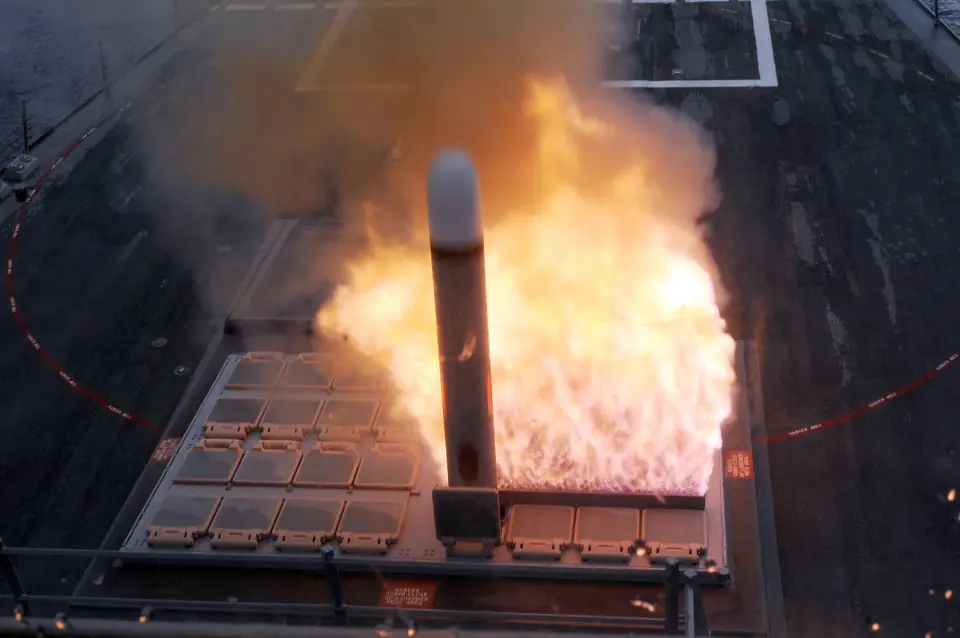
A Tomahawk cruise missile launches from the US Navy destroyer USS Farragut during a 2009 exercise: the type of missile fired at camps in Afghanistan in August 1998

On 20 August 1998, in response to the bombings of US embassies in Kenya and Tanzania, the United States struck camps in eastern Afghanistan linked to Osama bin Laden. The missiles flew over Pakistan, which was told only at the last moment; Pakistan protested at casualties and a stray missile on its soil.

Diplomacy

Sharif in Washington: waivers, a test-ban pledge and an end to the F-16 saga

Prime Minister Nawaz Sharif visited Washington on 1–4 December 1998 and met President Clinton on 2 December. Clinton had just waived some post-test sanctions, easing IMF support; Sharif reaffirmed a pledge to adhere to the test-ban treaty. Weeks later the eight-year F-16 dispute was settled.

Regional conflictKey moment

AfghanistanIranIndiaChinaArabian SeaPakistanIIOJKN0100 milesKargil

on the Line of Control

34° 34′ N · 76° 08′ E

Map: Kargil, on the Line of Control

Kargil and the Fourth of July at Blair House

With Pakistani forces entrenched across the Line of Control and fears of escalation between two new nuclear powers, Nawaz Sharif flew to Washington and agreed to steps to restore the line.

During the Kargil conflict, Prime Minister Nawaz Sharif met President Clinton at Blair House on 4 July 1999. Their joint statement said concrete steps would be taken to restore the Line of Control under the Simla Agreement. Sharif announced the withdrawal a week later; the fallout shaped Pakistani politics for years.

Diplomacy

The October 1999 coup and a third layer of sanctions

Sanctions

Section 508

Foreign aid appropriations law: aid barred after a military coup

Section 508, 1999

On 12 October 1999 the army chief, General Pervez Musharraf, removed Prime Minister Nawaz Sharif after Sharif tried to dismiss him. The Clinton administration called it a setback for democracy and on 15 October invoked Section 508 of the foreign-aid appropriations law, adding to the sanctions already in place.

Diplomacy

Five hours in Islamabad: Clinton speaks to Pakistan

AfghanistanIranIndiaChinaArabian SeaPakistanIIOJKN0100 milesIslamabad

Pakistan’s capital

33° 41′ N · 73° 03′ E

Map: Islamabad, Pakistan’s capital

On 25 March 2000 Bill Clinton made a one-day stop in Islamabad, the first visit by a US president since 1969. He met President Tarar and General Musharraf and gave a televised address urging democracy, restraint in Kashmir and action against terrorism, under extraordinary security.

Vol. VIThe Long Arc2001–2011 Edition

The post-9/11 partnership

2001201116 stories

After the attacks of 11 September 2001, Pakistan joined the US-led campaign in Afghanistan, sanctions were waived and assistance grew to some of its highest levels. Cooperation was extensive but often strained, and a series of crises in 2011 brought relations to a low point.

The long read4 min

A bargain struck in days

On the morning of 11 September 2001 the United States and Pakistan were estranged partners. Washington had cut most aid in 1990 over Pakistan's nuclear programme, added sanctions after the nuclear tests of 1998 and again after General Pervez Musharraf's takeover in 1999, and regarded Islamabad's patronage of the Taliban with growing alarm. Within a week the relationship had been transformed. Presented with a list of seven demands by Deputy Secretary of State Richard Armitage, Musharraf agreed to break with the Taliban, open Pakistan's airspace and airfields and share intelligence1. By the end of October the nuclear, coup-related and debt sanctions had been waived2,3.

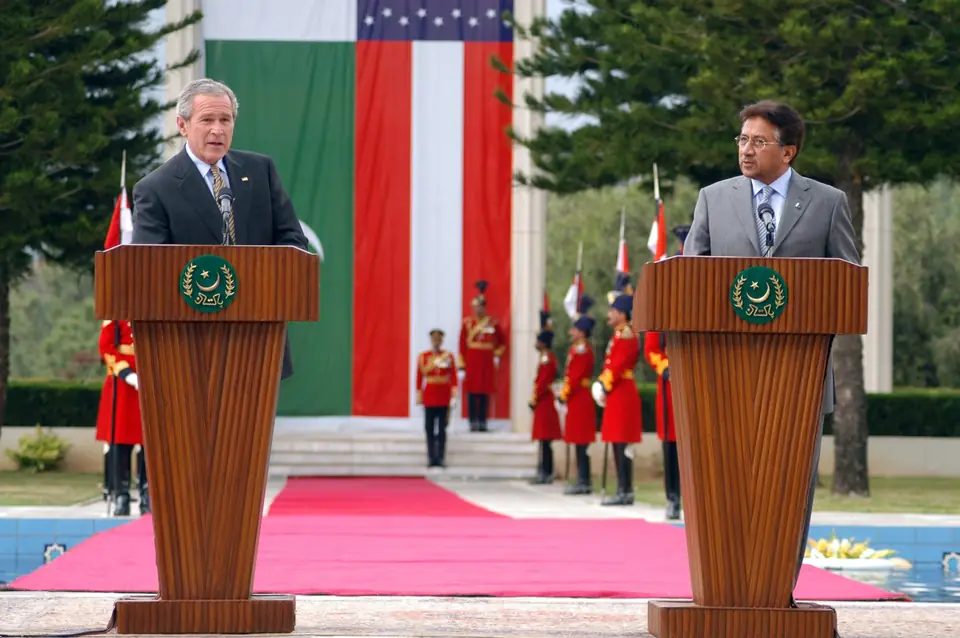
President George W. Bush and another speaker at lecterns in Islamabad, 4 March 2006

The decade that followed was the most intense period of cooperation since the 1980s, and in some respects more intimate: the two countries' armies and intelligence services worked together daily, Pakistani ports and roads carried most of the supplies for the war in Afghanistan, and Pakistan captured and handed over hundreds of al-Qaeda suspects. It was also a decade of deepening mutual suspicion, which by 2011 had brought the relationship close to rupture.

Money, status and its limits

American assistance flowed on a scale not seen before. A Christian Science Monitor tally in 2011 put the total since 2002 at about $20.7 billion, of which the largest component - around $8.9 billion - consisted of Coalition Support Funds reimbursing Pakistan for military operations, with roughly two-thirds of the total going to security purposes4. The CRS has tracked these flows year by year5. President Bush hosted Musharraf at Camp David in 2003 and promised $3 billion over five years; in 2004 Pakistan became a major non-NATO ally; and in 2006 Bush became the first US president to visit Pakistan since 2000, signing a joint statement on a "strategic partnership"6.

Yet the limits of the partnership were visible from the start. In February 2004 A. Q. Khan confessed to running a nuclear black market; Washington chose to accept Musharraf's assurances rather than penalise Pakistan. In New Delhi the same week as his 2006 Islamabad visit, Bush concluded the civil nuclear deal that Pakistan had sought and been refused. Pakistanis increasingly saw the relationship as transactional - useful to Washington while the war lasted, with no guarantee beyond it - while Americans asked why the Afghan Taliban leadership appeared to operate freely from Pakistani cities.

Two narratives of the war

The two governments came to tell very different stories about the war. In the American account, Pakistan took large sums while its military intelligence service continued to support the Afghan Taliban and the Haqqani network, which killed US soldiers in Afghanistan; Admiral Mike Mullen made the charge publicly in September 20117. In the Pakistani account, the country paid an enormous price for a war not of its making. The Pakistani Taliban, which emerged from 2007, waged a campaign of bombings across the country; Pakistan's official economic survey estimated cumulative economic losses of more than $126 billion by 2018, and Pakistani leaders put the death toll at more than 70,0008. The CIA's drone campaign in the tribal areas, which began in 2004 and peaked in 2010, embodied the contradiction: quietly tolerated at some levels, publicly condemned as a violation of sovereignty9.

From Musharraf to the civilians

The relationship was at first intensely personal, built on Bush's reliance on Musharraf. That changed after Benazir Bhutto's assassination in December 2007 and the elections of February 2008, which brought the Pakistan Peoples Party to power; Musharraf resigned in August and Asif Ali Zardari became president10. The Obama administration placed Pakistan at the heart of its regional strategy in March 2009 and backed the Kerry–Lugar–Berman act, which authorised $7.5 billion in civilian aid over five years - an attempt, in Washington's words, to build a relationship with the Pakistani people rather than a single leader11. The Strategic Dialogue was raised to ministerial level in 2010, and American relief after the 2005 earthquake and the 2010 floods showed another face of the partnership.

2011: the year everything broke

In 2011 the accumulated mistrust exploded. In January a CIA contractor, Raymond Davis, shot two men in Lahore; in May US special forces killed Osama bin Laden in Abbottabad without informing Pakistan; in September Mullen accused the ISI of backing Haqqani attacks; and in November NATO air strikes killed 24 Pakistani soldiers at Salala, after which Pakistan closed NATO's supply lines and expelled the Americans from Shamsi airbase12. The CRS described relations as seriously disrupted12.

Scholars of the relationship from both countries - Husain Haqqani, Pakistan's ambassador in Washington from 2008 to 2011, and Daniel Markey, a former State Department planner - have described this decade as the clearest example of a pattern of mismatched expectations and mutual dependence: neither side could do without the other, and neither fully trusted the other13,14.

Sources for this era (14)
  1. On anniversary of 9/11, new documents shed light on US-Pakistani relations, Unredacted (National Security Archive), 10 September 2010 · Primary document
  2. Bush Waives Nuclear-Related Sanctions on India, Pakistan, Arms Control Association, October 2001 · Scholarly
  3. Public Law 107-57, US Government Publishing Office (govinfo), 27 October 2001 · Primary document
  4. US cuts aid to Pakistan: Six key questions, Christian Science Monitor, 11 July 2011 · Press
  5. Direct Overt U.S. Aid Appropriations for and Military Reimbursements to Pakistan, FY2002-FY2020, Congressional Research Service (via EveryCRSReport), 12 March 2019 · Official
  6. Joint Statement on United States-Pakistan Strategic Partnership, The White House (George W. Bush archives), 4 March 2006 · Primary document
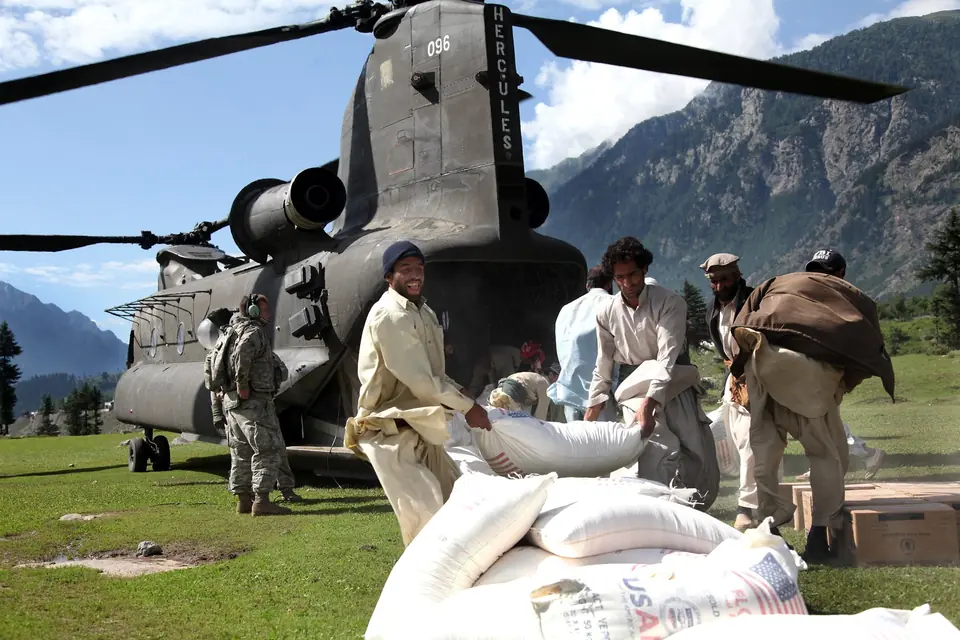
  7. Admiral Mullen: Pakistani ISI sponsoring Haqqani attacks, FDD’s Long War Journal, 22 September 2011 · Press
  8. ‘War on terror’ has cost Pakistan more than $150bn in losses since 9/11, officials say, Arab News, September 2021 · Press
  9. One decade of drone strikes in Pakistan, Council on Foreign Relations, 2014 · Scholarly
  10. World Report 2009: Pakistan, Human Rights Watch, 2009 · Reference
  11. Public Law 111-73: Enhanced Partnership with Pakistan Act of 2009, US Government Publishing Office (govinfo), 15 October 2009 · Primary document
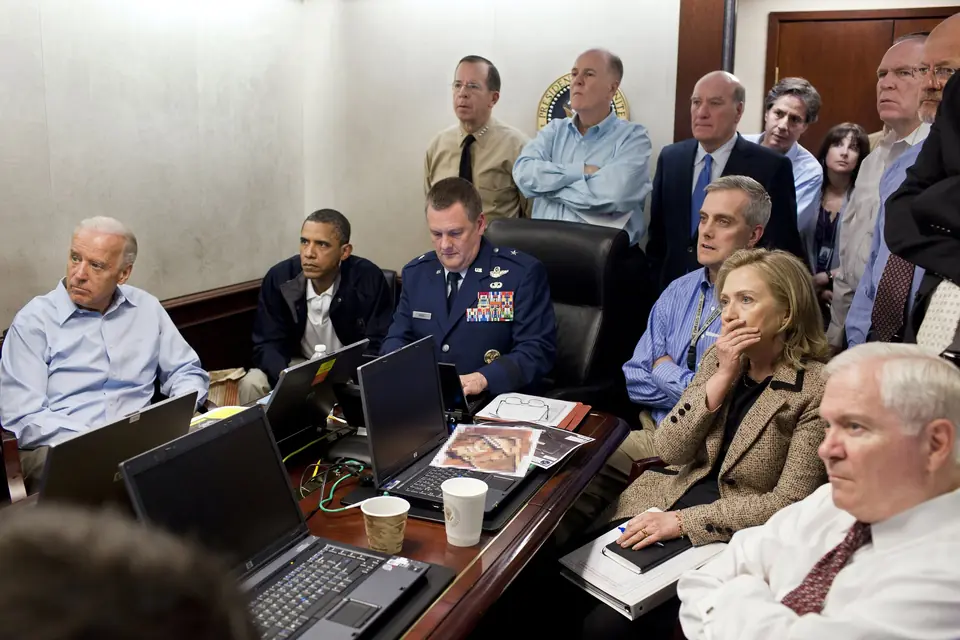
  12. Pakistan-U.S. Relations: A Summary (CRS R41832, October 2011), Congressional Research Service (via EveryCRSReport), 21 October 2011 · Official
  13. Magnificent Delusions: Pakistan, the United States, and an Epic History of Misunderstanding (Husain Haqqani, PublicAffairs, 2013), Publishers Weekly (catalogue entry), 2013 · Scholarly
  14. Daniel Markey’s new book No Exit from Pakistan argues US-Pakistan ties a condition to be managed, Council on Foreign Relations, 2013 · Scholarly

The record2001–2011

Security & defenceKey moment

AfghanistanIranIndiaChinaArabian SeaPakistanIIOJKN0100 milesJacobabadPasniDalbandin

airfields used by the US-led campaign

Map: Jacobabad, Pasni and Dalbandin, airfields used by the US-led campaign

After 11 September, Pakistan turns against the Taliban

Within days of the attacks on New York and Washington, General Musharraf accepted American demands for cooperation, abandoning the Taliban government Pakistan had backed and making his country a front-line partner once more.

After the attacks of 11 September 2001, Washington presented Pakistan with a list of demands for cooperation against al-Qaeda and the Taliban. General Musharraf accepted, opened airspace and bases to the US-led campaign and broke with the Taliban, transforming a relationship that had been under sanctions for a decade.

Economy & aid

A decade of sanctions is lifted in five weeks

Presidential Determination

Sanctions Waived

The Glenn and Symington sanctions

Then Public Law 107-57, 27 October 2001

Sanctions Waived, 2001

On 22 September 2001 President Bush waived the nuclear-related sanctions imposed on Pakistan and India after their 1998 tests, and those applied to Pakistan under the Symington amendment. Congress then passed the Brownback bill, signed on 27 October, letting him waive the coup-related and loan-default restrictions too.

Economy & aid

At Camp David, a $3 billion pledge

On 24 June 2003 President Bush hosted President Musharraf at Camp David and announced he would work with Congress to provide $3 billion in economic and security assistance over five years, about $600 million a year. A trade and investment framework agreement was also announced; the F-16 aircraft Pakistan sought were not included.

Nuclear

The A. Q. Khan network is exposed

On 4 February 2004 Abdul Qadeer Khan, revered in Pakistan as the father of its nuclear programme, admitted on state television to passing nuclear technology to other countries. Musharraf pardoned him the next day. President Bush publicly described the network a week later while continuing to praise Pakistan’s cooperation.

Security & defence

Pakistan becomes a major non-NATO ally

Presidential Determination

Major Non-NATO Ally

No. 2004-37

Major Non-NATO Ally, 2004

Secretary of State Colin Powell announced in Islamabad in March 2004 that the United States would designate Pakistan a major non-NATO ally. President Bush made the designation on 16 June 2004, easing Pakistan’s access to US defence equipment, training and cooperative research. India voiced its unease.

Security & defenceKey moment

Azam Warsak, near Wana in South Waziristan, in 2014

The drone war comes to the tribal areas

A CIA strike in South Waziristan in June 2004 began a covert campaign that would become one of the most contested features of the relationship.

The first known US drone strike in Pakistan, in June 2004, killed the militant commander Nek Muhammad in South Waziristan. Strikes multiplied after 2008, peaking in 2010. Independent trackers counted hundreds of strikes and thousands of deaths, with sharply disputed civilian tolls; Pakistan publicly condemned them as violations of sovereignty.

Economy & aid

Chinooks over Kashmir: the 2005 earthquake relief

Pakistani soldiers and local police unload relief supplies from a US Army CH-47 Chinook helicopter at a landing zone in Muzaffarabad, 12 October 2005

The earthquake of 8 October 2005 killed more than 73,000 people in Pakistan and left over three million homeless. The United States pledged $510 million and sent helicopters, field hospitals and engineers; its Chinooks flew thousands of relief missions before the military mission ended in March 2006.

Diplomacy

George W. Bush’s overnight stay in Islamabad

AfghanistanIranIndiaChinaArabian SeaPakistanIIOJKN0100 milesIslamabad

Pakistan’s capital

33° 41′ N · 73° 03′ E

Map: Islamabad, Pakistan’s capital

President Bush visited Islamabad on 3–4 March 2006, arriving after dark under heavy security after a visit to India. He and President Musharraf issued a joint statement on a long-term strategic partnership, but Pakistan did not receive the civil nuclear cooperation just offered to India.

Diplomacy

Elections end the Musharraf era

President George W. Bush and Prime Minister Yousaf Raza Gilani of Pakistan speak to the press on the South Lawn of the White House, 28 July 2008

Pakistan’s 18 February 2008 elections, held weeks after Benazir Bhutto’s assassination, brought her Pakistan Peoples Party to power. Musharraf resigned in August under threat of impeachment, and Zardari was elected president in September. Washington, long tied to Musharraf, moved to work with the elected government.

Security & defence

Obama puts Pakistan at the centre of the war

President Barack Obama talks with Admiral Michael Mullen, Chairman of the Joint Chiefs of Staff, and other officials before his speech on strategy for Afghanistan and Pakistan, 27 March 2009

On 27 March 2009 President Obama announced a new strategy for Afghanistan and Pakistan, aimed at disrupting, dismantling and defeating al-Qaeda in both countries. It promised more economic and security support for Pakistan. Pakistani leaders objected to being bracketed with Afghanistan, and the administration later dropped the “AfPak” shorthand.

Economy & aidKey moment

Water released through the Gomal Zam Dam in April 2011, when USAID was providing $40 million to finance the dam’s completion

Kerry–Lugar–Berman: $7.5 billion promised for Pakistan’s people

Congress authorised a tripling of civilian aid to Pakistan over five years. Its conditions provoked a storm in Pakistan, and far less than promised was ultimately spent.

President Obama signed the Enhanced Partnership with Pakistan Act on 15 October 2009, authorising $1.5 billion a year in non-military aid for five years. Pakistan’s army publicly objected to conditions it saw as intrusive, and in the end only around half of the promised sum was disbursed.

Diplomacy

The Strategic Dialogue goes ministerial

Secretary of State Hillary Rodham Clinton shakes hands with Pakistani Foreign Minister Shah Mahmood Qureshi at the US-Pakistan Strategic Dialogue meeting at the Department of State, Washington, 24 March 2010

On 24–25 March 2010 Secretary of State Hillary Clinton and Foreign Minister Shah Mehmood Qureshi co-chaired the first ministerial-level session of the US–Pakistan Strategic Dialogue in Washington. Military, intelligence and economic officials from both sides joined talks covering security, energy, water, agriculture, education and the economy.

Economy & aid

The superflood of 2010 and the American airlift

Pakistani men unload bags of flour from a US Army CH-47 Chinook helicopter delivering flood relief in the Swat Valley, 11 August 2010

Floods that began in late July 2010 swept down the Indus, killing around 1,700–2,000 people and affecting some 20 million. The United States became the largest donor, providing hundreds of millions of dollars in relief, and US military helicopters flew rescue and supply missions in Khyber Pakhtunkhwa and beyond.

Security & defence

The Raymond Davis affair

AfghanistanIranIndiaChinaArabian SeaPakistanIIOJKN0100 milesLahore

Punjab, Pakistan

31° 33′ N · 74° 20′ E

Map: Lahore, Punjab, Pakistan

On 27 January 2011 Raymond Davis, an American later revealed to be working for the CIA, shot dead two Pakistani men in Lahore. Washington insisted he had diplomatic immunity; Pakistani courts disagreed. He was freed on 16 March after the victims’ families were paid about $2.4 million in diyat (blood money).

Security & defenceKey moment

President Barack Obama, Vice President Joe Biden and members of the national security team receive an update on the mission against Osama bin Laden in the White House Situation Room, 1 May 2011

Abbottabad: bin Laden is killed in a garrison town

A US special forces raid without Pakistan’s knowledge killed Osama bin Laden near the Pakistan Military Academy, triggering recriminations on both sides.

In the early hours of 2 May 2011 (local time) US Navy SEALs killed Osama bin Laden in a compound in Abbottabad. Pakistan had not been told in advance and condemned the “unauthorised unilateral action”; Americans asked how bin Laden had lived there for years undetected. A Pakistani commission later found failures at almost all levels of government.

Security & defenceKey moment

AfghanistanIranIndiaChinaArabian SeaPakistanIIOJKN0100 milesSalala

Mohmand, on the Afghan border

34° 36′ N · 71° 12′ E

Map: Salala, Mohmand, on the Afghan border

Salala: 24 soldiers killed, supply lines cut

NATO air strikes on two Pakistani border posts brought relations to their lowest point of the decade: Pakistan closed the supply routes, expelled the Americans from Shamsi and boycotted the Bonn conference.

In the early hours of 26 November 2011 US aircraft struck two Pakistani border posts at Salala in Mohmand, killing 24 soldiers. Pakistan closed NATO’s ground supply routes, ordered the US out of Shamsi airbase and boycotted the Bonn conference on Afghanistan. A US inquiry blamed errors on both sides; Pakistan rejected it.

Vol. VIIThe Long Arc2012–2020 Edition

Recalibration

201220209 stories

Both governments worked to rebuild a narrower relationship: dialogue resumed, US assistance declined and security aid was suspended in 2018. Pakistan’s role in the Afghan peace process became a central thread of the relationship.

The long read3 min

After the rupture

The crises of 2011 left the relationship badly damaged. When Pakistan reopened NATO's supply routes in July 2012, after Hillary Clinton said the United States was sorry for the Pakistani soldiers' deaths at Salala, both governments set about rebuilding - but on a narrower basis1. The era that followed was one of recalibration: lower expectations, declining aid and a relationship increasingly defined by a single question, the end of the war in Afghanistan.

President Barack Obama welcomes Prime Minister Nawaz Sharif of Pakistan to the Oval Office, 23 October 2013

Normal business, narrower aims

Pakistan's elections of May 2013 produced its first transfer of power between two elected governments, and Nawaz Sharif's return as prime minister brought a revival of formal dialogue. John Kerry relaunched the Strategic Dialogue in Islamabad in August 2013, and Sharif visited the White House in October 2013 and again in October 20152,3. The 2015 joint statement, in which Pakistan committed to act against UN-designated groups including Lashkar-e-Taiba and to deny the Haqqani network space to operate, reflected the agenda Washington now prioritised3.

Pakistan, meanwhile, was fighting its own war. The army's Zarb-e-Azb offensive in North Waziristan from June 2014, and national outrage after the Pakistani Taliban's massacre at the Army Public School in Peshawar in December 2014, reduced terrorist violence significantly4. Pakistani officials argued that the country had turned the tide at great cost and deserved recognition rather than criticism; American officials welcomed the operations against the Pakistani Taliban but said the Afghan Taliban and the Haqqani network still found sanctuary.

The money runs down

US assistance, which had peaked in fiscal 2010, declined steadily. The Congressional Research Service later described it as reaching a twenty-year low under the Trump administration5. Congress grew more assertive: in 2016 it blocked US financing for eight F-16s, and the Pentagon withheld $300 million in Coalition Support Funds after declining to certify Pakistani action against the Haqqanis6. China's announcement of the China–Pakistan Economic Corridor in April 2015, with headline investment pledges of $46 billion, offered Pakistan an alternative partner on a scale that dwarfed recent American civilian aid7.

Confrontation and its limits

The low point came under President Trump. His August 2017 South Asia strategy accused Pakistan of harbouring the terrorists America was fighting while taking billions in aid, and called for a bigger Indian role in Afghanistan8. On 1 January 2018 he tweeted that Pakistan had given the United States nothing but "lies and deceit"; days later most security assistance was suspended9. In June 2018 Pakistan was placed on the Financial Action Task Force's grey list after a US-led motion10. Pakistan's government and military rejected what they saw as scapegoating for American failures in Afghanistan.

Yet pressure had limits. The administration's real objective was to leave Afghanistan, and that required Pakistan. In December 2018 Trump wrote to Prime Minister Imran Khan seeking help with talks with the Taliban11; Pakistan had already released the Taliban co-founder Abdul Ghani Baradar at Washington's request. Khan's White House visit in July 2019 was cordial, and military training cooperation resumed that December.

India, crisis and the end of an era

India was a constant presence in the background. Washington's deepening strategic partnership with New Delhi was viewed in Islamabad as tilting the regional balance; Trump's July 2019 offer to mediate on Kashmir, rejected by India, briefly suggested otherwise. During the February 2019 crisis that followed the Pulwama bombing and Indian air strikes at Balakot, Secretary of State Mike Pompeo spoke to both foreign ministers and urged them to avoid further military activity12.

The era closed with the Doha agreement of 29 February 2020, signed between the United States and the Taliban with Pakistan's foreign minister in attendance13. It promised what both governments had come to see as the only way out of a war that had shaped their relationship for two decades - and it left open what would replace that war as the relationship's organising purpose.

Sources for this era (13)
  1. After apology, Pakistan agrees to reopen military supply line into Afghanistan, NPR, 3 July 2012 · Press
  2. Joint Statement by President Obama and Prime Minister Nawaz Sharif, The White House (Obama archives), 23 October 2013 · Primary document
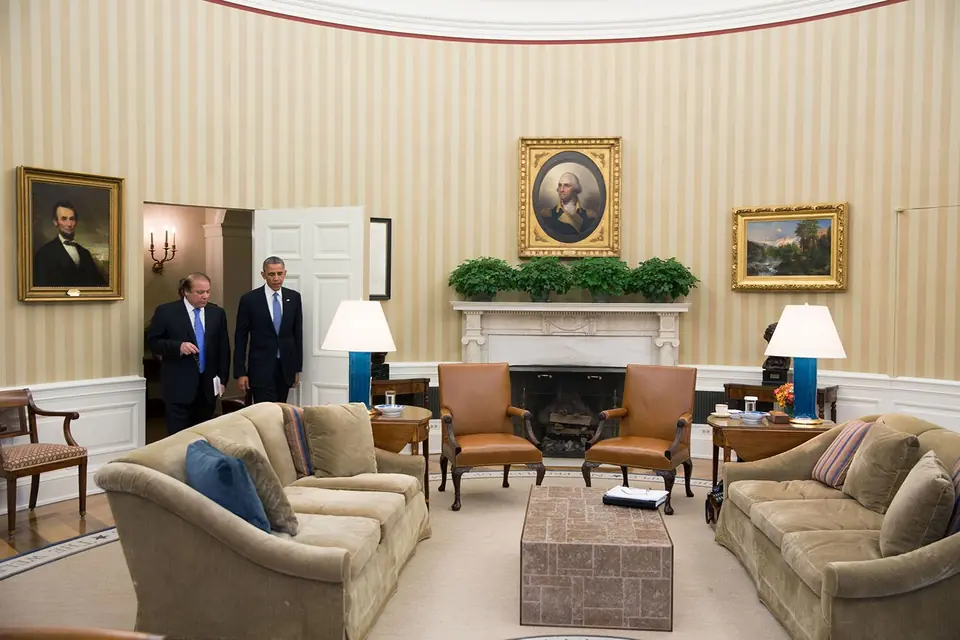
  3. 2015 Joint Statement by President Barack Obama and Prime Minister Nawaz Sharif, The White House (Obama archives), 22 October 2015 · Primary document
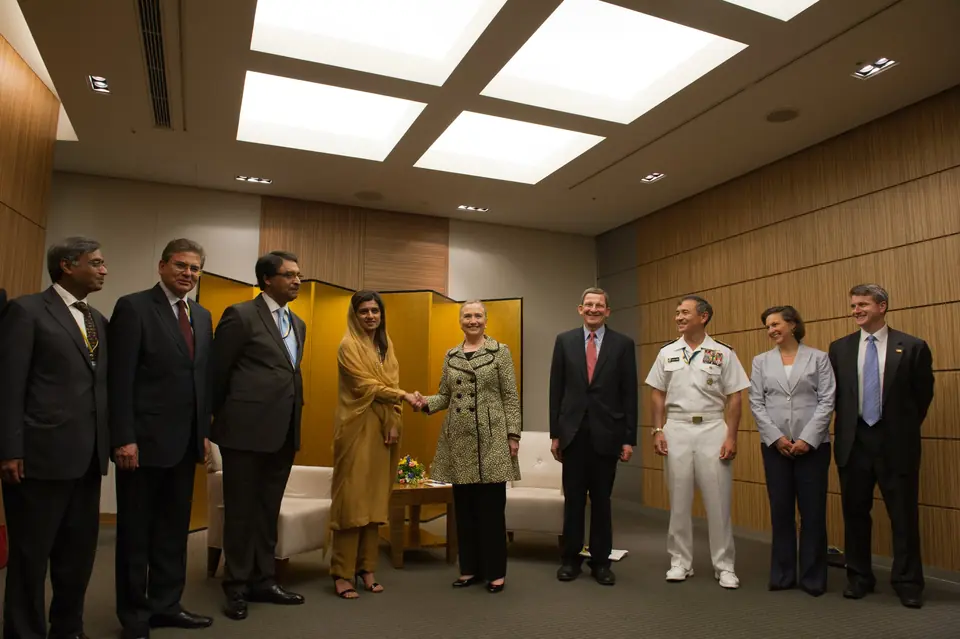
  4. The successes and failures of Pakistan’s Operation Zarb-e-Azb, Jamestown Foundation, 2015 · Scholarly
  5. Pakistan-U.S. Relations (CRS In Focus IF11270), Congressional Research Service (via EveryCRSReport), 15 July 2019 · Official
  6. US holds back some military aid for Pakistan, CNN, 4 August 2016 · Press
  7. China’s Xi Jinping in Pakistan to unveil trade plan, Al Jazeera, 20 April 2015 · Press
  8. Trump outlines security strategy for Pakistan, Afghanistan, Radio Free Europe/Radio Liberty, 22 August 2017 · Press
  9. U.S. suspends most security assistance to Pakistan, NPR, 4 January 2018 · Press
  10. Pakistan vows to implement plan to end terror financing, Anadolu Agency, 28 June 2018 · Press
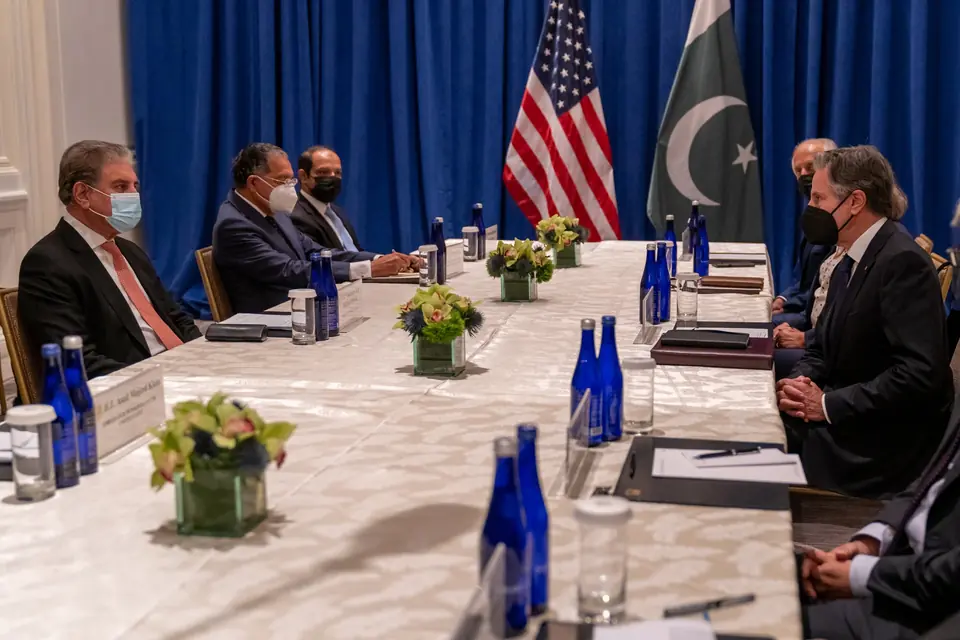
  11. Trump writes to PM Khan seeking Islamabad’s assistance in Afghan peace talks with Taliban, Dawn, 3 December 2018 · Press
  12. US urges India, Pakistan to ‘avoid escalation at any cost’, Al Jazeera, 27 February 2019 · Press
  13. What to know about the Afghan peace negotiations, Council on Foreign Relations, 2020 · Scholarly

The record2012–2020

Diplomacy

“We are sorry”: the supply lines reopen

Secretary of State Hillary Clinton shakes hands with Pakistani Foreign Minister Hina Rabbani Khar at their bilateral meeting at the Tokyo Conference on Afghanistan, 8 July 2012

On 3 July 2012, after a telephone call with Foreign Minister Hina Rabbani Khar, Secretary of State Hillary Clinton said the United States was sorry for the losses suffered by the Pakistani military at Salala. Pakistan reopened the ground supply routes to Afghanistan, closed since November 2011, without imposing a transit fee.

Diplomacy

Nawaz Sharif returns to the White House

President Barack Obama and Prime Minister Nawaz Sharif of Pakistan in the Oval Office at their bilateral meeting, 23 October 2013
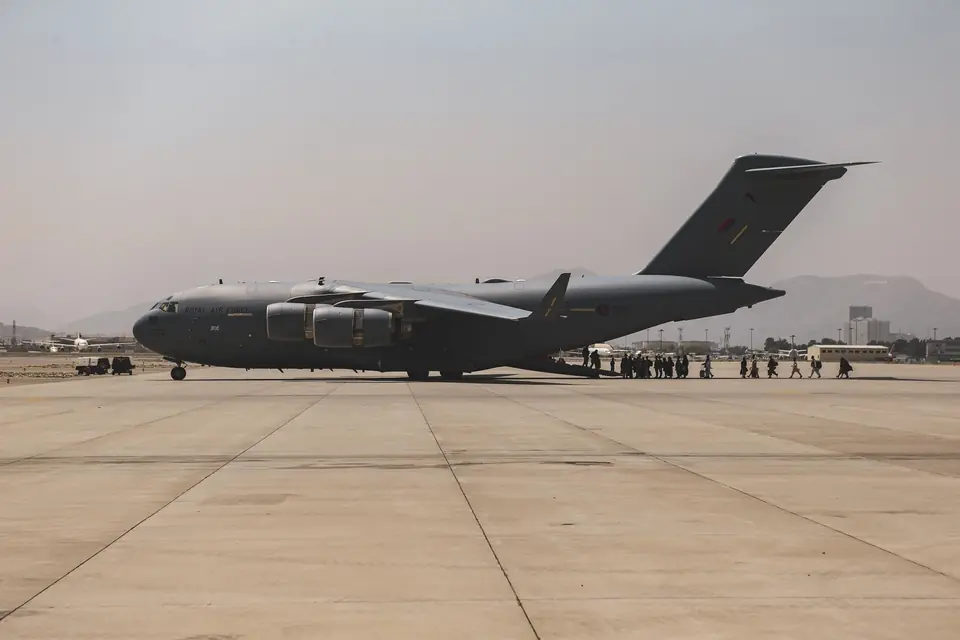
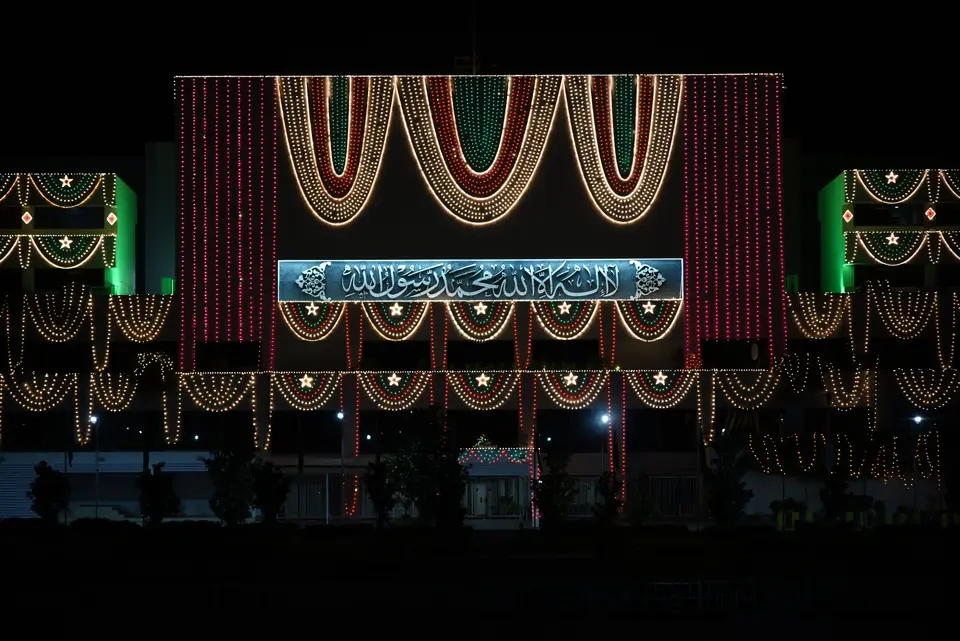
Nawaz Sharif, elected prime minister for a third time in May 2013, made an official visit to Washington on 20–23 October 2013. He and President Obama issued a joint statement on a partnership based on mutual interest and respect; Sharif said afterwards that he had urged an end to drone strikes.

Diplomacy

A second Sharif visit and a pledge on Lashkar-e-Taiba

Joint Statement

Joint Statement

Lashkar-e-Taiba and the Haqqani network named

President Obama · Prime Minister Nawaz Sharif

Joint Statement, 2015

During Prime Minister Nawaz Sharif’s official visit to Washington on 20–23 October 2015, he and President Obama issued a joint statement in which Pakistan committed to act against UN-designated terrorist groups including Lashkar-e-Taiba, and to ensure Taliban groups, including the Haqqani network, could not operate from Pakistani soil.

Security & defence

The F-16 deal that Congress would not pay for

Pakistan Air Force F-16B fighters in flight during the US Air Force’s Red Flag exercise, July 2010

In February 2016 the State Department approved the sale of eight F-16 Block 52 fighters to Pakistan for about $699 million. Senator Bob Corker blocked US financing, and in May Washington told Pakistan it would have to pay in full; the sale lapsed. In August the Pentagon withheld $300 million in Coalition Support Funds.

Security & defence

Trump’s South Asia strategy singles out Pakistan

President Donald Trump addresses the nation on his South Asia strategy at Conmy Hall, Fort Myer, Virginia, 21 August 2017

On 21 August 2017, at Fort Myer, President Trump announced a strategy for Afghanistan and South Asia that kept US troops in Afghanistan, sought a larger role for India and said the United States could no longer be silent about Pakistan’s safe havens. Pakistan’s National Security Committee said the country was being made a scapegoat.

Security & defenceKey moment

State Department Announcement

Security Assistance Suspended

Security Assistance Suspended, 2018

Washington suspends security aid

Days after a New Year tweet accusing Pakistan of “lies and deceit”, the State Department froze most security assistance until Pakistan acted against the Afghan Taliban and the Haqqani network.

On 4 January 2018 the State Department suspended most security assistance to Pakistan, including Coalition Support Fund reimbursements, until Pakistan took decisive action against the Afghan Taliban and the Haqqani network. Pakistan said arbitrary deadlines and shifting goalposts were counter-productive. In September the Pentagon reprogrammed a further $300 million.

Multilateral

Pakistan on the FATF grey list

FATF Statement

The Grey List

Pakistan under increased monitoring

The Grey List, 2018

In February 2018 the United States, backed by Britain, France and Germany, moved at the Financial Action Task Force to place Pakistan under increased monitoring. In June 2018 Pakistan was grey-listed and committed to an action plan on terrorist financing. It completed that plan and a second one, and was removed in October 2022.

Diplomacy

Imran Khan at the White House

President Donald Trump, Prime Minister Imran Khan of Pakistan and Melania Trump in the Oval Office, 22 July 2019

Prime Minister Imran Khan met President Trump at the White House on 22 July 2019. Their talks covered Afghanistan, trade and counter-terrorism. Trump offered to mediate on Kashmir, saying Prime Minister Modi had asked him to; India denied it. Military training cooperation was restored later in the year.

MultilateralKey moment

US envoy Zalmay Khalilzad and Taliban representative Abdul Ghani Baradar sign the agreement in Doha, Qatar, 29 February 2020

The Doha agreement: a timetable to leave Afghanistan

The United States and the Taliban signed a deal setting out a 14-month withdrawal; Pakistan, which had helped bring the Taliban to the table, attended as a witness to the ceremony.

On 29 February 2020 the United States and the Taliban signed the Agreement for Bringing Peace to Afghanistan in Doha. It set a 14-month timetable for the withdrawal of US and allied forces in return for Taliban counter-terrorism guarantees and talks with other Afghans. Pakistan’s foreign minister attended; both governments credited Pakistan’s facilitation.

Vol. VIIIThe Long Arc2021–Today Edition

A new agenda

2021Today13 stories

After the US withdrawal from Afghanistan in 2021, both governments have described their ties in broader terms, with trade and investment, climate, health, education and people-to-people links alongside security.

The long read3 min

After Afghanistan

For twenty years the war in Afghanistan had given the US–Pakistan relationship its purpose, its money and much of its bitterness. When the last American troops left Kabul at the end of August 2021, that purpose disappeared1. Secretary of State Antony Blinken told Congress that Pakistan had hedged its bets on Afghanistan and that Washington would reassess the relationship; Pakistan, which had helped evacuate thousands of people through Islamabad, faced a resurgent Pakistani Taliban operating from the new Taliban-ruled Afghanistan1,2. The question both governments faced was what, if anything, would replace the war as the relationship's organising principle.

Secretary of State Antony J. Blinken meets Pakistani Foreign Minister Shah Mahmood Qureshi on the margins of the UN General Assembly in New York, 23 September 2021

A broader agenda, slowly

The first answer was a broader, lower-key agenda. Relations with Imran Khan's government were cool, and after his removal by parliament in April 2022 Khan accused Washington of conspiring against him - an allegation the State Department repeatedly called false, but one that made the United States an issue in Pakistani domestic politics3. The Shehbaz Sharif government, with Bilawal Bhutto Zardari as foreign minister, sought to reset ties. The catastrophic floods of 2022, which affected 33 million people, brought a US air bridge and relief aid, and the two governments marked the 75th anniversary of relations by launching a "Green Alliance" framework on climate, water, agriculture and clean energy4. A $450 million F-16 sustainment package that September showed that a limited defence relationship survived, over India's objections5. Counter-terrorism cooperation was rebuilt through a regular dialogue focused on common enemies such as ISIS-Khorasan.

Frictions remained. Congress scrutinised Pakistan's February 2024 elections, passing a resolution by 368 votes to 7, which Islamabad called interference6. In December 2024 the outgoing Biden administration sanctioned the state body that builds Pakistan's ballistic missiles, and a senior official said Pakistan was developing capabilities that could eventually reach the United States7.

The 2025 turn

The return of Donald Trump in 2025 brought an unexpectedly rapid warming. In March Trump thanked Pakistan before Congress for capturing an ISIS-K suspect in the 2021 Abbey Gate bombing8. In May, after the Pahalgam attack and four days of fighting between India and Pakistan, Trump announced a ceasefire he said the United States had mediated; Pakistan thanked him and recommended him for the Nobel Peace Prize, while India insisted the truce was bilateral9. In June Trump hosted Field Marshal Asim Munir for lunch at the White House; in July a trade deal set a 19 per cent tariff on Pakistani goods and promised cooperation on oil; in August the State Department designated the Balochistan Liberation Army a foreign terrorist organisation; and in September Prime Minister Sharif and Munir were received in the Oval Office as a US company signed a critical-minerals memorandum with Pakistan's Frontier Works Organization10,11,12.

Pakistani officials and many analysts described the change as a shift from a security-driven relationship to one built on trade, minerals, energy and technology. Critics in both countries noted how closely the warming was tied to personal relationships between Trump and Pakistan's military leadership, and how sensitive it remained to India and to China, Pakistan's principal strategic partner.

A mediator's role

In 2026 Pakistan found itself in an unfamiliar role. It joined Trump's Board of Peace for Gaza in January13. When US and Israeli strikes on Iran in February killed Ayatollah Khamenei and set off a regional war, Pakistan condemned the attacks and faced violent protests at the US consulate in Karachi - yet it also became the principal mediator between Washington and Tehran, helping to secure an April ceasefire and hosting talks in Islamabad led by Vice President JD Vance, the highest-level direct US–Iran negotiations since 197914.

As of October 2026, the relationship rests on more varied foundations than at any time since 1947: a counter-terrorism dialogue whose August 2026 round named the TTP and BLA alongside ISIS-K and al-Qaeda as common enemies, unfinished trade negotiations, a nascent minerals partnership and an unusual diplomatic intimacy at the top15. Whether these foundations are deeper than the transactional bargains of earlier eras is the question that history has not yet answered.

Sources for this era (15)
  1. U.S. withdraws from Afghanistan as the Taliban take control, University of Virginia School of Law, 2021 · Scholarly
  2. Bipartisan anger against Pakistan in the US, as Blinken promises to reassess relationship, The Week, 14 September 2021 · Press
  3. Purported text of secret cable shows US ire at Imran Khan, Voice of America, 9 August 2023 · Press
  4. Issue Brief on “US-Pakistan Green Alliance”, Institute of Strategic Studies Islamabad, April 2023 · Scholarly
  5. Blinken defends Pakistan arms sales against Indian criticism, Arab News (AFP), 27 September 2022 · Press
  6. ‘No right to interfere’: Pakistan hits back at US over election scrutiny, Al Jazeera, 27 June 2024 · Press
  7. U.S. sanctions on Pakistan’s missile program highlight nuclear threats from South Asia, CSIS Project on Nuclear Issues, December 2024 · Scholarly
  8. Trump hails Pakistan’s help in arresting IS terrorist behind 2021 Kabul airport bombing, Dawn, 5 March 2025 · Press
  9. PM Modi told Trump ‘India will never accept mediation’ on tensions with Pakistan: MEA, Scroll.in, 18 June 2025 · Press
  10. Trump hosts Pakistan army chief for unprecedented lunch, confirms Iran discussed, Arab News, 18 June 2025 · Press
  11. Trump’s new order on tariffs: 25% for India, 19% for Pakistan, Gulf News, 1 August 2025 · Press
  12. ‘Strategic handshake’: how Pakistan is wooing Trump with critical minerals, Al Jazeera, 25 September 2025 · Press
  13. Pakistan PM signs Gaza Board of Peace charter at World Economic Forum in Davos, Arab News, 22 January 2026 · Press
  14. Vance leaves Islamabad after 21-hour talks end without agreement, praises Pakistan’s mediation efforts, Express Tribune, 12 April 2026 · Press
  15. Joint Statement on the U.S.-Pakistan Counterterrorism Dialogue, US Department of State, August 2026 · Official

The record2021–today

Regional conflictKey moment

Evacuees board a C-17 Globemaster III during the evacuation at Hamid Karzai International Airport, Kabul, 20 August 2021

The war ends: America leaves Afghanistan

The Taliban took Kabul and the last US troops left in August 2021. Pakistan helped evacuate thousands - and faced renewed accusations in Washington over its ties to the victors.

The Taliban entered Kabul on 15 August 2021 and the last US forces left at the end of August. Pakistan helped evacuate foreign nationals and Afghans through Islamabad. In Washington, Secretary Blinken said Pakistan had hedged its bets, while Pakistan faced a resurgent Pakistani Taliban across the border.

Diplomacy

Imran Khan’s fall and the “cipher”

Parliament House in Islamabad, where the National Assembly sits, lit with strings of lights at night in November 2018

Imran Khan was removed as prime minister by a no-confidence vote on 9 April 2022. He alleged that the vote was the result of a US-backed conspiracy, citing a cable (the “cipher”) reporting a meeting between a senior State Department official and Pakistan’s ambassador. The United States repeatedly called the allegation false.

Economy & aid

A third of Pakistan under water: the 2022 floods

A US Air Force C-17 loadmaster checks wing-tip clearance from the aircraft during a USAID-led flood relief mission at Sukkur Airport, Pakistan, 10 September 2022

Catastrophic monsoon floods in 2022 killed more than 1,700 people, affected 33 million and caused damage and losses estimated at about $30 billion. The United States sent an air bridge of relief flights, announced successive tranches of aid totalling more than $200 million, and launched a “Green Alliance” framework on climate, water, agriculture and clean energy.

Security & defence

A $450 million F-16 sustainment package

An F-16D Block 52+ in flight during testing in the United States before its delivery to the Pakistan Air Force, 2009

On 7 September 2022 the State Department approved a possible $450 million sale to sustain Pakistan’s F-16 fleet, consolidating earlier support cases. It included no new aircraft, weapons or munitions. India objected strongly; Secretary Blinken said the package helped Pakistan deal with terrorist threats.

Security & defence

Counter-terrorism talks on a new footing

A revived bilateral counter-terrorism dialogue in March 2023 refocused cooperation on shared enemies such as ISIS-Khorasan and the Pakistani Taliban.

Diplomacy

Washington questions Pakistan’s 2024 election

The State Department urged an investigation into reported irregularities, and the House passed a resolution on democracy in Pakistan by 368 votes to 7. Islamabad called it interference.

Nuclear

Sanctions on Pakistan’s missile programme

Sanctions

Executive Order 13382

The National Development Complex and three Karachi firms

Executive Order 13382, 2024

On 18 December 2024 the United States sanctioned Pakistan’s National Development Complex and three private firms for supporting its long-range ballistic missile programme. The next day Deputy National Security Adviser Jon Finer said Pakistan was developing capabilities that could eventually strike targets beyond South Asia, including the United States. Pakistan rejected the allegation.

Security & defence

Pakistan hands over an Abbey Gate suspect

President Donald Trump delivers his address to a joint session of Congress in the House Chamber of the US Capitol, 4 March 2025

On 4 March 2025 President Trump told Congress that Pakistan had helped arrest Mohammad Sharifullah, an ISIS-K figure accused of helping plan the August 2021 Abbey Gate bombing that killed 13 US service members. He was extradited and appeared in federal court in Virginia. The episode opened the warmer phase of relations in 2025.

Regional conflictKey moment

Announcement

Ceasefire

President Trump

Ceasefire, 2025

Four days of war and a ceasefire Trump announced

After the Pahalgam attack and Indian strikes on Pakistan, the nuclear-armed neighbours fought their most serious conflict in decades. Pakistan credited US mediation for the ceasefire; India said it was agreed bilaterally.

Following a terrorist attack on tourists at Pahalgam in Indian-administered Kashmir on 22 April 2025, India struck targets in Pakistan on 7 May and four days of missile, drone and air combat followed. On 10 May President Trump announced a ceasefire after what he called US-mediated talks. Pakistan thanked him and later nominated him for the Nobel Peace Prize; India denied any mediation.

Diplomacy

A White House lunch for Pakistan’s army chief

On 18 June 2025 President Trump hosted Field Marshal Asim Munir, Pakistan’s army chief, for lunch at the White House, the first time a US president had received a Pakistani army chief there without civilian leaders. Iran and trade were discussed. Munir returned to the United States in August, when the US designated the Balochistan Liberation Army a terrorist organisation.

Economy & aid

Tariffs, a trade deal and the promise of oil

Executive Order

Reciprocal Tariff Rates

Pakistan: 19 per cent

Reciprocal Tariff Rates, 2025

In April 2025 the United States announced a 29 per cent reciprocal tariff on Pakistani goods, later suspended for talks. On 30–31 July the two governments announced a trade deal and an executive order set Pakistan’s rate at 19 per cent; Trump said the US would help develop Pakistan’s oil reserves. After the Supreme Court struck down the IEEPA tariffs in February 2026, negotiations on a reciprocal trade framework continued.

Economy & aid

Critical minerals and an Oval Office meeting

Field Marshal Asim Munir, with Prime Minister Shehbaz Sharif beside him, shows President Donald Trump an open case of stones among gifts from Pakistan in the Oval Office, 25 September 2025

On 8 September 2025 US Strategic Metals signed a memorandum with Pakistan’s Frontier Works Organization on a $500 million partnership in critical minerals, including a refinery in Pakistan. On 25 September Trump received Prime Minister Shehbaz Sharif and Field Marshal Asim Munir in the Oval Office. Pakistan’s first shipment of rare earths and other minerals was sent in early October.

MultilateralKey moment

AfghanistanIranIndiaChinaArabian SeaPakistanIIOJKN0100 milesIslamabad

Pakistan’s capital

33° 41′ N · 73° 03′ E

Map: Islamabad, Pakistan’s capital

The Islamabad Talks: Pakistan mediates between Washington and Tehran

After US and Israeli strikes killed Iran’s supreme leader and set off a regional war, Pakistan - which had condemned the attacks - brokered a ceasefire and hosted the highest-level US–Iran talks since 1979.

US and Israeli strikes on Iran on 28 February 2026 killed Ayatollah Ali Khamenei and set off a regional war; protesters stormed the US consulate in Karachi. Pakistan condemned the attacks but became the principal mediator, helping secure a ceasefire on 8 April and hosting talks led by Vice President Vance in Islamabad on 11–12 April. A deal to end the war followed in June.

How this timeline is made

The Long Arc follows the relationship between the United States and Pakistan from Pakistan's independence in 1947 to today. It is divided into eras so that individual events can be read in context. Era names and summaries are the Center's own editorial framing.

Sources and review

Every event is checked by a CUPA editor against at least one published source, listed under the event with a link. Dates are given only as precisely as the sources allow: a year, a month or a day.

Corrections

If you think an entry is wrong or something important is missing, please [contact us](/contact). We review every suggestion.