Economy & aidThe post-9/11 partnership
The superflood of 2010 and the American airlift
Monsoon floods covered about a fifth of Pakistan and affected some 20 million people. The United States became the largest donor and sent dozens of military helicopters.
1 min read
Background
Unusually heavy monsoon rains from late July 2010 caused flooding first in Khyber Pakhtunkhwa and then along the length of the Indus through Punjab and Sindh. The Brookings Institution described it as by far the worst natural disaster in Pakistan's history, affecting more than 20 million people and covering about one-fifth of the country's territory1. The National Disaster Management Authority reported 1,985 deaths by late October2.
What happened
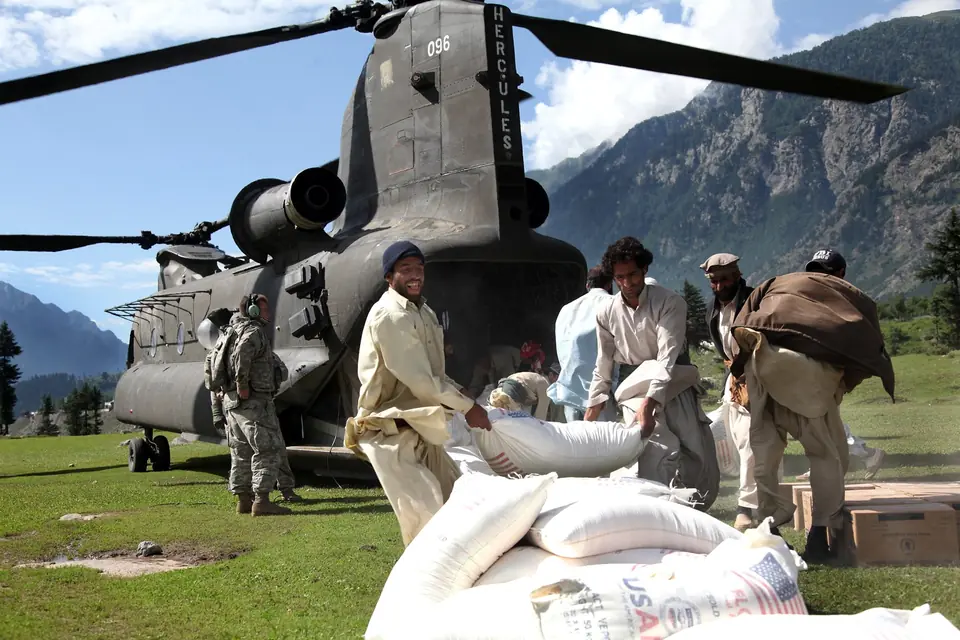
The United States responded with funding, supplies and military airlift. USAID deployed disaster experts and relief supplies in the first days3. US Army and Marine Corps helicopters began rescue and supply flights in the Swat valley and elsewhere in early August; by late August the Pentagon had pledged to double its helicopter presence, adding ten CH-47 Chinooks and eight UH-60 Black Hawks to the fifteen helicopters and three C-130 transport aircraft already deployed4,5. US assistance grew rapidly: by mid-October USAID had provided some $334 million for immediate needs, and the United States was described as the largest donor to the relief effort1,6.
Why it mattered
As in 2005, American helicopters delivering food and evacuating stranded families were visible in areas - including the Swat valley, recently cleared of Pakistani Taliban control - where anti-American sentiment ran high. US officials hoped the aid would improve perceptions; Pakistani officials thanked Washington, though some commentators argued that the international response as a whole was slow and insufficient for the scale of need.
Legacy
Reconstruction absorbed part of the Kerry–Lugar–Berman funding, slowing other projects. The experience fed into the much larger climate-related cooperation after the 2022 floods.
Sources
- Pakistan floods (Brookings briefing, 1 September 2010), Brookings Institution, 1 September 2010 · Scholarly
- Pakistan: Floods – Jul 2010, ReliefWeb (UN OCHA), 2010 · Reference
- USAID sends flood aid, relief experts to Pakistan, WaterWorld, August 2010 · Press
- More U.S. helicopters join Pakistan flood-relief effort, NBC News, August 2010 · Press
- DoD news release on flood relief (27 August 2010), GlobalSecurity.org (US Department of Defense), 27 August 2010 · Official
- US pledges flood aid to Pakistan, Voice of America, 2010 · Press
Next in The Long ArcThe Raymond Davis affair