Economy & aidThe post-9/11 partnership
Chinooks over Kashmir: the 2005 earthquake relief
When a 7.6-magnitude earthquake devastated northern Pakistan, US military helicopters became a lifeline for survivors in the mountains - and briefly changed how many Pakistanis saw America.
2 min read
Background
At 8.50 on the morning of 8 October 2005 a magnitude 7.6 earthquake struck Azad Jammu and Kashmir and the North-West Frontier Province (now Khyber Pakhtunkhwa). Muzaffarabad, Balakot and hundreds of mountain villages were flattened. The Pakistani government's official death toll exceeded 73,000, and an estimated 3.3 to 3.5 million people were left homeless as the Himalayan winter approached1.
What happened
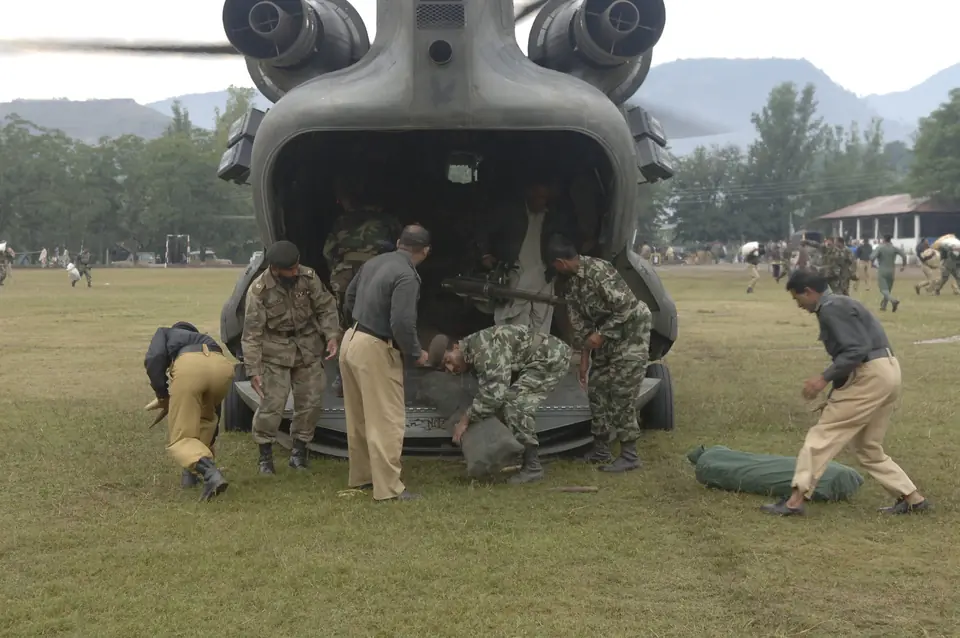
The United States responded quickly. Within about a day the US military had helped set up a disaster relief centre in Islamabad, and heavy-lift CH-47 Chinook and other helicopters were diverted from Afghanistan to reach villages cut off by landslides2,3. At the peak, more than 1,200 US personnel and two dozen helicopters provided transport, logistics, medical and engineering support; a US Army field hospital and Navy Seabees also deployed4.
Washington pledged $510 million for relief and reconstruction: $300 million in humanitarian and reconstruction aid, $110 million in military support for relief operations and at least $100 million expected from US private contributions4. USAID later signed a four-year, $200 million grant agreement for rebuilding schools and health facilities and restoring livelihoods4.
When the US military formally ended its mission on 30 March 2006, its helicopters had flown more than 4,000 relief missions and delivered over nine million kilograms of supplies in less than six months2. The Air Force reported that funds committed to the relief effort had nearly doubled as the operation went on5. The CRS reviewed the international and US response in early 20066.
Why it mattered
For many Pakistanis the sight of American helicopters flying food and tents into remote valleys - and evacuating injured villagers - offered a different image of the United States from the one shaped by the war next door. Pakistani officials publicly thanked the US for its help, and opinion surveys at the time recorded a temporary improvement in views of America3.
Legacy
The relief operation became a model for later disaster cooperation, notably during the 2010 and 2022 floods. It also showed the limits of goodwill created by aid: within a few years, controversies over drones and the war in Afghanistan had again overshadowed it.
Sources
- Pakistan: Earthquake: 2005/10/08, Asian Disaster Reduction Center · Reference
- US Military Ends Earthquake Relief Mission in Pakistan (VOA), GlobalSecurity.org, 30 March 2006 · Press
- Pakistan lauds US for help after massive earthquake, Stars and Stripes, 28 March 2006 · Press
- US earthquake assistance to Pakistan (Washington File, 19 November 2005), GlobalSecurity.org (US State Department Washington File), 19 November 2005 · Official
- Pakistan quake relief funds nearly double, US Air Force, 2005 · Official
- Pakistan earthquake: response (CRS RL33196), Congressional Research Service (via EveryCRSReport), 24 March 2006 · Official
Next in The Long ArcGeorge W. Bush’s overnight stay in Islamabad