Security & defenceStrains and embargoes
Ford lifts the ten-year arms embargo
Weeks after Bhutto's visit to Washington, the United States ended its ban on selling lethal weapons to Pakistan and India - for cash only.
1 min read
Announcement
Arms Embargo Lifted
Lethal equipment for Pakistan and India, for cash only
Announcement
Arms Embargo Lifted
Lethal equipment for Pakistan and India, for cash only
Background
Since September 1965 the United States had refused to sell lethal military equipment to India or Pakistan, with limited exceptions such as spare parts from 1967 and Nixon's one-time offer to Pakistan in 19701,2. Pakistan, whose arsenal was largely American, regarded the embargo as discriminatory in effect.
What happened
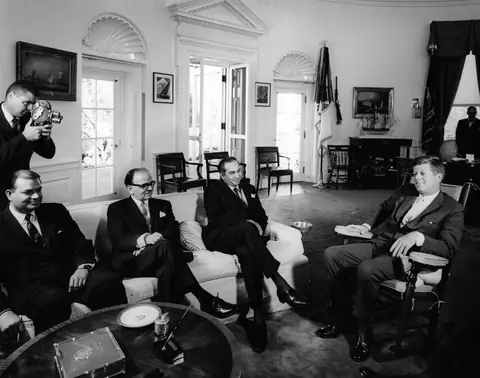
Prime Minister Bhutto visited Washington from 4 to 7 February 1975. He met President Ford at the White House on 5 February, and Ford hosted a state dinner in his honour that evening, at which he welcomed Bhutto as a true friend of America3,4,8. The joint statement spoke of establishing a personal relationship in the spirit of cooperation that had traditionally existed between the two countries' leaders3. On 24 February the administration announced that it was lifting the embargo on sales of lethal military equipment to Pakistan and India; sales would be made on a cash basis only, case by case5.
Reactions
India reacted sharply. Prime Minister Indira Gandhi said the decision would reopen old wounds and hinder normalisation with Pakistan, and her foreign minister postponed a visit to Washington5,6. Pakistan welcomed the decision, and according to US records Bhutto followed it with overtures to India to continue the process of normalisation begun at Simla in 19726.
Why it mattered
The lifting of the embargo closed a chapter that had begun with the 1965 war. But the cash-only terms limited what Pakistan could afford, and within a year American concern over Pakistan's nuclear plans would put new strains on the relationship7.
Sources
- Foreign Relations of the United States, 1969–1976, Volume E–7, Document 42: Analytical Summary Prepared for the National Security Council Review Group, Office of the Historian, US Department of State, 1969 · Primary document
- Foreign Relations of the United States, 1969–1976, Volume E–7, Document 83: Letter From President Nixon to Pakistani President Yahya, Office of the Historian, US Department of State, 15 October 1970 · Primary document
- Joint Statement Following Discussions With Prime Minister Bhutto of Pakistan, The American Presidency Project, UC Santa Barbara, February 1975 · Primary document
- ZA Bhutto in Washington, 1975, The Friday Times, 9 February 2018 · Press
- Foreign Relations of the United States, 1969–1976, Volume E–8, Document 193: National Security Decision Memorandum 289, Office of the Historian, US Department of State, February 1975 · Primary document
- Foreign Relations of the United States, 1969–1976, Volume E–8, Document 205, Office of the Historian, US Department of State, 1975 · Primary document
- The United States and Pakistan, 1947–2000: Disenchanted Allies (Dennis Kux), Woodrow Wilson Center Press / Johns Hopkins University Press, 2001 · Scholarly
- State dinner for Prime Minister Bhutto, 5 February 1975 (exhibit file), Gerald R. Ford Presidential Library and Museum, 5 February 1975 · Primary document
Next in The Long ArcKissinger in Lahore: aircraft for a reprocessing plant