Regional conflictKey momentThe alliance era
American arms for India shake the alliance
When China attacked India, Washington rushed weapons to New Delhi. To Pakistan, it looked like an ally arming its enemy.
2 min read
Background
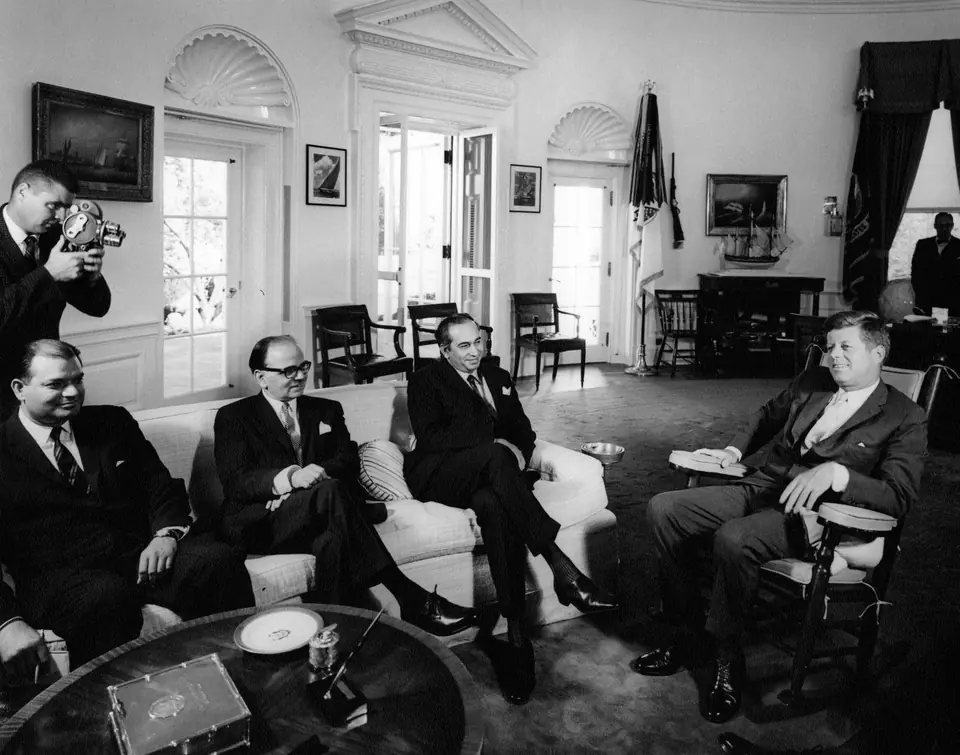
From the start of the alliance, Pakistan's leaders had feared that the United States would one day arm India. The Kennedy administration's interest in a closer relationship with New Delhi had already worried Ayub Khan in 19611. In October 1962, while the world's attention was fixed on the Cuban missile crisis, China launched an offensive against Indian positions along the disputed Himalayan border2.
What happened
Nehru appealed to Washington for urgent military help, and the United States and Britain began supplying infantry weapons and equipment. Kennedy took care to assure Ayub that American arms would be for India's immediate needs and for use against China only; Washington avoided sending heavier equipment that might be used against Pakistan2. China declared a ceasefire and withdrew in late November2.
Ayub was not reassured. In a letter delivered to Kennedy on 12 November 1962, he expressed alarm at India's military build-up with American and British equipment and pointed out that most Indian forces were concentrated on Pakistan's borders3. He argued that the situation was precisely the kind in which the United States had promised to consult Pakistan in advance before arming India3,4. Pakistani anger was intense; there was talk of leaving SEATO and CENTO5.
Kashmir diplomacy
Washington and London tried to use the moment to settle Kashmir. The US envoy Averell Harriman and the British minister Duncan Sandys visited New Delhi and Rawalpindi, and on 29 November 1962 Ayub and Nehru announced a renewed effort to resolve their differences6. Six rounds of ministerial talks between Zulfikar Ali Bhutto and Sardar Swaran Singh followed between December 1962 and May 19637. American records show that Ayub tied his tolerance of the emergency arms programme to India's attitude in those talks4. They ended without agreement7.
The China factor
On the eve of the first round, Pakistan announced an agreement in principle with China on their border, and on 2 March 1963 Bhutto and Chinese Foreign Minister Chen Yi signed the Sino-Pakistan boundary agreement. The State Department believed it had destroyed the slim prospects of the Kashmir talks8. In April 1964 Pakistan International Airlines began scheduled flights to China, the first airline of a non-communist country to do so9.
Different perspectives
For Pakistanis, 1962 confirmed that the alliance would not protect them against India and that an American partnership with India was a direct threat; it encouraged the turn towards China. For American officials, helping a democracy under Chinese attack was consistent with containment and did not betray Pakistan, which had joined the alliances against communism2,10. For India, Western help in its moment of crisis was welcome, but Western pressure over Kashmir was resented7.
Legacy
Many historians date the decline of the alliance to these months. Pakistan's diplomacy began to balance Washington with Beijing, a shift that would later make Pakistan the channel for the American opening to China10.
Sources
- When JFK hosted Pakistan's president at Mount Vernon (Bruce Riedel), Brookings Institution, 6 July 2021 · Scholarly
- JFK's Overshadowed Crisis, The National Interest · Scholarly
- Foreign Relations of the United States, 1961–1963, Volume XIX, Document 228: Letter From President Ayub to President Kennedy, Office of the Historian, US Department of State, November 1962 · Primary document
- Foreign Relations of the United States, 1961–1963, Volume XIX, Document 234: Telegram From the Embassy Office in Pakistan to the Department of State, Office of the Historian, US Department of State, December 1962 · Primary document
- US-India-Pak: Tired Nehru, Wily Ayub, Distracted Kennedy, Angry Indira, The Quint · Press
- Talks with W. Averell Harriman (30 November 1962), Nehru Archive, 30 November 1962 · Primary document
- India and Pakistan's surprisingly successful negotiations, Foreign Policy · Press
- Sino-Pakistan Agreement, Wikipedia · Reference
- 1964 in Pakistan, Wikipedia · Reference
- The United States and Pakistan, 1947–2000: Disenchanted Allies (Dennis Kux), Woodrow Wilson Center Press / Johns Hopkins University Press, 2001 · Scholarly
Next in The Long ArcWar with India, and an American embargo