Security & defenceThe sanctions years
The Gates mission and the Kashmir crisis of 1990
As troops massed and an uprising spread in Kashmir, the Bush administration sent Robert Gates to Islamabad and New Delhi to head off a war that some feared could turn nuclear.
1 min read
Islamabad · New Delhi, May 1990
Islamabad · New Delhi, May 1990
Background
In early 1990 an armed uprising spread across the Kashmir valley. India accused Pakistan of arming and training militants; Pakistan described the revolt as an indigenous struggle and offered political support. Troop movements on both sides and sharp rhetoric raised fears in Washington of a fourth India–Pakistan war5, this time between two states thought to be capable of assembling nuclear weapons1,2.
What happened
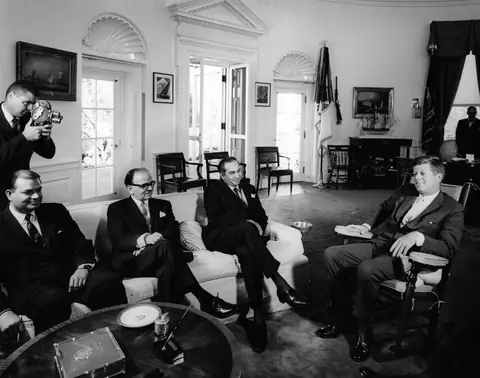
The Bush administration sent Deputy National Security Adviser Robert Gates to the region. He arrived in Islamabad on 20 May 1990 and went on to New Delhi2,3. According to accounts of the mission, Gates told Pakistani leaders that a war would not stay confined to Kashmir, that US analyses expected Pakistan to lose, and that Pakistan should not count on American support; he urged Pakistan to stop supporting militancy in Kashmir and to tone down its rhetoric, and pressed both sides to adopt confidence-building measures, offering US help to verify troop pullbacks3,4. Tensions eased in the following weeks.
Contested memories
The nuclear dimension of the crisis became public only years later, notably through press reports in 1993, and it remains disputed. Some American accounts present the Gates mission as having averted a nuclear confrontation. Indian participants have generally rejected this, describing US alarm as exaggerated, and a joint study by Indian, Pakistani and American scholars characterised 1990 as a ‘compound crisis’ in which perceptions on each side diverged sharply2,4. Pakistani officials denied any intention of using nuclear weapons.
Why it mattered
The crisis showed that, even as the Cold War alliance unwound, the United States would remain the outside power most engaged in managing India–Pakistan crises - a role it played again in 1999 and after. It also deepened Washington’s conviction that Pakistan’s nuclear programme had advanced, months before the Pressler certification was withheld1.
Sources
- Nuclear Issue Strains US-Pakistan Ties, The Christian Science Monitor, 5 July 1990 · Press
- Review: Perception, Politics and Security in South Asia: The Compound Crisis of 1990, Institute of Peace and Conflict Studies (IPCS), New Delhi · Scholarly
- When Bob Gates came calling, Siddharth Varadarajan (blog of the Indian journalist), 10 November 2006 · Press
- How the US helped avert a nuclear war between India and Pakistan in 1990, The EurAsian Times · Press
- India, Pakistan were on the brink of war on Kashmir in 1990?, Kashmir Life · Press
Next in The Long ArcNo certificate: Pressler sanctions take effect