Regional conflictKey momentThe sanctions years
Kargil and the Fourth of July at Blair House
With Pakistani forces entrenched across the Line of Control and fears of escalation between two new nuclear powers, Nawaz Sharif flew to Washington and agreed to steps to restore the line.
2 min read
Kargil, July 1999
on the Line of Control
34° 34′ N · 76° 08′ E
Kargil, July 1999
on the Line of Control
34° 34′ N · 76° 08′ E
Background
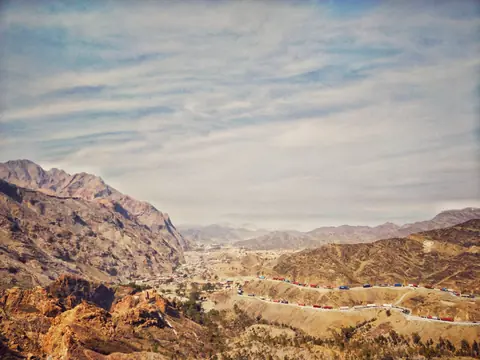
In February 1999 Prime Minister Atal Bihari Vajpayee travelled by bus to Lahore, and he and Sharif signed a declaration committing their governments to dialogue. Within weeks, however, Pakistani soldiers and militants had occupied high ground across the Line of Control (LoC) in the Kargil sector of Indian-administered Kashmir. India discovered the incursion in early May and launched a military and air campaign to dislodge the intruders, who included regular Pakistani army troops1. Fighting at altitudes of around 5,000 metres killed several hundred combatants on each side1.
The diplomacy
Pakistan’s foreign minister, Sartaj Aziz, visited New Delhi on 12 June without result, and international pressure for Pakistan to withdraw behind the LoC mounted1. The United States, determined to prevent a wider war between countries that had tested nuclear weapons a year earlier, pressed Pakistan publicly and privately to pull back, and declined to reward the incursion with the international mediation on Kashmir that Pakistan sought2,3.
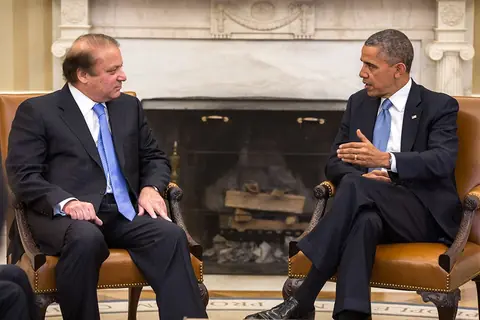
Facing military pressure and isolation, Sharif asked to come to Washington. Clinton agreed to meet him at Blair House, opposite the White House, on 4 July 1999 - the US Independence Day holiday10. Bruce Riedel, then the National Security Council’s senior director for South Asia and the only other American present for the private talks, later wrote that Sharif arrived with his family, fearing for his position at home2,4. According to Riedel, Clinton warned of the dangers of escalation, including US concern about Pakistani nuclear preparations, and insisted on withdrawal before anything else2,4.
The agreement
The joint statement issued after about three hours of talks said the two leaders agreed that the fighting was dangerous and contained the seeds of a wider conflict, that the LoC must be respected in accordance with the 1972 Simla Agreement, and that concrete steps would be taken to restore the LoC. Clinton urged an immediate cessation of hostilities once those steps were taken, and the leaders agreed that the bilateral dialogue begun at Lahore was the best forum for resolving all issues, including Kashmir. Clinton also said he would take a personal interest in encouraging that dialogue once the LoC was restored5,6. On 11 July Sharif announced the withdrawal; sporadic fighting continued after India’s 16 July deadline1.
Perspectives
In India, US pressure on Pakistan during Kargil was seen as a turning point that opened the way to closer US–India relations3. In Pakistan the withdrawal was widely regarded as a humiliation. Sharif and the army blamed each other: Sharif later said he had not been properly informed of the operation, while political rivals and some officers insisted he had been briefed on several occasions7,8. The Pakistani journalist Nasim Zehra’s study of the episode traces how it deepened the rift between the civilian government and the army9.
Why it mattered
Kargil was the first crisis between nuclear-armed India and Pakistan, and the Blair House meeting became a model for US crisis diplomacy in South Asia. It also set in motion the breakdown between Sharif and his army chief, General Pervez Musharraf, that ended with the coup of 12 October 1999.
Sources
- Kargil War, Encyclopaedia Britannica · Reference
- American Diplomacy and the 1999 Kargil Summit at Blair House (Bruce Riedel), in Asymmetric Warfare in South Asia, Cambridge University Press, 2009 · Scholarly
- How the 1999 Kargil conflict redefined US-India ties, Brookings Institution · Scholarly
- The story of how Nawaz Sharif pulled back from nuclear war, Foreign Policy, 14 May 2013 · Press
- Joint Statement by President Clinton and Prime Minister Sharif of Pakistan, 4 July 1999, The White House (Clinton administration archive), 4 July 1999 · Primary document
- Joint Statement With Prime Minister Nawaz Sharif of Pakistan on the Situation in Kashmir, The American Presidency Project, UC Santa Barbara, 4 July 1999 · Primary document
- Dawn report: Shujaat disputes Sharif’s Kargil claim, Dawn · Press
- Clinton adviser: confusion gripped Islamabad during Kargil crisis, Dawn · Press
- Book Review: From Kargil to the Coup (Nasim Zehra, Sang-e-Meel, 2018), Newsline · Press
- Background Briefing on Meeting with Prime Minister Sharif, 4 July 1999, The White House (Clinton administration archive), 4 July 1999 · Primary document
Next in The Long ArcThe October 1999 coup and a third layer of sanctions