DiplomacyThe sanctions years
Sharif in Washington: waivers, a test-ban pledge and an end to the F-16 saga
Six months after the tests, Nawaz Sharif’s visit brought partial sanctions relief, a Pakistani commitment on the test-ban treaty and, weeks later, a settlement for the undelivered F-16s.
2 min read
Dateline
Washington
District of Columbia, United States
38° 54′ N · 77° 02′ W
Dateline
Washington
District of Columbia, United States
38° 54′ N · 77° 02′ W
Background
By late 1998 Pakistan’s economy was under severe strain from the nuclear sanctions and its own financial difficulties, and it needed an International Monetary Fund programme that required US support. Washington wanted Pakistani commitments on the Comprehensive Test Ban Treaty (CTBT), fissile material and export controls - the agenda of the Talbott talks that followed the tests1.
What happened
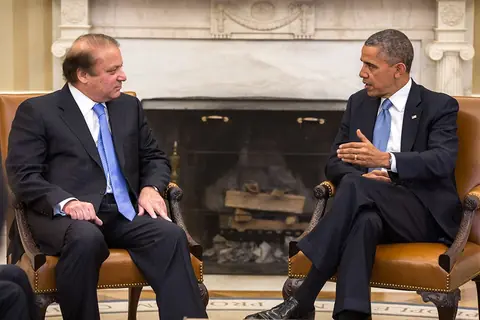
On 1 December 1998, using authority granted by Congress in October, President Clinton signed a waiver of some of the sanctions imposed after the tests until 21 October 1999. It opened the way to US lending and investment programmes, military training and US backing for a $5.5 billion IMF-led rescue package for Pakistan2. Sharif visited Washington from 1 to 4 December and met Clinton for talks and lunch at the White House on 2 December3,4. Their joint statement stressed the long friendship between the two countries; nonproliferation was the main item on the agenda, and Clinton welcomed Sharif’s decision to adhere to the CTBT by September 1999, a commitment Sharif reaffirmed3. White House officials described the meeting as very warm and positive5.
The F-16 settlement
The visit also unlocked the oldest grievance in the relationship. Clinton had pledged an early and fair resolution of the F-16 dispute, and later in December the two governments announced a settlement6,7. Pakistan had paid $658 million for the 28 aircraft; the United States, which had already reimbursed $157 million, agreed to pay $326.9 million, mostly from the Treasury’s Judgment Fund, and to provide goods worth a further $140 million, including $60 million in wheat6.
Perspectives
In Pakistan the settlement was welcomed as overdue justice, though many felt it was less than full compensation for an eight-year wait. In Washington, nonproliferation advocates questioned the speed with which post-test sanctions were being eased, while the administration argued that engagement was the best route to restraint1.
Why it mattered
The visit marked a brief high point in Clinton’s dealings with Sharif. The CTBT pledge was never fulfilled: the treaty stalled after the US Senate rejected ratification in October 1999, and within months the Kargil crisis and the October coup overtook the agenda.
Sources
- Confrontation and Retreat: The U.S. Congress and the South Asian Nuclear Tests, Arms Control Association (Arms Control Today), January 2000 · Scholarly
- Clinton waives some sanctions on India and Pakistan (news report, 2 December 1998), GlobalSecurity.org (news archive), 3 December 1998 · Press
- Joint Statement from Pakistan and the United States, 4 December 1998, The White House (Clinton administration archive), 4 December 1998 · Primary document
- Memorandum of Conversation: Meeting with Prime Minister Nawaz Sharif, 2 December 1998, William J. Clinton Presidential Library, 2 December 1998 · Primary document
- Press Briefing on Pakistan Prime Minister Visit, 2 December 1998, The White House (Clinton administration archive), 2 December 1998 · Primary document
- U.S. to Repay Pakistan for Undelivered F-16s, Arms Control Association (Arms Control Today), 1998 · Press
- Statement by the Press Secretary on Pakistani F-16s, 21 December 1998, The White House (Clinton administration archive), 21 December 1998 · Primary document
Next in The Long ArcKargil and the Fourth of July at Blair House