Security & defenceThe sanctions years
US cruise missiles cross Pakistan to strike bin Laden’s camps
After the East Africa embassy bombings, the United States fired cruise missiles at camps in Afghanistan across Pakistani airspace, telling Pakistan’s army chief only as the missiles flew.
2 min read
Background
On 7 August 1998 al-Qaeda bombed the US embassies in Nairobi and Dar es Salaam, killing more than 200 people. US investigators quickly linked the attacks to Osama bin Laden, who had been living in Afghanistan under the protection of the Taliban since 19961,2. Pakistan was one of only three countries that recognised the Taliban government, and its intelligence services maintained close links with the movement3.
What happened
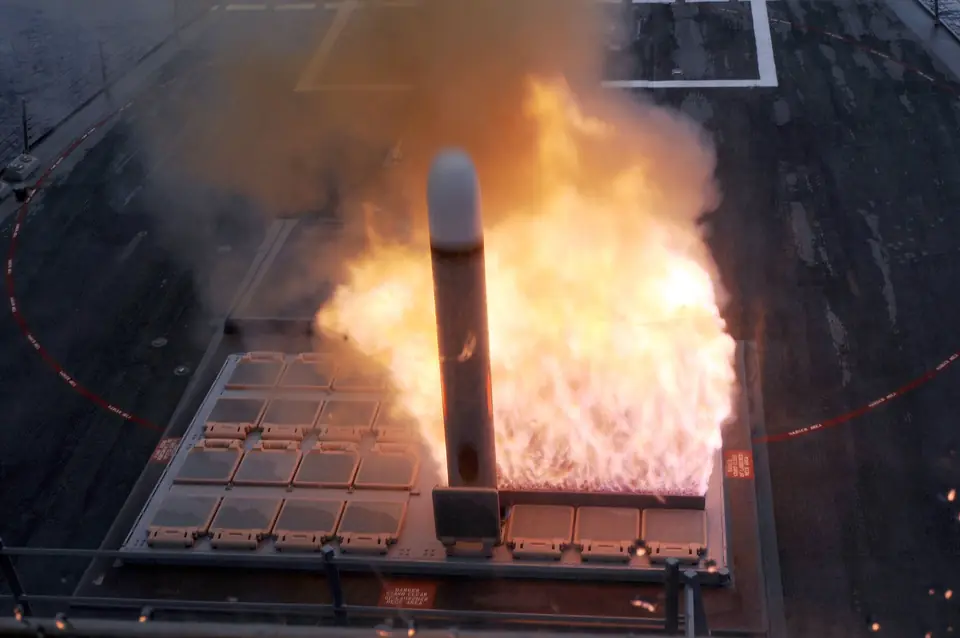
On 20 August 1998 US Navy ships in the Arabian Sea fired cruise missiles at camps near Khost in eastern Afghanistan and at a pharmaceutical plant in Khartoum, Sudan7. In an address to the nation, President Clinton said the target was the network of radical groups affiliated with and funded by bin Laden1.
The missiles’ route to Afghanistan lay across Pakistan. Washington feared that warning Islamabad in advance might allow the targets to be tipped off, but also that Pakistan might mistake missiles in its airspace for an Indian attack, only three months after both countries had tested nuclear weapons. The solution, as Clinton later described it, was to send General Joseph Ralston, vice-chairman of the Joint Chiefs of Staff, to dine with Pakistan’s army chief, General Jehangir Karamat, and inform him as the missiles entered Pakistani airspace4.
Pakistan’s reaction
The strikes took Pakistan’s military by surprise4,5. Pakistan said one missile had come down on its territory, killing several people, and lodged a protest; a US diplomat suggested a technical error6. Militants killed in the strikes reportedly included Pakistanis training for operations in Kashmir, which embarrassed Islamabad and fuelled anti-American feeling5. Bin Laden was not at the camps.
Why it mattered
The strikes marked the point at which terrorism emanating from Afghanistan became a central issue in US–Pakistan relations. Over the following three years Washington repeatedly pressed Pakistan to use its influence with the Taliban to hand over bin Laden, with little result2,3. The episode also showed how the nuclear tests had changed military planning in the region: even a limited US operation had to account for the risk of being misread by a nuclear-armed Pakistan.
Sources
- Address to the Nation on Military Action Against Terrorist Sites in Afghanistan and Sudan, 20 August 1998, The White House (Clinton administration archive), 20 August 1998 · Primary document
- Ghost Wars: The Secret History of the CIA, Afghanistan, and Bin Laden, from the Soviet Invasion to September 10, 2001 (Steve Coll), Penguin Press, 2004 · Scholarly
- Pakistan, scene of Afghan resolve, The Christian Science Monitor, 15 November 1999 · Press
- Dawn report on the Ralston–Karamat dinner during the 1998 strikes, Dawn · Press
- The Tribune (Chandigarh), world news, 23 August 1998, The Tribune, 23 August 1998 · Press
- RFE/RL report on Pakistan’s protest over a stray US missile, Radio Free Europe/Radio Liberty, August 1998 · Press
- Missile Attacks on Afghanistan and Sudan (1998), EBSCO Research Starters · Reference
Next in The Long ArcSharif in Washington: waivers, a test-ban pledge and an end to the F-16 saga