Security & defenceKey momentThe post-9/11 partnership
Abbottabad: bin Laden is killed in a garrison town
A US special forces raid without Pakistan’s knowledge killed Osama bin Laden near the Pakistan Military Academy, triggering recriminations on both sides.
2 min read
Background
After escaping from Afghanistan in late 2001, bin Laden disappeared. US intelligence eventually traced a courier to a large walled compound in Abbottabad, a garrison town north of Islamabad and home of the Pakistan Military Academy. Fearing a leak, the Obama administration decided not to inform Pakistan.
What happened
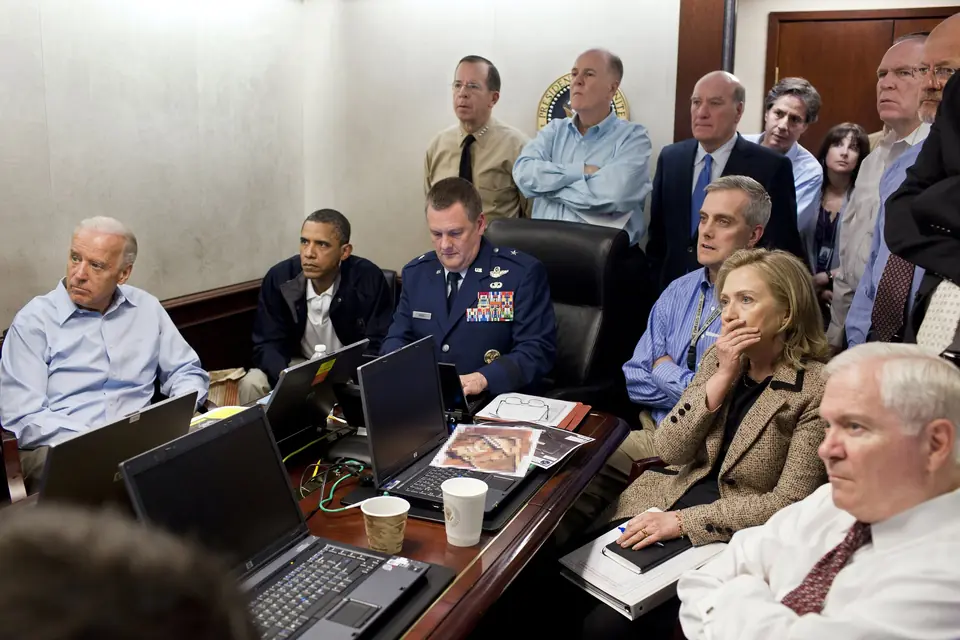
US Navy SEALs flown by helicopter from Afghanistan raided the compound in the early hours of 2 May 2011, Pakistan time - the evening of 1 May in Washington - killing bin Laden and several others1,2. President Obama announced the operation in a late-night televised address, saying that counter-terrorism cooperation with Pakistan had helped lead the United States to the compound, while making clear that the raid itself was American2.
Pakistan's Foreign Office expressed deep concern at the operation's having been carried out without prior information or authorisation, described it as an unauthorised unilateral action that could not be taken as a rule, and categorically denied reports that its civil or military leadership had known in advance3,4. Pakistani officials said the ISI had shared information about the area with the CIA since 20093. In the United States, members of Congress demanded to know whether elements of the Pakistani state had sheltered bin Laden and questioned continued aid; the CRS summarised the intense scrutiny the revelations brought6.
The Abbottabad Commission
Pakistan appointed a judicial commission under Justice Javed Iqbal. Its report, submitted in January 2013 but never officially released, was published by Al Jazeera in July 2013. It found culpable negligence and incompetence at almost all levels of government, documented missed opportunities by local agencies to inspect the compound, and also criticised the US raid as an act of war against Pakistan5,7. It found no evidence of official complicity, though it did not rule out that individuals had helped.
Why it mattered
For Americans, the discovery of bin Laden in a military town deepened doubts about Pakistan as a partner. For Pakistanis, the raid was a humiliating violation of sovereignty that also exposed the military to rare domestic criticism. The fact that a Pakistani doctor, Shakil Afridi, had run a fake vaccination campaign for the CIA to gather DNA added to mistrust and harmed polio vaccination efforts5.
Legacy
Cooperation was curtailed for months, and relations reached their nadir later that year after the Salala incident. The raid remains a defining memory in both countries, recalled in Washington as a triumph and in Pakistan as a breach of trust.
Sources
- May 1, 2011 (Obama White House archive page on the death of Osama bin Laden), The White House (Obama archives), 1 May 2011 · Primary document
- Text of President Obama’s announcement, Voice of America, 1 May 2011 · Primary document
- Pakistan criticizes US raid on bin Laden, Bangor Daily News (AP), 3 May 2011 · Press
- Pakistani Foreign Office issues longer statement after bin Laden raid, Newsline, May 2011 · Press
- Was Pakistan complicit in Bin Laden case?, Al Jazeera, 9 July 2013 · Press
- Pakistan-U.S. Relations: A Summary (CRS R41832, May 2011), Congressional Research Service (via EveryCRSReport), 16 May 2011 · Official
- Leaked Osama bin Laden report accuses Pakistani officials of ‘gross incompetence’, ABC News, July 2013 · Press
Next in The Long ArcSalala: 24 soldiers killed, supply lines cut