DiplomacyThe Afghan decade
Benazir Bhutto addresses Congress
Six months after becoming the first woman elected to lead a Muslim-majority state, Benazir Bhutto came to Washington to argue that democratic Pakistan deserved continued American support.
2 min read
Background
In elections on 16 November 1988, the first openly contested polls in more than a decade, Benazir Bhutto’s Pakistan People’s Party won the largest bloc of seats, and she was sworn in as prime minister on 2 December, the first woman to head the government of a Muslim-majority state in modern times1. Educated at Harvard’s Radcliffe College and at Oxford, she was well known in Washington; her father, Zulfikar Ali Bhutto, had been executed under Zia in 19791.
What happened
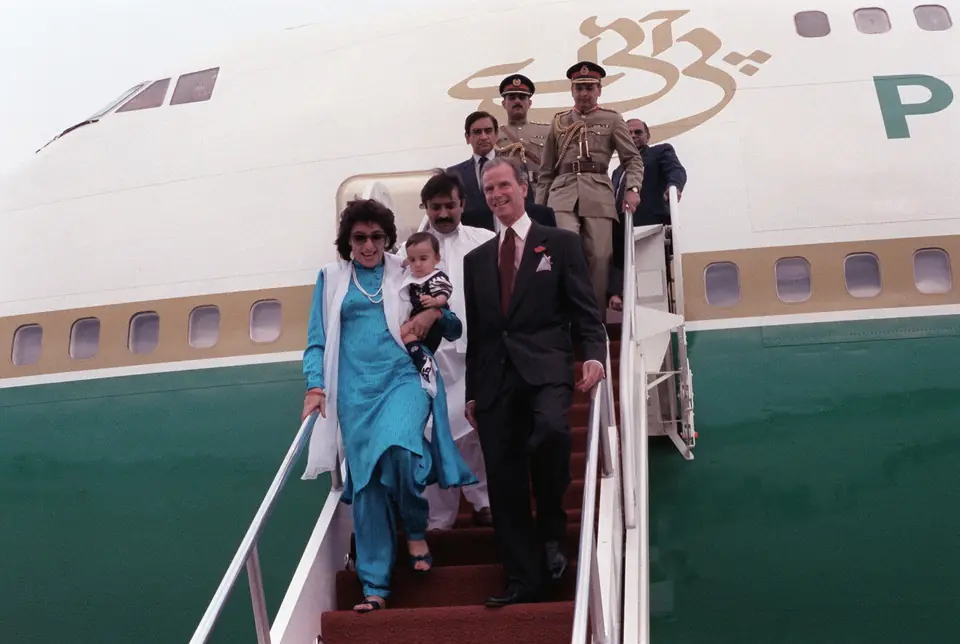
Bhutto made an official visit to the United States in June 19892. President George H. W. Bush welcomed her at the White House on 6 June3. On 7 June she addressed a joint meeting of Congress4. She asked for continued American support for the Afghan resistance after the Soviet withdrawal and presented Pakistan’s return to democracy as a reason for the United States to stand by it4. On the nuclear issue she told Congress that Pakistan did not possess, and did not intend to make, a nuclear device5. During the trip she also visited Boston, where she gave the commencement address at Harvard and received an honorary degree, and New York2,6.
The nuclear background
The visit took place under the shadow of the Pressler certification. According to a later account by the journalist Emily MacFarquhar, the director of central intelligence, William Webster, gave Bhutto an unusual briefing on what the United States knew about Pakistan’s nuclear programme5. Bhutto’s position at home was constrained: the army and President Ghulam Ishaq Khan retained control of the nuclear programme and of Afghan policy. Washington, for its part, moved forward with plans for a further sale of F-16 aircraft5.
Perspectives
In Washington the speech was widely praised, and Bhutto was celebrated as a symbol of democratic renewal in the Muslim world. In Pakistan, her opponents accused her of seeking American favour, while supporters saw the visit as restoring Pakistan’s international standing after the Zia years. Analysts at the time urged the Bush administration to use the visit to press both for democracy and for nuclear restraint7.
Legacy
The address was a high point for the relationship at the end of the Afghan decade. Within eighteen months Bhutto had been dismissed by the president and US aid had been cut off under the Pressler Amendment.
Sources
- Benazir Bhutto (Britannica 100 Women Trailblazers), Encyclopaedia Britannica · Reference
- Pakistan – Visits by Foreign Leaders, Office of the Historian, US Department of State · Official
- Remarks at the Welcoming Ceremony for Prime Minister Benazir Bhutto of Pakistan, George H. W. Bush Presidential Library, 6 June 1989 · Primary document
- Benazir Bhutto: Address to a Joint Meeting of the US Congress, American Rhetoric, 7 June 1989 · Primary document
- Benazir and the Bomb, Alicia Patterson Foundation (Emily MacFarquhar) · Press
- Harvard Magazine on Benazir Bhutto’s 1989 Commencement address, Harvard Magazine · Press
- What Bush Should Tell Pakistan's Bhutto, The Heritage Foundation, 1989 · Scholarly
Next in The Long ArcThe Gates mission and the Kashmir crisis of 1990