Regional conflictThe Afghan decade
The last Soviet soldier leaves Afghanistan
General Boris Gromov’s walk across the Friendship Bridge on 15 February 1989 ended the Soviet occupation - and with it the strategic logic of the US–Pakistan partnership of the 1980s.
1 min read
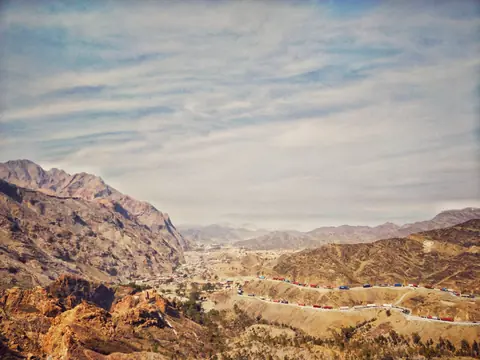
Friendship Bridge, February 1989
on the Amu Darya, Afghanistan’s northern border
37° 14′ N · 67° 25′ E
Friendship Bridge, February 1989
on the Amu Darya, Afghanistan’s northern border
37° 14′ N · 67° 25′ E
What happened
The withdrawal set out in the Geneva Accords began in May 1988. On 15 February 1989 Lieutenant-General Boris Gromov, commander of the Soviet 40th Army, crossed the Friendship Bridge over the Amu Darya near Termez, the last Soviet soldier to leave Afghanistan after more than nine years of occupation1,2,7. The war had cost the Soviet Union about 15,000 soldiers’ lives, and Afghans incomparably more1.
In Islamabad, the CIA station chief marked the moment with a cable to headquarters: “We won”3.
A war that did not end
The Soviet exit did not bring peace. The government of Mohammad Najibullah in Kabul, still supplied by Moscow, survived for three more years, and the United States and Pakistan continued to arm the mujahideen under the principle of ‘positive symmetry’4. A mujahideen offensive on Jalalabad in the spring of 1989, planned with Pakistani support, failed, and the resistance parties remained divided.
Why it mattered
For the United States, the withdrawal achieved the central aim of its Afghan policy. But it also removed the main reason for overlooking Pakistan’s nuclear programme. Within eighteen months President Bush would decline to make the Pressler certification, and most US aid to Pakistan would stop. Many Pakistanis came to see this sequence as abandonment by an ally whose usefulness had expired, a view expressed widely in Pakistani commentary on the period5. US officials responded that the law, not a change of heart, had forced the outcome, and that Pakistan had been warned for years6.
Legacy
The pattern - close cooperation driven by a shared adversary, followed by estrangement once the adversary was gone - has become the dominant theme in histories of the relationship6. It also left Afghanistan to a civil war in which Pakistan remained deeply involved and from which the Taliban would eventually emerge.
Sources
- Afghanistan and the Soviet Withdrawal 1989: 20 Years Later, National Security Archive, 15 February 2009 · Primary document
- Soviet forces withdrawal from Afghanistan, Presidential Library named after B. N. Yeltsin · Reference
- What We Won: America's Secret War in Afghanistan, 1979–89 (Bruce Riedel), Brookings Institution Press, 2014 · Scholarly
- Afghanistan: The U.S. Role in the Approaching Endgame, The Heritage Foundation · Scholarly
- The cat-and-mouse game of US sanctions on nuclear Pakistan, Dawn · Press
- The United States and Pakistan, 1947–2000: Disenchanted Allies (Dennis Kux), Woodrow Wilson Center Press / Johns Hopkins University Press, 2001 · Scholarly
- Afghanistan and the Soviet Withdrawal 1989 – 20 Years Later, Voice of America, 2009 · Press
Next in The Long ArcBenazir Bhutto addresses Congress