MultilateralKey momentRecalibration
The Doha agreement: a timetable to leave Afghanistan
The United States and the Taliban signed a deal setting out a 14-month withdrawal; Pakistan, which had helped bring the Taliban to the table, attended as a witness to the ceremony.
2 min read
Background
Direct US–Taliban talks began in earnest in 2018 under the special representative Zalmay Khalilzad. Pakistan's influence over the Taliban leadership, much of which had long lived in Pakistan, made its cooperation essential. In October 2018 Pakistan released Mullah Abdul Ghani Baradar, a Taliban co-founder detained in Karachi since 2010; Khalilzad later said the release had been at his request because Baradar was seen as favouring a settlement4. Baradar went on to lead the Taliban's negotiating team in Doha.
What happened
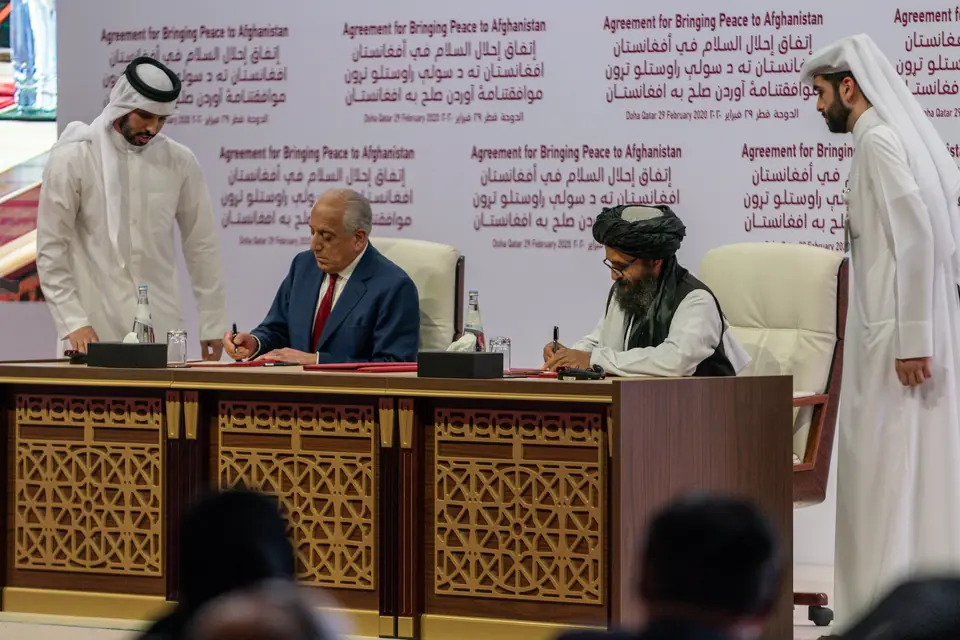
The agreement was signed in Doha on 29 February 2020 by Khalilzad and Baradar, with Secretary of State Mike Pompeo present1,2. Its four parts covered Taliban guarantees that Afghan soil would not be used by any group to threaten the security of the United States and its allies; a timetable for the withdrawal of all foreign forces; intra-Afghan negotiations; and a permanent ceasefire to be discussed in those negotiations. The United States committed to reduce its forces to 8,600 within 135 days and to withdraw all forces within fourteen months if the Taliban met their commitments1,2. The Afghan government was not a party.
Pakistan's Foreign Minister Shah Mehmood Qureshi attended the signing at Qatar's invitation; Prime Minister Imran Khan had visited Doha in the preceding days, and Islamabad described the agreement as a milestone it had helped to make possible3,5. Qatar's foreign ministry, as host, published its own account of the ceremony6.
Pakistan's part
Pakistani officials had argued for years that there was no military solution in Afghanistan and that Washington should talk to the Taliban; American officials had in turn long pressed Pakistan to use its influence to bring the movement to the table. In 2018–20 those positions converged. Islamabad facilitated travel and contacts for Taliban negotiators and kept up pressure on the leadership to engage, while maintaining that it did not control the movement. US officials publicly thanked Pakistan for its role during the talks, and the warmer tone of the July 2019 White House visit was closely tied to that cooperation2,4.
Why it mattered
For Pakistan the agreement validated its long-standing argument that the war could only end through negotiation and showed the value of its role. For the United States it opened the way to ending its longest war, but critics argued that it gave the Taliban legitimacy and US withdrawal without securing a political settlement.
Legacy
Intra-Afghan talks began in September 2020 but made little progress. President Biden decided in April 2021 to complete the withdrawal by September, and the Taliban took Kabul in August 2021. Pakistan's role in the process is viewed in sharply different ways: in Pakistan as constructive facilitation, and among many Afghan and some American critics as support for the Taliban's return.
Sources
- Agreement for Bringing Peace to Afghanistan (text), PA-X Peace Agreements Database, University of Edinburgh, 29 February 2020 · Primary document
- What to know about the Afghan peace negotiations, Council on Foreign Relations, 2020 · Scholarly
- FM Qureshi to represent Pakistan tomorrow in signing of US-Taliban peace deal in Qatar, Business Recorder, 28 February 2020 · Press
- Assessing claims that Trump freed the leader of Afghanistan from prison in 2018, The Dispatch, 2021 · Press
- Pakistan’s Imran Khan holds talks with Qatari emir in Doha, Al Jazeera, 28 February 2020 · Press
- Agreement for Bringing Peace to Afghanistan signed under auspices of the State of Qatar, Ministry of Foreign Affairs, Qatar, 29 February 2020 · Official
Next in The Long ArcThe war ends: America leaves Afghanistan