Security & defenceKey momentThe alliance era
The alliance is signed in Karachi
A Mutual Defense Assistance Agreement opened the way for a decade of American weapons, training and money for Pakistan's armed forces.
2 min read
Background
Pakistan inherited a share of British India's army but very little of its equipment or industrial base. Its leaders, above all the army commander General Ayub Khan and the defence secretary Iskander Mirza, had pressed Washington for a full military assistance programme for several years1. The breakthrough came with President Eisenhower's announcement of 25 February 1954 that the United States would provide military aid2.
What happened
The Mutual Defense Assistance Agreement was signed in Karachi on 19 May 1954 by the US chargé d'affaires and Pakistan's foreign minister, and entered into force the same day. Announcing it, the State Department said the United States would provide Pakistan with military equipment and training assistance3. The agreement was registered in the US treaty series as 5 UST 852 (TIAS 2976)3,4.
As with other American military aid agreements of the period, the equipment came with conditions on its use, tied to self-defence and collective security; Pakistan undertook not to use it for aggression. How those conditions applied to a conflict with India was a question the two governments would later answer differently5.
What followed
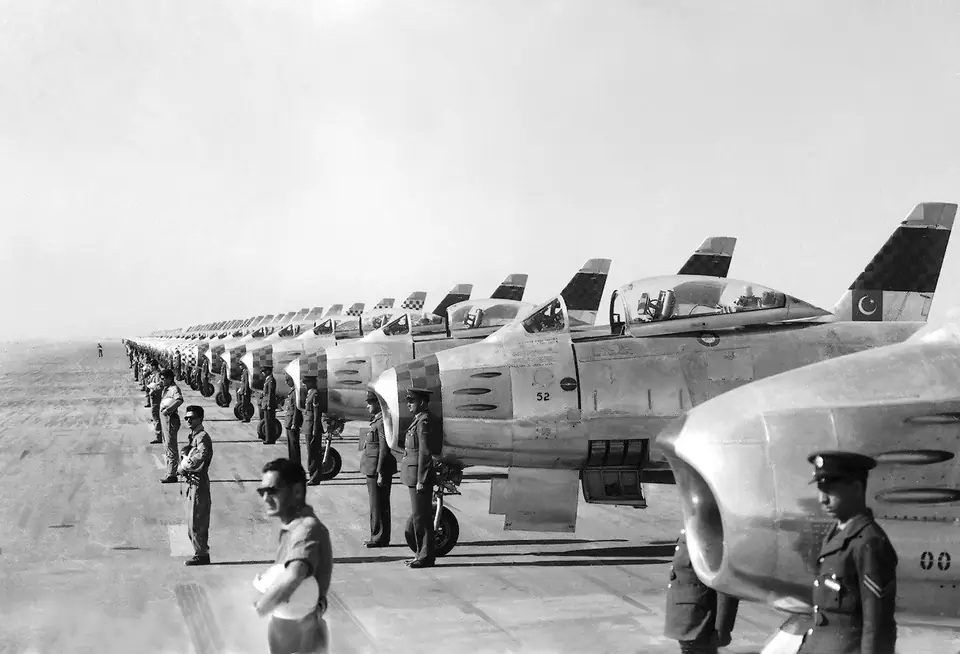
Over the next decade the agreement became the channel for a large programme of grant military aid. The Pakistan army received American Patton tanks, artillery and vehicles, and the air force was re-equipped with jet fighters including F-86 Sabres and, later, F-104 Starfighters6. Estimates of total US military aid between 1954 and the mid-1960s vary; figures of around $700 million are commonly cited, while some Pakistani accounts give higher totals7,6. American advisers and training programmes also shaped a generation of Pakistani officers.
Different perspectives
For Pakistan the agreement offered security against a larger India and the means to build modern armed forces. For the United States it was part of a worldwide system of alliances against communist expansion. India regarded it as a threat, and Prime Minister Nehru saw it as importing the Cold War into South Asia5. These differing understandings of what the aid was for - defence against communism, or a balance against India - would collide in 1965, when Pakistan used American equipment in its war with India and the United States suspended assistance5.
Legacy
The 1954 agreement remains the legal foundation of US–Pakistan defence cooperation and the starting point of the relationship between the two countries' militaries, which has often outlasted political strains between their governments5.
Sources
- How the US-Pakistan military alliance was born, The Friday Times, 13 December 2019 · Press
- Statement by the President on Military Aid to Pakistan, The American Presidency Project, UC Santa Barbara, 25 February 1954 · Primary document
- Foreign Relations of the United States, 1952–1954, Volume XI, Part 2, Editorial Note (Mutual Defense Assistance Agreement), Office of the Historian, US Department of State · Primary document
- Mutual defense assistance agreement between the United States of America and Pakistan (catalogue record), UNT Libraries, Monthly Catalog of US Government Publications, 1954 · Official
- The United States and Pakistan, 1947–2000: Disenchanted Allies (Dennis Kux), Woodrow Wilson Center Press / Johns Hopkins University Press, 2001 · Scholarly
- Our on-off relationship, Defence Journal (Pakistan), 10 May 2018 · Press
- United States aid to Pakistan, Wikipedia · Reference
Next in The Long ArcPakistan signs the Manila Pact