DiplomacyThe post-9/11 partnership
Elections end the Musharraf era
After Benazir Bhutto’s assassination, the February 2008 elections brought a civilian coalition to power; within months Musharraf had resigned and Asif Ali Zardari had become president.
2 min read
Background
By 2007 Musharraf's position had weakened. His attempt to dismiss the Chief Justice set off a lawyers' movement, and in November he declared a state of emergency. Washington, worried about instability, encouraged a power-sharing arrangement under which Benazir Bhutto would return from exile and contest elections while Musharraf gave up his army command3. Bhutto returned in October 2007; on 27 December she was killed in a gun and suicide-bomb attack after a rally in Rawalpindi3.
What happened
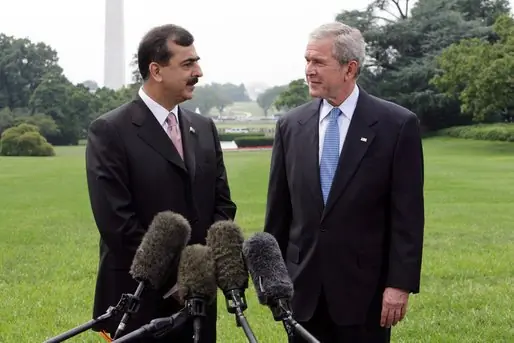
Elections went ahead on 18 February 2008. The Pakistan Peoples Party (PPP), now led by Bhutto's widower Asif Ali Zardari, won the most seats; Musharraf's PML-Q was heavily defeated1. Yousaf Raza Gilani became prime minister, and on 28 July 2008 he was received at the White House on his first visit as head of the elected civilian government4.
Facing an impeachment move by the PPP and Nawaz Sharif's PML-N, Musharraf resigned on 18 August 20081,2,6. Secretary of State Condoleezza Rice called him a friend of the United States and one of the world's most committed partners against terrorism, and said Washington would continue to work with Pakistan's government and political leaders2. Zardari was elected president on 6 September 2008 and met President Bush in New York on 23 September1,5.
Why it mattered
The transition ended nine years of military-led rule and the personal Bush–Musharraf channel that had carried the relationship since 2001. US policy now had to work with an elected but fragile civilian government, a powerful army under General Ashfaq Parvez Kayani, and a deteriorating security situation as the Pakistani Taliban expanded attacks inside Pakistan. American support for democracy in Pakistan was welcomed by many Pakistanis, but Washington's long reliance on Musharraf had left lasting scepticism.
Legacy
The Zardari–Gilani government completed its term in 2013, and the 2013 elections produced Pakistan's first transfer of power from one elected government to another. In Washington the transition opened the way to the Obama administration's emphasis on long-term civilian assistance, embodied in the Kerry–Lugar–Berman act of 2009.
Sources
- World Report 2009: Pakistan, Human Rights Watch, 2009 · Reference
- Muted response to Musharraf exit, Al Jazeera, 18 August 2008 · Press
- Benazir Bhutto, done in. Now what?, The American Prospect, 27 December 2007 · Press
- Digest of other White House announcements (Gilani visit), The American Presidency Project, UC Santa Barbara, July 2008 · Primary document
- President Bush meets with President Zardari of Pakistan, The White House (George W. Bush archives), 23 September 2008 · Primary document
- Musharraf resigns as Pakistan’s president, Christian Science Monitor, 19 August 2008 · Press
Next in The Long ArcObama puts Pakistan at the centre of the war