Economy & aidThe alliance era
Bogra returns to Washington as prime minister
Pakistan's former ambassador came back to negotiate the first big aid package of the alliance years.
1 min read
What happened
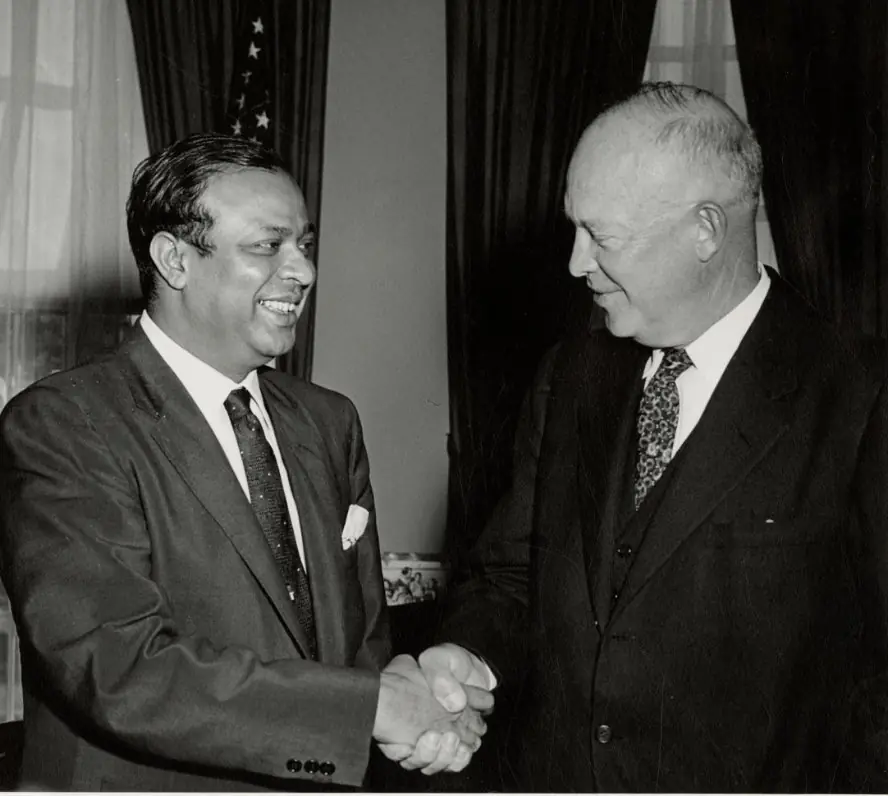
Mohammad Ali Bogra had been Pakistan's ambassador to the United States until April 1953, when he was recalled to become prime minister1. He returned to Washington on 14 October 1954 for discussions on economic and military matters, months after the signing of the defence agreement and Pakistan's entry into SEATO2.
According to the State Department's records, the Pakistani delegation was told that the United States would make available about $75 million in special commodity assistance, part of it as loans, in addition to some $25 million in technical and development aid; Washington had also promised about $30 million in military assistance for the 1955 fiscal year2,3. A joint communiqué at the end of the visit on 21 October summarised the results, and Bogra left pleased with assurances of about $105 million in economic assistance2.
Why it mattered
The visit turned the new alliance into money. Economic aid on this scale helped Pakistan's balance of payments and development plans, while the military figures were far below what Pakistan's commanders had hoped for - a gap that would be argued over for years4.
Sources
- Mohammad Ali Bogra, Wikipedia · Reference
- Foreign Relations of the United States, 1952–1954, Volume XI, Part 2, Document 1163, Office of the Historian, US Department of State, October 1954 · Primary document
- Foreign Relations of the United States, 1952–1954, Volume XI, Part 2, Document 1165 (telegram, 22 October 1954), Office of the Historian, US Department of State, 22 October 1954 · Primary document
- The United States and Pakistan, 1947–2000: Disenchanted Allies (Dennis Kux), Woodrow Wilson Center Press / Johns Hopkins University Press, 2001 · Scholarly
Next in The Long ArcPakistan joins the Baghdad Pact