Economy & aidThe Afghan decade
Junejo in Washington and a second, $4 billion package
As martial law ended in Pakistan, the Reagan administration offered a follow-on aid programme of just over $4 billion - and set off a fresh fight in Congress over the bomb.
2 min read
Background
The 1981 programme was due to end in 1987. By 1986 Pakistan’s political landscape had changed: General Zia had held non-party elections in 1985, appointed Mohammad Khan Junejo as prime minister and lifted martial law at the end of the year. Washington was keen to reward the transition and to keep the Afghan pipeline secure.
What happened
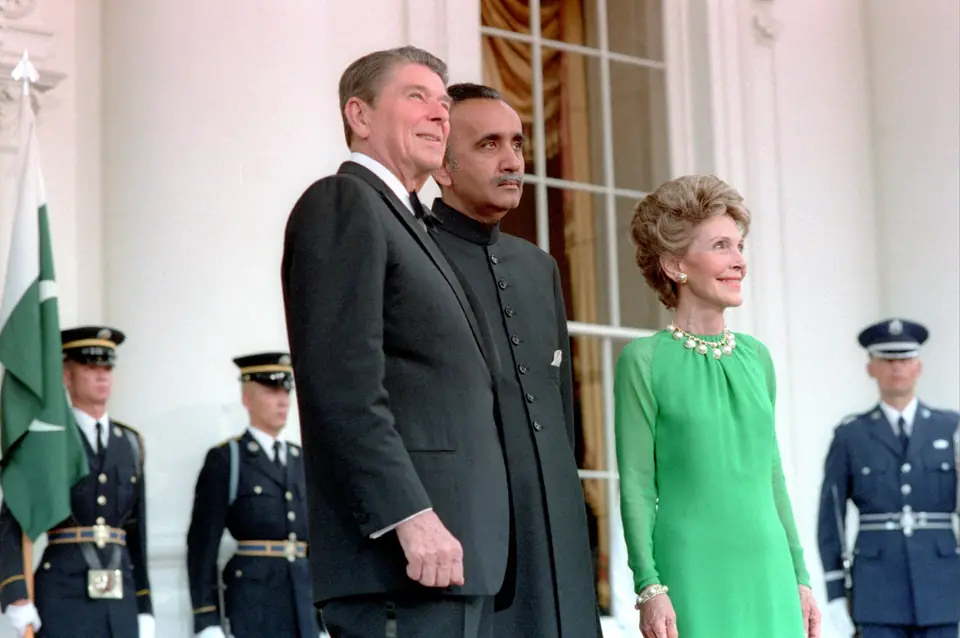
Junejo made an official visit to the United States from 15 to 21 July 19861. President Reagan welcomed him at the White House on 16 July; in his diary Reagan noted that Junejo had brought about the end of martial law and a return to democracy, and that he was impressed by him2. During the visit Junejo was briefed on a follow-on assistance programme worth $4.02 billion over six years, to begin when the existing $3.2 billion programme ran out1. A Library of Congress country study describes the 1986 package as worth over $4 billion, with the larger share for economic assistance3.
The nuclear complication
The package required congressional approval, and it arrived as concern about Pakistan’s nuclear programme intensified. The Symington waiver granted in 1981 expired in 1987, and the July 1987 arrest of a Pakistani-born businessman for trying to export nuclear-related materials sharpened the debate4. Press coverage at the time framed the package as a test of whether aid restrained or rewarded Pakistan’s nuclear ambitions4,5. Congress ultimately approved the programme, though with a shorter waiver than the administration sought6.
Perspectives
For the Reagan administration the package was necessary to sustain Pakistan’s security against Soviet pressure and to recognise the help it gave the Afghan resistance4. Pakistani leaders saw it as confirmation of the partnership and of their country’s value; critics in Pakistan noted that it continued to flow mainly through a system still dominated by Zia. Analysts writing at the time also noted that the US relationship increasingly linked Pakistan to wider American strategy in the Gulf5.
Why it mattered
The 1986 programme was the high-water mark of US assistance in this period. It was also never completed: after the Pressler certification lapsed in October 1990, the remaining military and new economic aid under it stopped.
Sources
- National Security Archive document on the Junejo visit and the follow-on assistance programme (document 21), National Security Archive, George Washington University, 1986 · Primary document
- White House Diaries: entry for 16 July 1986, Ronald Reagan Presidential Foundation & Institute, 16 July 1986 · Primary document
- Pakistan: relations with the United States (country study text), GlobalSecurity.org (reproducing Library of Congress country study) · Reference
- Pakistan, United States aid – and the bomb, The Christian Science Monitor, 29 September 1987 · Press
- Pakistan and the Central Command, Middle East Research and Information Project (MERIP), July 1986 · Scholarly
- Chronology of Key Events (US v. Pakistan sanctions case), Peterson Institute for International Economics · Scholarly
Next in The Long ArcThe Pervez case puts Pakistan’s nuclear procurement on trial