Regional conflictKey momentStrains and embargoes
1971: civil war, war with India, and the birth of Bangladesh
The Nixon administration's 'tilt' towards Pakistan in the crisis that split the country remains one of the most debated episodes in US policy in South Asia.
2 min read
Background
Pakistan's two wings, separated by India, differed in language, ethnicity and culture, and Bengalis in the East had long resented the dominance of the West1. In the December 1970 elections the Awami League, led by Sheikh Mujibur Rahman and campaigning for autonomy for East Pakistan, won an overwhelming majority of the East's seats and a majority in the national assembly. It was prevented from forming a government, and in March 1971 the army launched a crackdown; Mujib was arrested1.
The crisis
The repression in East Pakistan provoked mass flight: millions of refugees crossed into India. Bengali guerrilla forces, supported by India, fought the Pakistani army through the autumn1. On 6 April 1971 American diplomats at the consulate general in Dacca, with the endorsement of Consul General Archer Blood, sent a formal dissent telegram condemning their government's failure to speak out against the atrocities they were witnessing2,3. The administration did not change course; Blood was recalled. He and his colleagues were later honoured by the American Foreign Service Association for constructive dissent3.
President Nixon and his national security adviser, Henry Kissinger, valued Pakistan as a Cold War ally and as their secret channel to China, and in August India signed a treaty of friendship with the Soviet Union. The administration avoided public condemnation of Islamabad, while also pressing Yahya privately towards a political settlement1,4.
The war
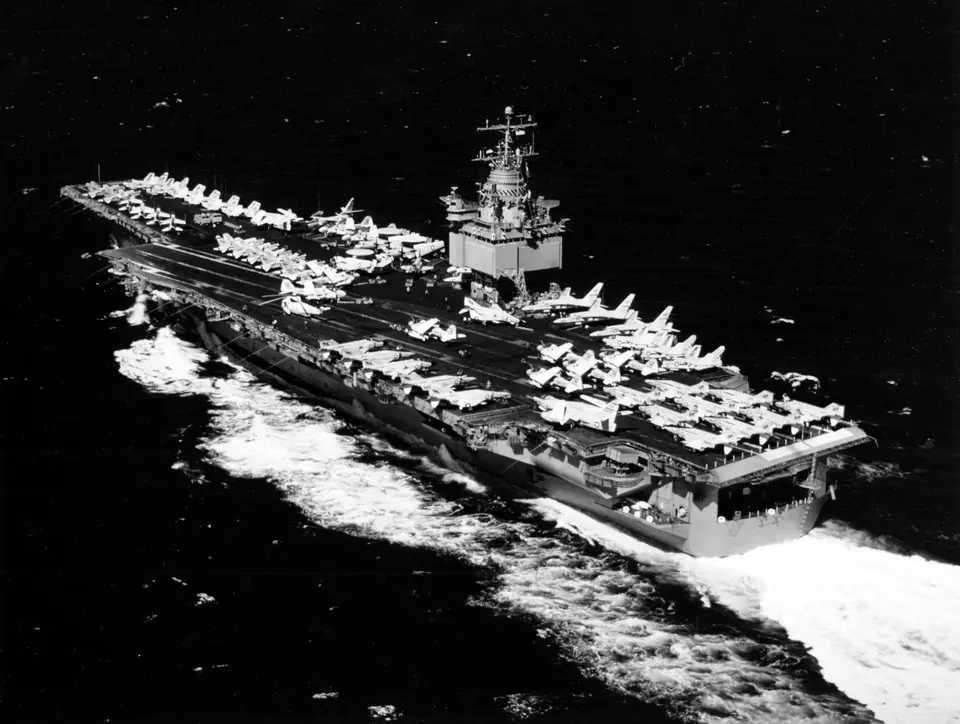
Open war began on 3 December 1971, when Pakistan launched air strikes on Indian airfields after weeks of escalating clashes; India's forces advanced rapidly into East Pakistan1. The administration publicly blamed India, cut economic aid to New Delhi and, after the CIA reported that East Pakistan was collapsing, ordered a carrier task force led by USS Enterprise from the Pacific towards the Bay of Bengal4,5. The task force entered the Bay of Bengal in mid-December but took no action5. On 16 December the Pakistani commander in the East, Lieutenant-General A. A. K. Niazi, signed the instrument of surrender in Dacca, and India declared a ceasefire in the West the next day6. On 20 December Yahya handed power to Zulfikar Ali Bhutto7.
Different perspectives
The episode is remembered very differently in each country. In Bangladesh it is the war of liberation, and American support for Pakistan during the killings of 1971 is a source of lasting bitterness. Many Indians regard the Enterprise deployment as an attempt at intimidation. American defenders of Nixon's policy, including Kissinger, argued that the tilt preserved the China opening and deterred an Indian attack on West Pakistan; critics, drawing on the declassified record, argue that it ignored mass atrocities4,8. In Pakistan, many concluded that the United States had once again failed to come to an ally's aid despite the 1959 agreement, while others blame Pakistan's own leadership for the loss of the East8,9.
Legacy
1971 tilted the balance of power in South Asia decisively towards India, ended the idea of a united Pakistan, and pushed Bhutto's Pakistan towards greater self-reliance, including, within months, a decision to pursue nuclear weapons8,9.
Sources
- Milestones: The South Asia Crisis and the Founding of Bangladesh, 1971, Office of the Historian, US Department of State · Official
- Foreign Relations of the United States, 1969–1976, Volume E–7, Document 130: Telegram 1249 From the Consulate General in Dacca to the Department of State, Office of the Historian, US Department of State, 6 April 1971 · Primary document
- Archer Blood, Wikipedia · Reference
- Foreign Relations of the United States, 1969–1976, Volume XI, South Asia Crisis, 1971, Office of the Historian, US Department of State, 2005 · Primary document
- Nixon Feared Regional War in South Asia in 1971, US Department of State (Washington File), via GlobalSecurity.org, May 2005 · Official
- Pakistani Instrument of Surrender, Wikipedia · Reference
- Zulfikar Ali Bhutto, Encyclopaedia Britannica · Reference
- 1971: A Global History of the Creation of Bangladesh (Srinath Raghavan), Harvard University Press (bookseller listing), 2013 · Scholarly
- The United States and Pakistan, 1947–2000: Disenchanted Allies (Dennis Kux), Woodrow Wilson Center Press / Johns Hopkins University Press, 2001 · Scholarly
Next in The Long ArcBhutto in Washington: support for Pakistan's integrity