DiplomacyThe Afghan decade
Zia-ul-Haq’s state visit to the White House
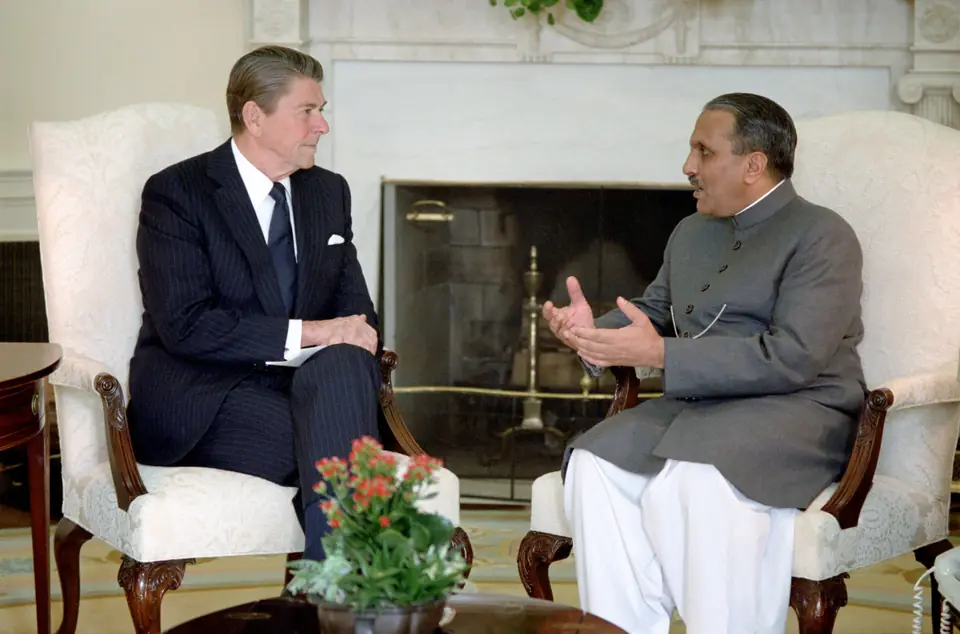
A state visit in December 1982 put the restored partnership on public display, while in private President Reagan set out the limits he expected on Pakistan’s nuclear programme.
2 min read
Background
Two years after rejecting Carter’s offer, General Zia-ul-Haq arrived in Washington as the head of one of America’s most valued partners. The $3.2 billion assistance programme was under way, F-16 deliveries were weeks away and covert support for the Afghan resistance was growing. The Christian Science Monitor, on the eve of the visit, described a markedly chummier relationship than under Carter1.
What happened
Zia was received with a state arrival ceremony on the South Lawn of the White House on 7 December 1982, followed by talks in the Oval Office and a state dinner with toasts in the State Dining Room2,3. The State Department’s record of the visit lists stops in New York, Houston, Sacramento and San Francisco4. In his public welcome, as recalled in a Pakistani retrospective, Reagan praised Pakistan’s “courageous and compassionate role” in sheltering Afghan refugees, while Zia said that the friendship between the two countries was strong enough to withstand differences of opinion5.
The main difference was nuclear. Declassified records show that in their private meeting Reagan set out specific parameters for Pakistan’s programme: no assembly or testing of a nuclear device, no transfer of nuclear-weapons technology, no violation of international safeguards and no unsafeguarded reprocessing6. Zia, for his part, repeatedly assured US officials that Pakistan’s programme was peaceful.
Perspectives
For the Reagan administration, the visit was a demonstration that the United States stood by front-line allies against Soviet expansion. For Zia, a military ruler who had come to power in a coup and faced criticism at home and abroad, a state visit to Washington brought international standing. Critics in Congress and in the press, however, questioned the closeness of the embrace given Pakistan’s nuclear ambitions and its lack of democratic government1,7.
Why it mattered
The visit marked the peak of public warmth in the Reagan–Zia partnership. The private nuclear parameters became a reference point for later US assessments of whether Pakistan was keeping its word; tensions over intelligence suggesting it was not grew through the rest of the decade6.
Sources
- What's behind the chummier US-Pakistan relationship, The Christian Science Monitor, 6 December 1982 · Press
- Photograph C11771-01: State dinner toasts, President Zia-ul-Haq of Pakistan, 7 December 1982, Ronald Reagan Presidential Library, 7 December 1982 · Primary document
- General Muhammad Zia-ul-Haq (Reagan Library artifacts and records), Ronald Reagan Presidential Library / National Archives · Primary document
- Pakistan – Visits by Foreign Leaders, Office of the Historian, US Department of State · Official
- Rendezvous with destiny, 1982, The Friday Times, 1 November 2019 · Press
- Document page on the Reagan–Zia meeting of 7 December 1982, National Security Archive, George Washington University · Primary document
- The United States and Pakistan, 1947–2000: Disenchanted Allies (Dennis Kux), Woodrow Wilson Center Press / Johns Hopkins University Press, 2001 · Scholarly
Next in The Long ArcWashington widens the covert war in Afghanistan